Schools
'Budgetary Risks' Associated with District 112's Reconfiguration Plan: Letter
Former North Shore School District 112 SCFFAC co-chair concerned about "magnitude of spending" planned.




The following letter was written and submitted by Dan Littmann, former co-chair of North Shore School District 112’s SCFFAC Finance subcommittee.
It’s been three years since I enthusiastically accepted the role of co-chair for District 112’s SCFFAC Finance Subcommittee. As co-chair, I interacted with the administration and studied the financials of the district. It became clear to me that change and additional investment is warranted. However, the district’s recent request for a referendum of nearly $200 million dollars of debt is out of bounds with the supporting facts.
While I remain supportive of a change to district configuration, I am opposed to the magnitude of spending proposed by the administration. Moreover, I’ve been disappointed that the administration has not communicated the budgetary risks associated with spending $200 million. Therefore, I have outlined a series of facts and data that puts the district’s request into perspective.
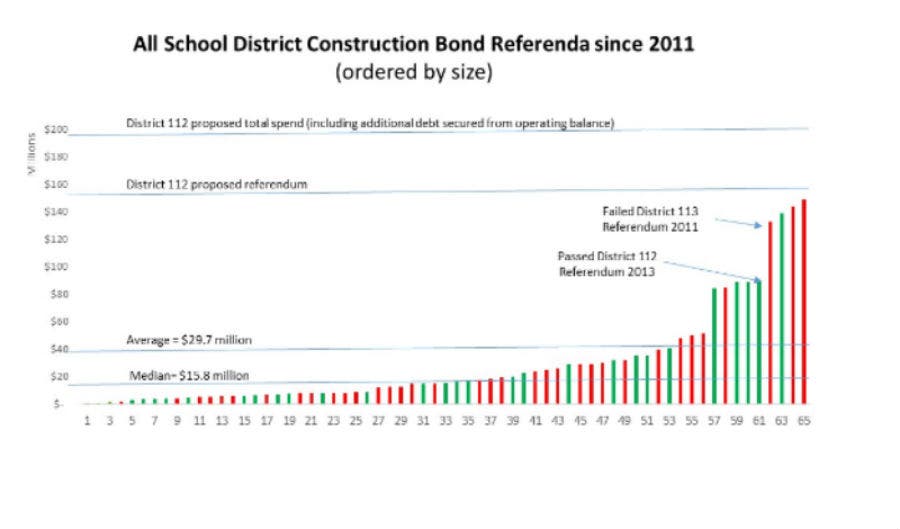
- District 112’s request to spend $198.5 million is an unprecedented amount. Since 2011, there have been 65 school district construction referenda in Illinois. Only four have requested more than $100 million, the largest - and only successful of these four - was Rockford Illinois at $139 million (Rockford’s population is more than 4X that of District 112’s population). In fact, only nine of the 65 referenda have been greater than $80 million (two of which were for our High School, District 113). The graph below plots all referenda color coded for pass and fail and demonstrates the sheer magnitude of the proposed bonds. (Graphic 1)
- By the district’s own admission, the reconfiguration of schools and rebuilding of facilities will do nothing to protect us from future state cut backs. One of the primary objectives of the SCFFAC when I first assumed the role was to protect our operating balance against the likely contingency of federal or state shortfalls.
The district has now done an about-face on this objective and admits that in such a contingency, the $198.5 million spent on reconfiguration and new facilities will indeed fail to prevent a future operating referendum.
If passed, the resulting debt load would also be unparalleled. We would be exceeding our publically reported debt by more than $50 million making our debt nearly 300% of our revenue capacity (source: 2014 District 112 Annual Financial Report). The table below depicts the significance of such a debt load compared to surrounding communities with whom we compete for population and enrollment.
The District has stated that it can actually borrow more than its published capacity, but it has not clarified the impact on debt rating, future borrowing costs or ability to pay it back. (Graphic 2)
- Increased taxes will put Highland Park at a competitive disadvantage when compared to neighboring districts. The administration’s tax-rate comparisons fail to demonstrate the extent of Highland Park’s comparative tax disadvantage versus other leading school districts. The table below shows an “all-in” view for taxes paid for a $600,000 home in surrounding suburbs, both before and after the referendum (referendum tax amounts shown for year 1, ignoring the 1% to 2.5% annual increase for the duration of the 30 year bond). New families weighing the choice of moving to Highland Park or another community will look at total taxes, not cryptic school tax rates that the administration publishes. Furthermore, disadvantaging District 112 through uncompetitive tax policy has the potential to impact enrollment and ultimately home values. A scenario in which we end up with excess capacity in our brand new buildings and insufficient funds is hardly far-fetched. (Graphic 3)
- Our operating balance, approximately $30 million today, will fall significantly below the benchmark of 25% of expenditures for at least several years. Returning the balance to healthy levels depends on rosy forecasts of home values, population growth and enrollment. A depleted savings account combined with debt of more than 130% our limit leaves very little room to a maneuver.
- Moreover, 30 year bonds (versus more typical 20 year bonds), implies that we are financially handcuffing future generations of district 112 families.
Two years ago I was part of the committee that led the charge for change. I volunteered to explain the need for change to the community during open meetings at the Highland Park Recreation Center and in a video still posted on the district web site (“Tipping Point”).
My endorsement of reconfiguration and investment has always been contingent on a responsible plan that protects the district’s long term fiscal heath in addition to addressing facilities issues. Unfortunately, the administration’s current plan spends beyond our means while failing to address the more serious long term funding and budgetary issues.
Find out what's happening in Highland Parkfor free with the latest updates from Patch.
Get more local news delivered straight to your inbox. Sign up for free Patch newsletters and alerts.