Crime & Safety
Samantha Harer Gunshot Residue Test Results
Patch obtained hundreds of reports from Channahon Police's probe into the WESCOM 911 dispatcher's violent death.


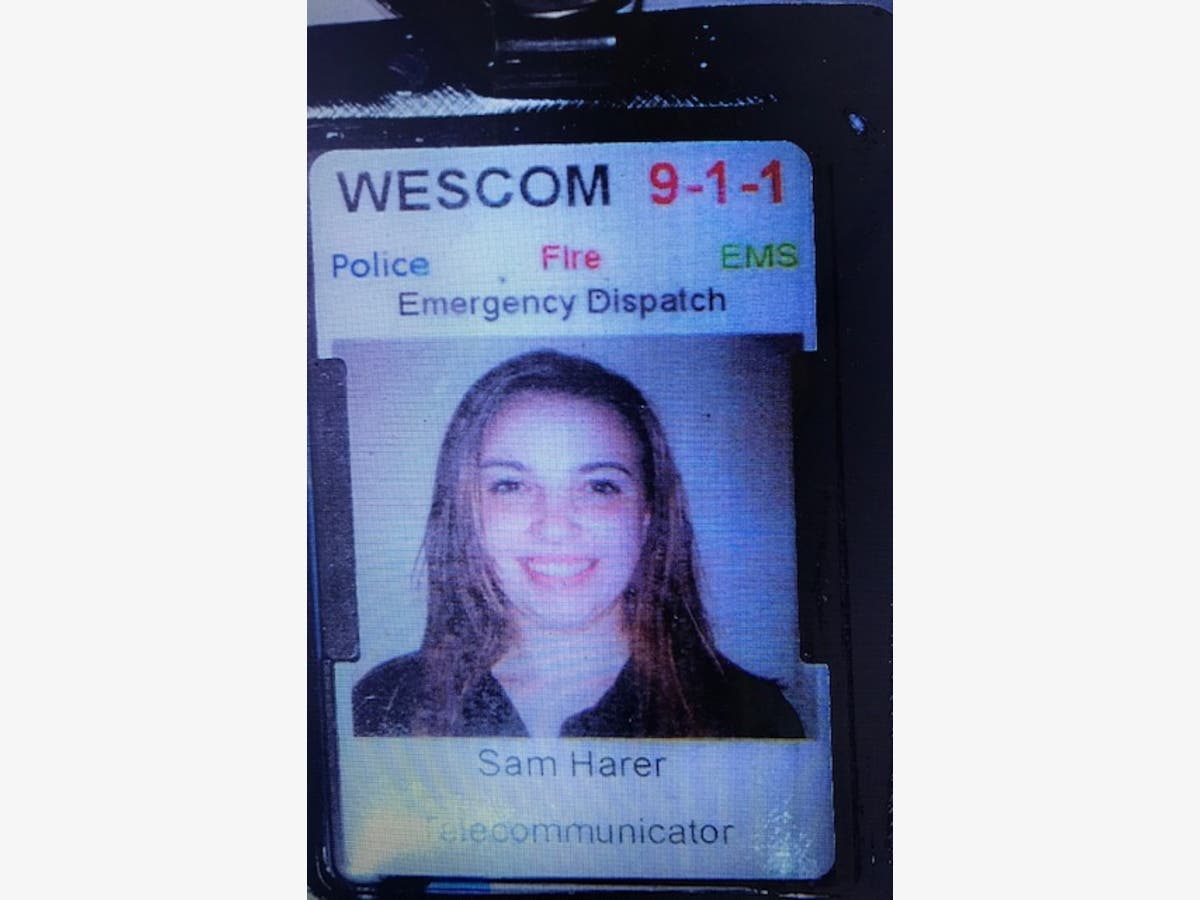
CHANNAHON, IL - A number of noteworthy forensic science tests performed by an independent police agency surrounding the Feb. 13, 2018 gunshot wound to Samantha Harer's head raise questions about whether the 23-year-old WESCOM dispatcher took her own life, Joliet Patch has uncovered.
Last week, Channahon's Police Department complied with Patch's follow-up Freedom of Information Act request seeking access to all reports generated from the death investigation. On Dec. 28, Channahon's Deputy Police Chief Adam Bogart issued a press release announcing Harer's death was being ruled as a self-inflicted gunshot wound. Harer's boyfriend, off-duty Crest Hill Police Officer Phil Flores, was inside her apartment in Channahon at the time of her shooting. The two had broken up for eight days in December, and Flores had stayed overnight at her apartment in the hours leading up to her death.
Crest Hill Police have kept Flores on paid leave since the day of Harer's death. Based on a recent interview with Crest Hill Police Chief Ed Clark, it does not appear Crest Hill is in any hurry to bring Flores back to the police force, perhaps for liability reasons.
Find out what's happening in Jolietfor free with the latest updates from Patch.
In 2016, Flores was investigated in connection with allegations that he raped a 30-year-old sleeping woman, who let him crash on her couch after a long night of drinking at a local bar. In that incident, criminal charges were not filed, but Flores drew a one-month unpaid suspension from Chief Clark.
Then in 2017, he began dating Harer, a relatively new 911 dispatcher who was 10 years younger. Their relationship was rocky in the weeks leading up to her horrific death, the police reports show.
Find out what's happening in Jolietfor free with the latest updates from Patch.
On the morning of her death, a Tuesday, Channahon Police summoned the Will County-Grundy County Major Crimes Task Force to Harer's Bridge Street apartment. From the outset, Harer's death was being treated as a suicide, rather than a homicide. Flores assured everyone that Harer had shot herself with her gun and that he was not able to stop her, reports show.
Conflicting interview statements:
Bolingbrook Police Detective Jaimie Marquez interviewed one of the neighboring apartment dwellers who heard commotion coming from Samantha Harer's apartment No. 8.
Here were the highlights of the interview statement, according to Marquez's report:
The next door neighbor was suddenly awoken as he slept in his bedroom, perhaps between 8 and 8:15 a.m. "by someone banging on the wall or someone slamming the door in the apartment next door, which is the victim's apartment. He then heard (the) female yell, 'Let me go" two or three times coming from the same apartment."
The tenant's bedroom "has a common wall with the victim's apartment, which happened to be the victim's bedroom." The Channahon tenant then advised the Bolingbrook officer "he did not hear anything after he heard 'Let me go,'" Marquez noted.
The man then got out of bed about five minutes later after his roommate was in their living room and looking out the window, noticing all the police cars arriving.
"The witness did not see or hear anything else," according to Marquez.
The next door neighbor's interview account completely contradicts the statement given by Officer Flores, the investigation shows.
"(Flores) was questioned in reference to Samantha making a statement of 'Let me go.' He stated Samantha never made any statement to let her go because he never had a reason to touch her in any way ...
"He has never put his hands on Samantha. (He) stated he and Samantha did argue, however, he did not put his hands on her," Joliet Police Detective Carlos Matlock wrote in summarizing Flores' interview.
During further questioning, Flores stated "that Samantha never made any statement to let her go, she only stated, 'Leave me alone.'"
Flores Doesn't Perform CPR On Harer
When asked to recite the events leading up to his girlfriend's fatal shooting, Flores gave this account to Matlock: "the only time he touched Samantha was after she shot herself and she was covered in blood. (Flores) was questioned as to why he did not perform CPR on Samantha. He stated that he did not know and he could only state that he panicked."
Matlock asked Officer Flores about finding his girlfriend "laying" on the bedroom floor once her gun went off. Her gun was found between her legs.
Flores "stated after re-entering the room after the shot occurred, despite being instructed to perform CPR on Samantha, he did not believe he could do it. He confirmed he did touch her, but not specifically where on her body," Matlock observed.
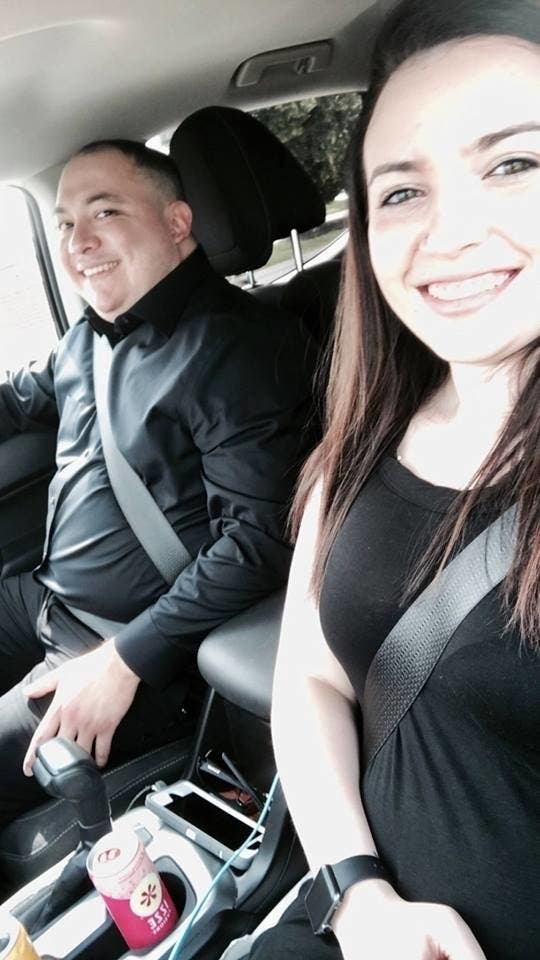
Bloodstains on Flores Sweatshirt Undergo Analysis
On Feb. 13, 2018 Channahon Police Detective Andrew McClellan compiled an evidence inventory report showing the following items were seized by police:
- 2 white socks from Flores
- 1 black-hooded sweatshirt with red blood like stains
- 1 pair of blue jeans with red blood like stains
- 1 Smart Watch with red blood like stains
- 1 Gun Shot Residue "GSR" kit for Officer Flores
- 1 swab of Flores' right hand top
- 1 swab of Flores' right palm
- 1 swab of Flores' left hand top
- 1 swab of Flores' left palm
- 1 Gun Shot Residue "GSR" kit for Samantha Harer
- 2 thumb drives of 911 recordings
Eight days later, items were transferred to Illinois State Police Sgt. Cary Morin. He had been called to the scene to analyze the massive amount of blood present on two of the bedroom walls.
Sgt. Morin's written summary included the following observations in regard to the Crest Hill Officer's black hooded sweatshirt: "Stains 1, 2,3, 4, 5 and 7 tested positive for the presence of human blood. Stain #6 tested negative for blood."
The area of blood stain No. 1: "was located on the front at the end of the right sleeve. Numerous stains were present and ranged in size from 1 to 10 millimeter in diameter. Area 1 also included larger, more saturated stains on the rear portion of the right sleeve."
The area of blood stains 2,3, 4 and 5: "were located on the exterior front of the sweatshirt. Stains 2 through 5 were near the center of the front of the shirt and consisted of approximately 25 individual stains. The stains were primarily circular or elliptical in shape and ranged in size from approximately 1-8 millimeter in diameter."
Blood stain No. 7: "on the exterior front at the end of the left sleeve. Two stains were observed at 7 and approximately 3 to 5 millimeter in diameter."
Morin's analysis of the blood on the Crest Hill officer's black sweatshirt: Flores "reportedly attempted to provide aid at the scene and was in contact with the victim during moments after sustaining her injury. Due to the dynamics of the incident and the variability involving blood saturation into clothing, the manner in which the blood was deposited onto the sweatshirt cannot be determined."
Regarding the blood on the off-duty officer's clothing, Sgt. Morin checked the boxes for: exterior, front, right, left and he did not check the boxes for rear and interior. Regarding the shape of the blood stains, Morin checked the boxes of: circular, irregular and elliptical.
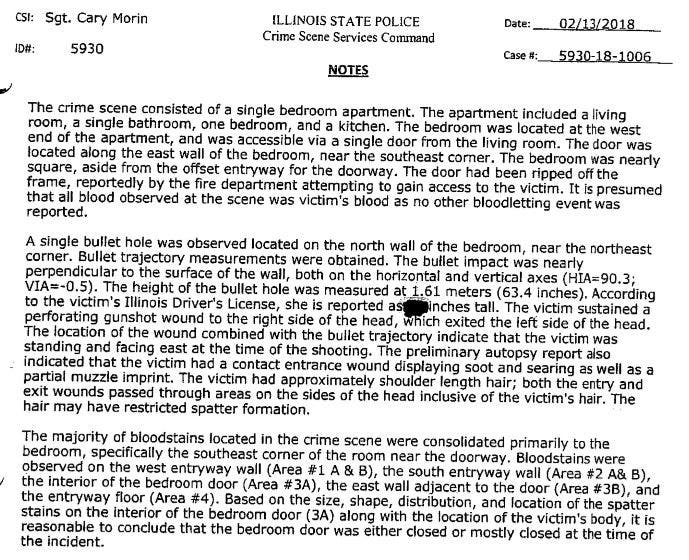
Analysis of Harer's Smith & Wesson 9MM handgun: The DNA testing involved swabbing the trigger, slide release and textured areas of the slide and grip. The gun was sent to the Joliet Forensic Science Laboratory on Feb. 21. Buccal swabs from Harer and Flores were sent on March 23. The lab report revealed: "A major female DNA profile was identified which matches the DNA profile of Samantha Harer. Additional minor DNA profiles were identified that are potentially incomplete and unsuitable for comparison to known standards."
However, the report indicated "a mixture of human DNA profiles was identified (on Harer's gun) at all loci except DYS391 that was interpreted as a mixture of at least three people." One of the first Channahon officers who responded to the apartment that morning noted that he found the gun between Harer's legs, and secured it by placing it into his squad car for safekeeping.
Gun Shot Residue Test Results: On Feb. 27, Detective McClellan of Channahon delivered two sealed GSR evidence collection kits to the Illinois State Police Forensic Science Center in Chicago. One kit had been administered on Harer's body, and the other upon her boyfriend.
On July 14, Illinois State Police Forensic Scientist Mary Wong, who is nationally accredited in her profession, submitted the following analysis. (For reference, the samples called Exhibit 2 belonged to Flores. The Exhibits from Harer were labeled as Exhibit 3.)
According to the GSR testing upon Harer's right hand: "Exhibit 3A contains particles characteristic of background samples."
The GSR testing upon Harer's left hand showed: "Exhibit 3B contains particles characteristic of background samples."
"All samples in Exhibit 3 were examined by scanning electron microscopy for the presence of primer gunshot residue particles based on elemental composition and morphology," Wong advised.
As for GSR testing upon Exhibit 2, Wong's analysis made the following observations in regard to the sample taken from Flores' right hand: "Exhibit 2A contains a minimum of three tri-component and additional consistent gunshot residue (PGSR) particles."
According to Wong's report, her GSR testing for his left hand revealed: "Exhibit 2B contains particles characteristic of background samples."
Wong's GSR test results were part of a report dated July 14. The document went to Detective McClellan.

Four days prior, on July 10, McClellan submitted the black sweatshirt worn by Flores at the time of the shooting. That means McClellan had the physical evidence for five months before he decided to submit it to Wong for additional Gunshot Residue testing at Illinois State Police's Forensic Science Center in Chicago.
Toward the end of August, on Aug. 29, Wong, a nationally accredited forensic scientist III, was finished with her analysis of the boyfriend's sweatshirt, which was labeled Exhibit 7A.
"PGSR samples were recovered and examined by scanning electron microscopy for the presence of primer gunshot residue (PGSR) particles based on elemental composition and morphology," Wong wrote.
Exhibit 7A1 - sample from the right cuff - "contains a minimum of three of tri-composition and additional consistent primer gunshot residue (PGSR) particles."
Exhibit 7A2 - sample from the left cuff - "contains a minimum of three of tri-composition and additional consistent primer gunshot residue (PGSR) particles."
Exhibit 7A3 - was a control room sample that was similar to an adhesive blank.
Exhibit 7A4 - sample from the chest area - "contains a minimum of three of tri-composition and additional consistent primer gunshot residue (PGSR) particles."
Exhibit 7B - the black T-shirt worn underneath the sweatshirt - "No PGSR samples were recovered."
In the end, Wong informed Channahon Police she reached the following scientific conclusions in regard to the sweatshirt: "The results of Exhibit 7A indicate that the samples areas contacted a PGSR related item or were in the environment of a discharged firearm."
She further explained how "tri-component primer gunshot residue particles are composed primarily of lead, barium and antimony. Consistent particles are similarly composed of one or two of these elements."
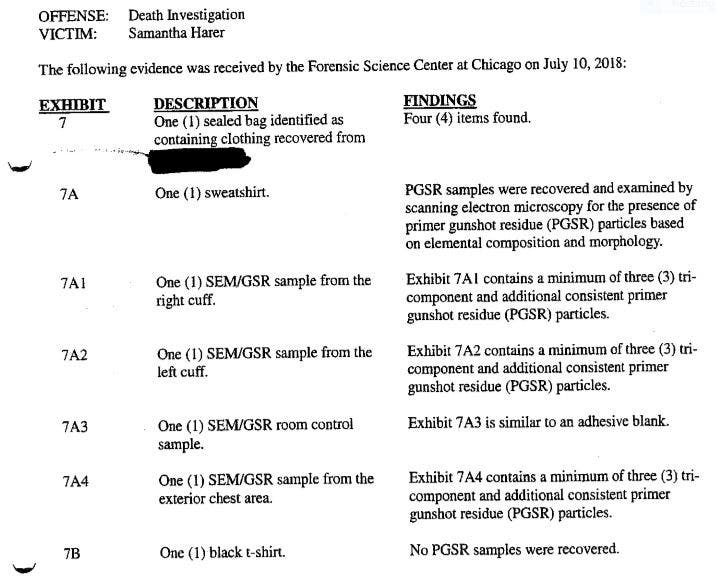

Wong's report was dated Aug. 29.
On Dec. 28, nearly four months later, Channahon's deputy police chief issued a press release that included the following statement: "The investigation has now been completed and presented to the Will County Coroner and the State’s Attorney’s Office. The Will County Coroner has determined that Samantha’s cause of death was by a self-inflicted gunshot wound. That finding is consistent with, and supported by, the evidence presented by this multi-jurisdictional investigation."
Channahon Has Problems: Turvey
Dr. Brent Turvey, an internationally known forensic science consultant from Alaska, who has authored several books including Criminal Profiling, Crime Reconstruction and Forensic Investigations, has reviewed the case file provided by law enforcement as part of the recent Freedom of Information Act disclosure to the Joliet Patch.
Turvey said he is now working on the case with Paul Ciolino, the spokesman for the parents of Samantha, Kevin and Heather Harer.
Turvey said the gunshot residue tests on Flores' hands as well as his sweatshirt "strongly suggest the possibility that he fired a weapon. The gunshot residue tests on her were negative, meaning there is no physical evidence that she fired any weapon."
Turvey said that Channahon Police chose not to disclose the GSR tests at the time the agency announced the investigation was over, that Harer's death was being classified as a suicide.
"They had this information, they should have disclosed it, but they didn't, which is troubling because it runs absolutely contrary to their theory," Turvey told Joliet Patch. "For that reason, it's something that they would not want the public to know.
"The whole point of doing the gunshot residue test was to prove their theory, that she shot herself and that he was not in the room or he was not involved ... There is clear evidence in the gunshot residue report that she did not fire the weapon and there is no evidence that she did."
RELATED: Listen To 911 Call Made By Phil Flores
RELATED: Channahon Police Choose To Classify Harer's Death As Suicide
Main image of Samantha Harer WESCOM badge via Joliet Patch FOIA
Get more local news delivered straight to your inbox. Sign up for free Patch newsletters and alerts.