Kids & Family
Montgomery's History is All Relatives
Tracing the village's family trees, from the 1800s to the present.
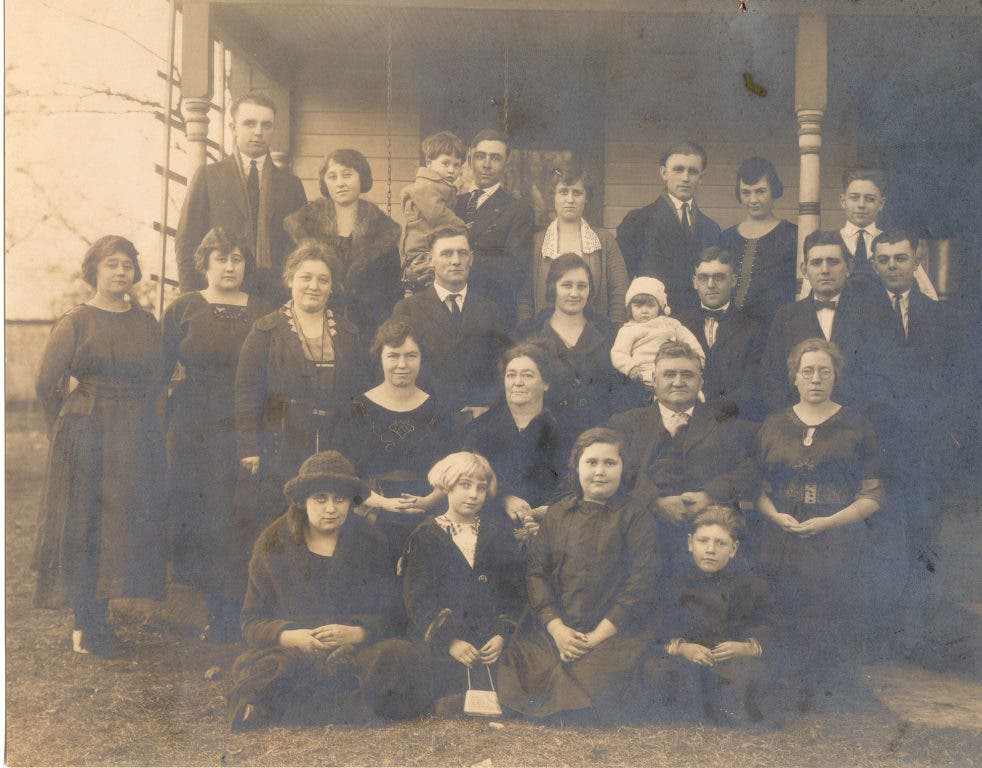

In 1840, when Jacob and Nancy Cook Keck arrived here from New York’s Mohawk Valley, they led a party of 40 relatives.
With them were three sons and seven daughters, plus their husbands. Besides the Keck boys—Jacob, Jr., Adam and John—there were the in-laws: John Staley, Hiram Bauder, James Stansel, John Fikes, George Fikes, Orville Van Fleet, and James Young. And, of course, there were many grandchildren. There was safety and comfort in numbers.
As time went by, some very confusing and tangled relationships developed among the descendants of Jacob and Nancy Keck. As grandchildren began to marry, they brought new blood into the family, and new names to sort out. Figuring who belonged to who is easier when you have a guide.
Find out what's happening in Montgomeryfor free with the latest updates from Patch.
I contacted Robert Cooney, a former Montgomery resident, who lives in Florida, to help me out. He has a large database that includes some of these families. From his records, I was able to make connections, such as the fact that two Montgomery school classmates, Phyllis Cooney, and Leslie (Skippy) Paris, are cousins.
Leila Gertrude Paris, daughter of George McClelland and Minnie (Standiford) Paris, married Vernon McKinley Cooney. Phyllis’ mother and Skippy’s father were brother and sister. They were just two of the many cousins in every classroom at Montgomery School.
Find out what's happening in Montgomeryfor free with the latest updates from Patch.
My favorite childhood memories include two older Cooney sisters, called Cyrilla and Serena. I can still picture these chubby little ladies in their garden on Case Street, wearing look-alike gingham dresses. As a child, I could not tell them apart, and thought they were twins, but I just learned they were not. I also learned that the sisters were actually named Ethel Cyrilla and Alice Serena, but their middle names were much more poetic, so that’s what they were called.
The sisters had an unusual sideline. In the days of black and white photographs, they developed film in their darkroom. Their prices were reasonable, it was a convenient walk through the alley, and you received great personal service. The first affordable little Brownie Hawkeye cameras were available in the '40s, but photographs were still just for special occasions. To have someone in town that could develop these pictures was nice.
The genealogy of the Cooney family is rich with picturesque and meaningful names. I saw George Washington Cooney, Cyrus Cooney, George McClelland Paris, Minnie Minerva, and twins Lanie Lucinda and Nancy Marinda Meyer, along with the above-mentioned Cyrilla and Serena. They clearly gave a lot of thought to naming their children.
Bertha VanSickle, daughter of Avery and Nellie (Keck) VanSickle, married Melvin Paris and they became the parents of Jean, Alvin, Barbara and Leslie (Skippy). Melvin died in 1936 leaving Bertha a widow. When an opening at the post office came along, she was appointed postmaster, a position she held for many years.
For a small village, she was kept busy. Each piece of mail was sorted by hand, with the volume growing with each new business in town. For many years she managed to do it alone.
Everyone had a box at the post office. There was no mail delivery. Bags of mail were thrown from the train several times a day. Someone picked up the mailbags and brought them to the post office for sorting each time. I’m sure I wasn’t the only one who would go in several times a day to see if a certain letter had come in. Bertha was never idle. In spite of everything, she was never cross or unpleasant.
Bertha Paris was the right person for the job. Imagine how rich these stories would be if she was writing them. What if she had kept a diary?
An old family story is that the Cooney family, although they had a very Irish sounding name, actually came from Alsace-Lorraine. When the first two brothers came to America, their name was spelled variously Keuhne, Kuney or Cuny. Some official who was processing their papers decided to spell it Cooney to conform to the common Irish spelling.
These brave young men, who left family and friends behind to travel to an unknown land and face an unknown future, faced yet another challenge: a language barrier. When they reached their destination in Pennsylvania, they joined their fellow countrymen and were known collectively as the Pennsylvania Dutch.
Daniel Cooney came to Illinois from Perry County, PA. They settled in Oswego first, where there was already a large German population who they would have no problem communicating with. Eventually they ended up in Montgomery, where a Paris/Cooney marriage took place.
There are many surprises and twists in these records. We are just beginning to learn how interrelated these early families were. The Historical Preservation Commission is always looking for genealogies of these early families, and even the not-so-early ones.
Volunteers are collecting information and putting it into a database using a program developed especially for museums. Letters, diaries, photographs, company business records and brochures are preserved for future historians.
Be sure to consider donating these items. They will be accessioned, given an identifying number, and appropriately stored. You will be sent a “Deed of Gift” acknowledging your donation and you will have the comfort of knowing that your things are in good hands. Some long lost cousins may find you.