Neighbor News
The Secret Is Out. The Secret Kitchen Opens in Schaumburg
The Secret Kitchen, Chef Aanal Kotak's award-winning Modern Indian restaurant, makes its American debut in Schaumburg

There is a particular kind of silence in an Indian royal kitchen — the hush before a spice is ground, the pause before a flame is lit. Aanal Kotak grew up hearing about those kitchens, through her grandmothers, through family stories passed like heirlooms. She spent years reconstructing them — traveling, researching, tasting — until she understood not just the recipes but the philosophy behind them. Food as inheritance. Food as ceremony. Food as a declaration of who you are and where you come from.
That philosophy now has a new address. This month, Chef Aanal Kotak opens The Secret Kitchen — 1411 W. Schaumburg Rd. in Schaumburg, Illinois — the restaurant’s first location on American soil, and the newest chapter in a culinary story that has already captivated diners in India, Australia, and Canada.
Chicago has a formidable dining culture, one that has earned the city its reputation as one of the world's great restaurant capitals. Into that landscape steps a chef who is not trying to replicate anything already here — because nothing quite like what she’s doing has arrived yet.
Find out what's happening in Schaumburgfor free with the latest updates from Patch.
The Chicago-area dining scene is not an easy room to enter. It has produced James Beard Award winners in outsized numbers for a city its size. It has nurtured a culture of diners who know what they’re eating and care deeply about it. Kotak does not seem daunted. She spent years building restaurants in India before taking them international. She understands that respect is earned plate by plate.
What she is offering Schaumburg — and by extension, greater Chicagoland — is something the region has not yet had: royal Indian cuisine, reconstructed from historical sources and handmade spices, served in a setting that honors the grandeur of that culinary tradition without holding it hostage to the past. Modern Indian cuisine, the way it was always meant to travel.
Find out what's happening in Schaumburgfor free with the latest updates from Patch.
“The Secret Kitchen’s roots are inspired by my grandmothers, who excelled at royal Indian cooking. It’s about time that the world experiences this side of exquisite Indian cuisine with a modern touch.” — Chef Aanal Kotak
THE CHEF: A SELF-MADE LEGEND FROM AHMEDABAD
Kotak’s origin story reads like the kind that gets told on culinary television — because, in a way, it was. She was twelve years old in Ahmedabad, India, in the Gujarat region, when a family gathering of fifty people suddenly had no caterer, and this twelve-year-old with remarkable composure stepped into the kitchen. She cooked for all of them. She hasn’t really stopped cooking since.
By nineteen, she had turned down an offer to host a television show, choosing instead to compete — and she won, becoming Gujarat’s Youngest Cooking Expert. She auditioned for the regional cooking program Rasoi Show on Colors Gujarati from her own engagement ceremony, slipping away to make the call. Upon learning this, her husband chose to support her rather than be alarmed. Together, they opened Gujarat’s first fine-dining restaurant: The Secret Kitchen.
What has followed is a journey of ambition made real. Kotak has been named Restaurateur of the Year (2022) and Woman Chef of the Year (2021) by the Food Connoisseurs India Convention (FCIC), India’s largest F&B industry honors, presented annually in New Delhi. She was recognized as Chefpreneur of the Year at the India Business Awards (2018) and counted among India’s Top 50 Food Entrepreneurs. She holds two records with the India Book of Records, based in Ghaziabad, Uttar Pradesh — one for a hand-crafted Mohanthal tower, one for the largest Christmas plum cake. She appeared as a guest judge on MasterChef India, produced by Endemol Shine India for Star Plus in Mumbai, the country’s most-watched culinary competition.
Kotak launched Swabhiman Abhiyan, an initiative providing mentorship and financial support to aspiring women in the culinary field. She has appeared on the Entrepreneur India 35 Under 35 list (2024), the New Delhi-based magazine’s annual ranking of the country’s most remarkable young business leaders. She runs a retail line of handmade spices, ready-to-cook mixtures, and bakery premixes.
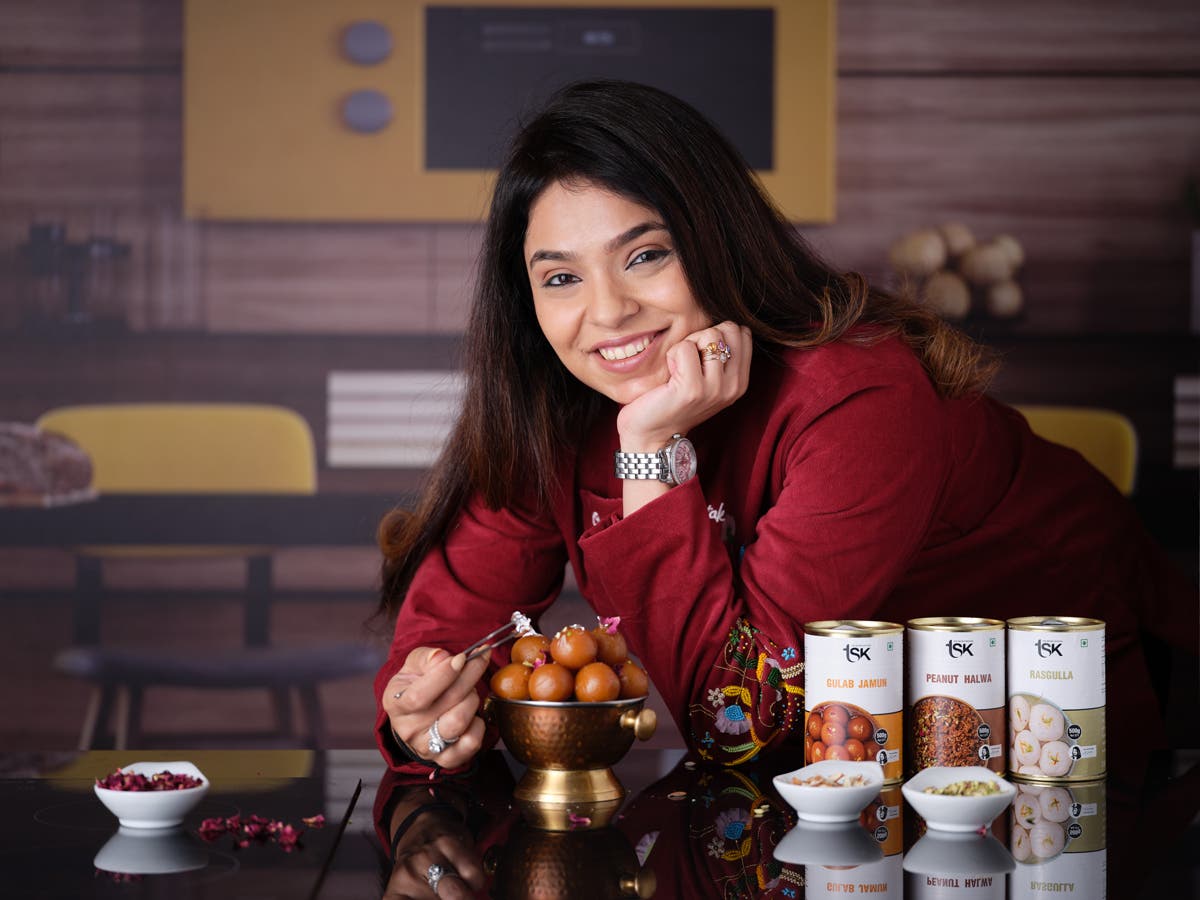
The spices are not incidental. They are, arguably, the signature of everything she does.
Kotak built her culinary identity by studying the kitchens of Indian royalty — their meticulous approach to spice-making, their use of edible flowers and flower petals, and botanicals that most of the culinary world had long since abandoned. She learned to grind those spices herself. To this day, she handcrafts every blend used across her restaurants. No shortcuts. No substitutes. The flavor in every plate at The Secret Kitchen is traceable back to a mortar, a petal, a decision made by hand.
THE RESTAURANT: ROYAL TRADITIONS, REINVENTED
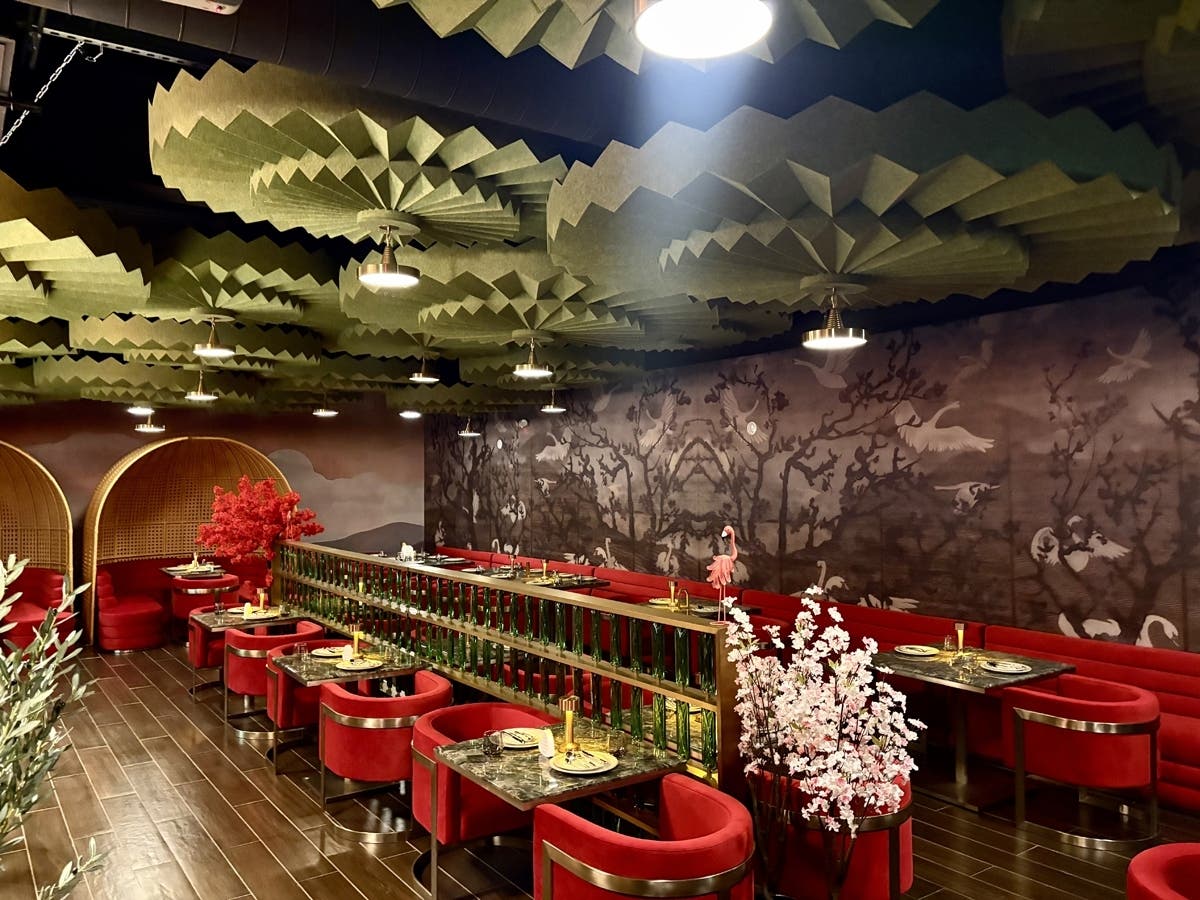
Schaumburg’s Secret Kitchen does not arrive quietly. The dining room is a maximalist fever dream executed with genuine craft — the kind of space that stops a first-time visitor mid-sentence. Overhead, giant pleated discs of sage-green fabric hang from a near-black ceiling like oversized origami lotus pads, their sculptural geometry shifting with the light. Beneath them, red coral lantern pendants cast a warm, theatrical glow across the room.
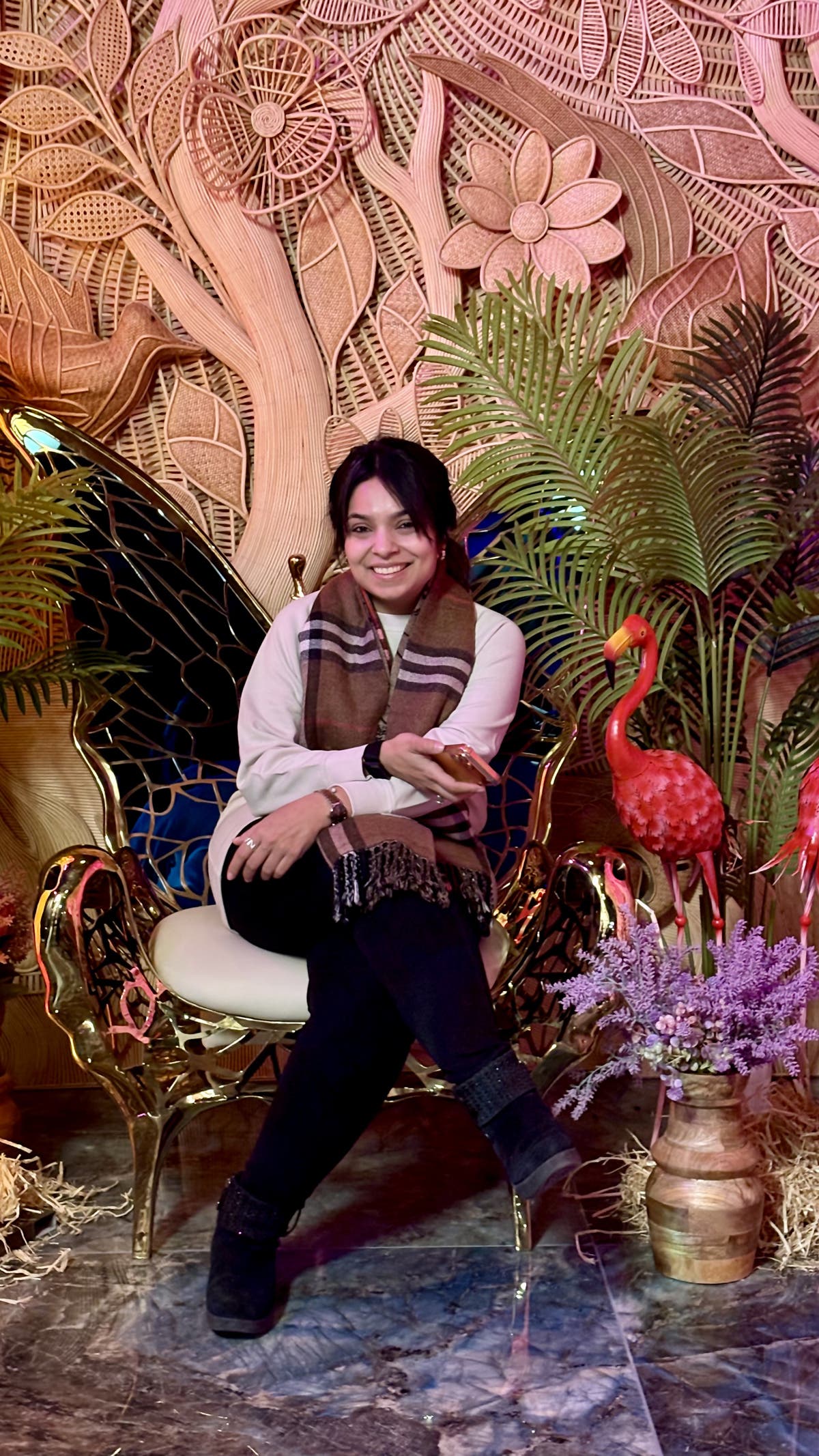
The dominant seating is crimson velvet — curved barrel chairs with brass-trimmed bases around dark marble-topped tables — but the lounge zone steps further still: dramatic wicker egg-pod booths, arched like a birdcage, upholstered inside in red. For those who want a photograph as much as a meal, there is the butterfly throne: a gold-framed chair whose back unfolds into teal-stained-glass wings, set against an intricate carved rattan wall panel of tropical botanicals.
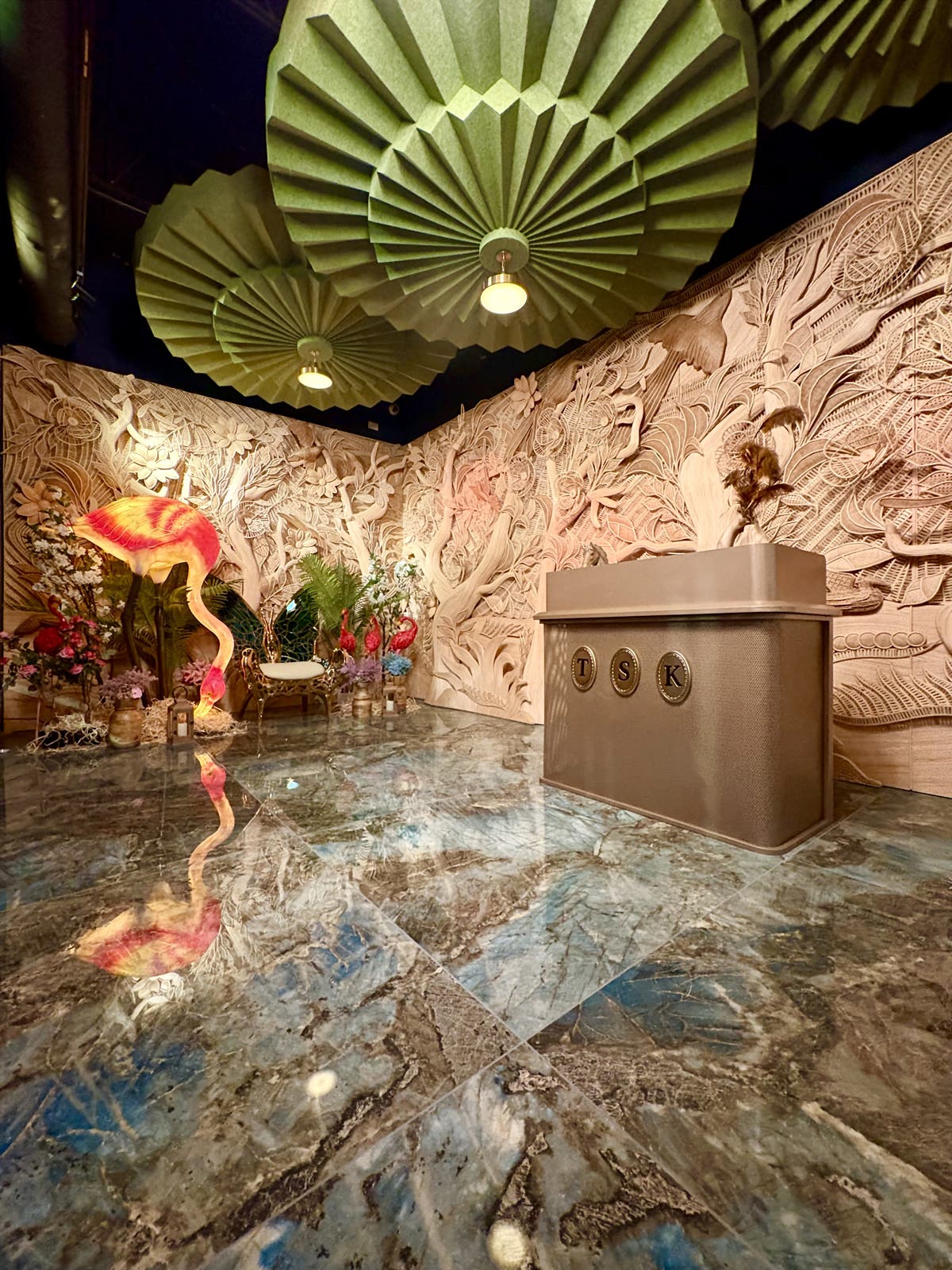
The entrance sets the tone before a single dish is ordered. Step inside, and the foyer stops you. The floors are deep jewel-green marble, the color of a rainforest seen from above. The walls — every wall, floor to ceiling — are covered in a monumental custom bas-relief mural: gnarled trees, layered canopies, flowering botanicals, all sculpted in three dimensions from pale natural wood. It is the scale of a fresco and the craft of a museum installation, and it wraps the entire entry in something between a garden and a dream.
At its center, as if growing from the forest itself, stands the restaurant’s most photographed object: a throne chair in polished gold, its back rising into teal-stained-glass butterfly wings traced in brass filigree. It is positioned, knowingly, for selfies — but the backdrop it sits against earns every one of them. The message is clear from the first step inside: this is not a restaurant that takes itself too seriously, but it takes its craft very seriously indeed.
Beyond the foyer, the dining room shifts palette but not ambition. The floors here are dark charcoal tile — a grounding contrast to the jewel-green marble of the entry — and overhead, the ceiling becomes its own landscape. Large, pleated panels of sage-green felt radiate outward from central points in sunburst formations, their edges cutting a dramatic zigzag where one disc meets the next.
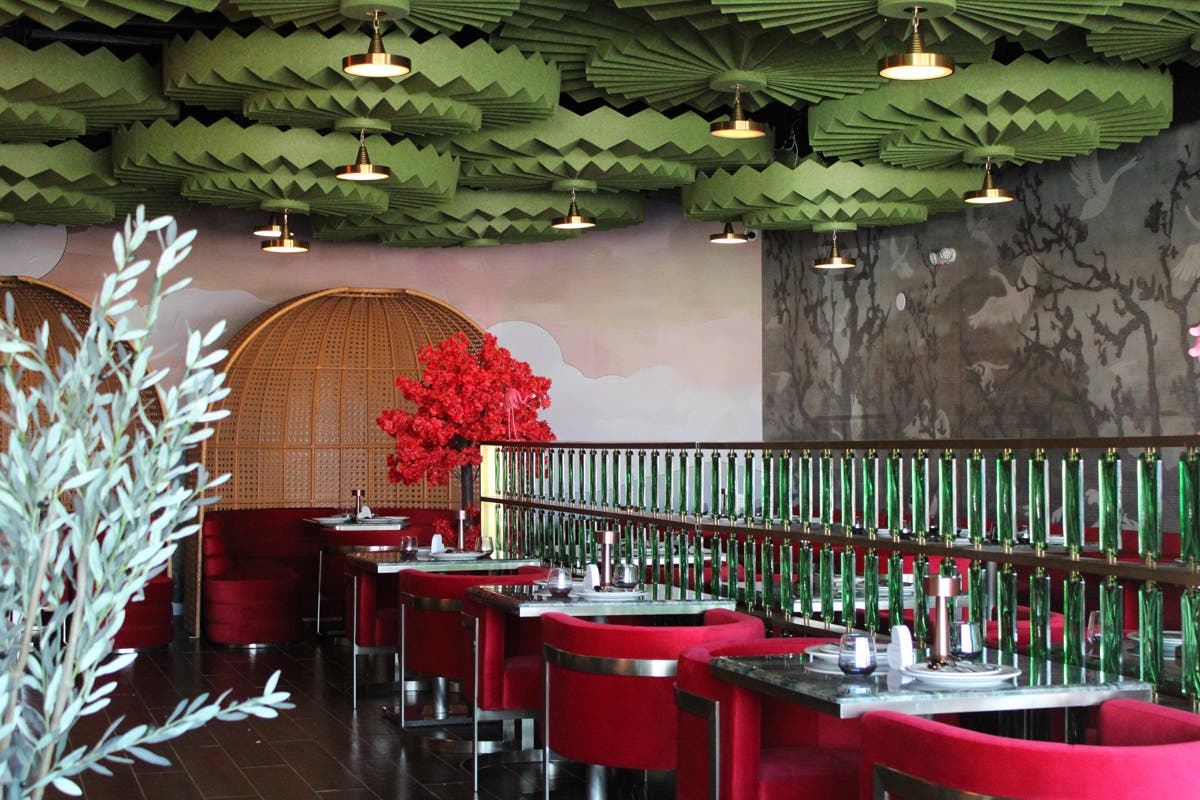
The effect of looking up is a canopy of oversized origami lotuses — custom acoustic art that also, practically, softens the room. Running the length of the space is a brass-framed room divider filled with emerald green glass column balusters, casting green-tinted light across every surface it touches. Red coral lantern pendants hang throughout, and a sculptural, crimson-blossomed tree stands near the window, visible from across the room.
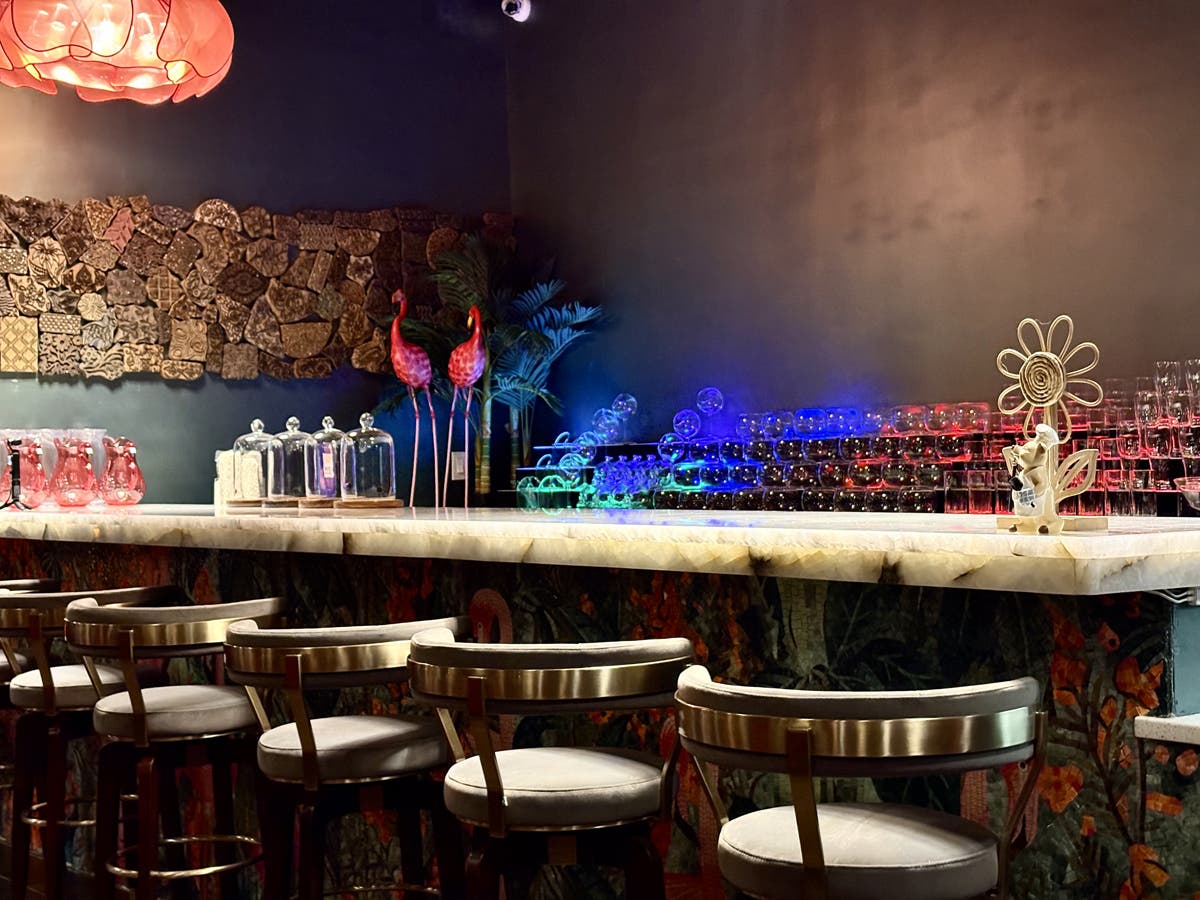
The bar is its own destination. The countertop is white onyx, backlit from within so that it glows with a warm, almost lunar luminosity. Its face is covered entirely in handmade tile mosaic — individual tesserae, each placed by hand — depicting flamingos wading through a lush tropical jungle in deep teal, coral-orange, and rose-pink.
The bar stools are curved and refined: wraparound gray velvet backs, brass-ring bases, the kind of seating that invites lingering. Flamingos appear throughout the space as a recurring motif — as neon wall sculpture, as glowing three-dimensional art pieces, as decorative figures along the divider shelf. A carved white jali screen — the Mughal latticework of interlocking arched niches — appears as a decorative panel, a quiet nod to the royal Indian heritage that informs everything on the plate. One wall carries a misty gray-blue mural of cranes in a fog-shrouded forest. It is a lot, and it coheres.
The menu at The Secret Kitchen is organized not by conventional course structure but by narrative chapters — The First Plate, The Main Plate, The Comfort Plate, The Dessert Bar — a sequencing that suggests a story unfolding rather than an order being placed. It is a menu that rewards curiosity.
“Each dish is a tribute to its origin — meticulously crafted and presented with refined elegance.”
Kotak’s culinary vision is proudly pluralist. While her philosophy has always tilted toward the celebration of plant-based and vegetarian cooking — an allegiance she shares with her acknowledged culinary hero, the legendary Michelin-starred French chef Alain Passard — she insists that The Secret Kitchen offers something for every diner. “Vegetarian, vegan, non-vegetarian, plant-based — everyone belongs at this table,” she has said. The menu bears that out.
THE FOOD: ANCIENT KITCHENS, CONTEMPORARY PLATES
A meal at The Secret Kitchen might begin in the street — not literally, but imaginatively. The Indian Street Foods section, cheekily subtitled #dil Se Desi (from the heart, essentially), opens with the Avocado Dahi Puri: crispy puri shells cradling cool, creamy avocado, crowned with chilled yogurt, house-made chutneys, and fresh herbs. It is a dish that honors the beloved chaat tradition while refusing to be bound by it, the avocado arriving not as novelty but as natural counterpart. Nearby, the Khasta Kachori Chaat — flaky kachori with spiced lentils and chutneys — offers a masterclass in textural contrast.
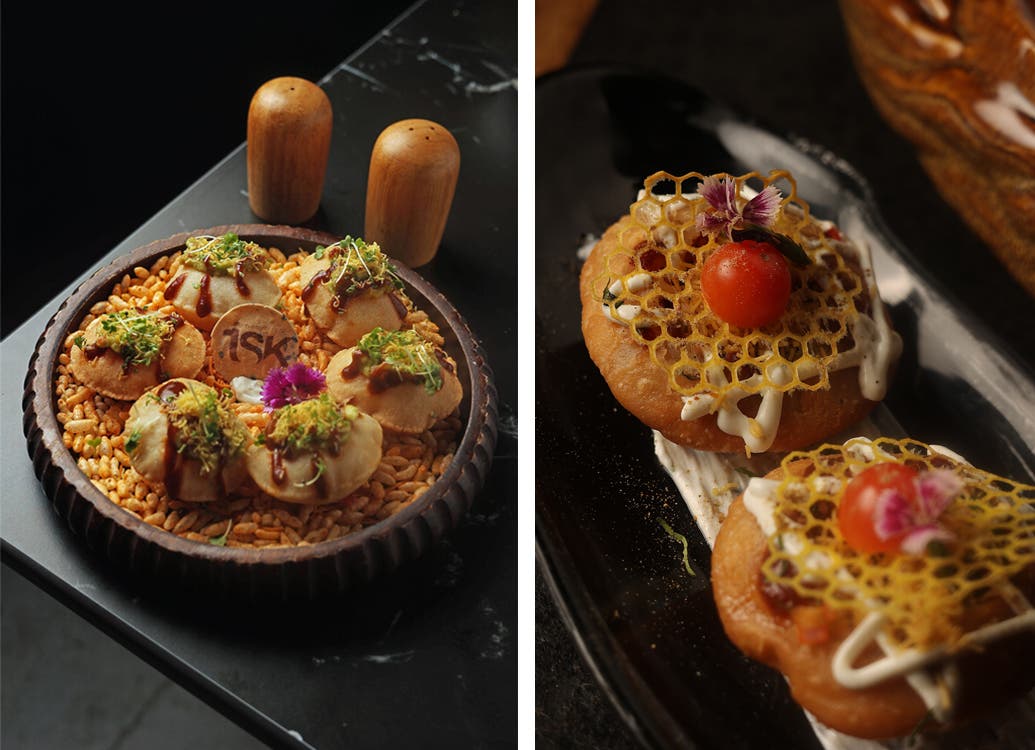
From The First Plate, the Rajwadi Paneer Tikka showcases Kotak’s royal-kitchen research most directly: cottage cheese marinated in hand-ground royal spices and herbs, char-kissed in the tandoor. The Thecha Paneer Tikka — a Chef Special — delivers a bolder proposition: cubes of cottage cheese coated in a thecha marinade of green chili, garlic, peanut, and fresh coriander, finished with a smoky tandoor roast. The Tandoor ke Phool, a vegetarian dish of cauliflower and broccoli roasted with spicy garlic, sweet cashew, and fresh mint, then finished in clarified butter, exemplifies the kitchen’s precision with plant-based cooking: nothing timid, nothing afterthought.
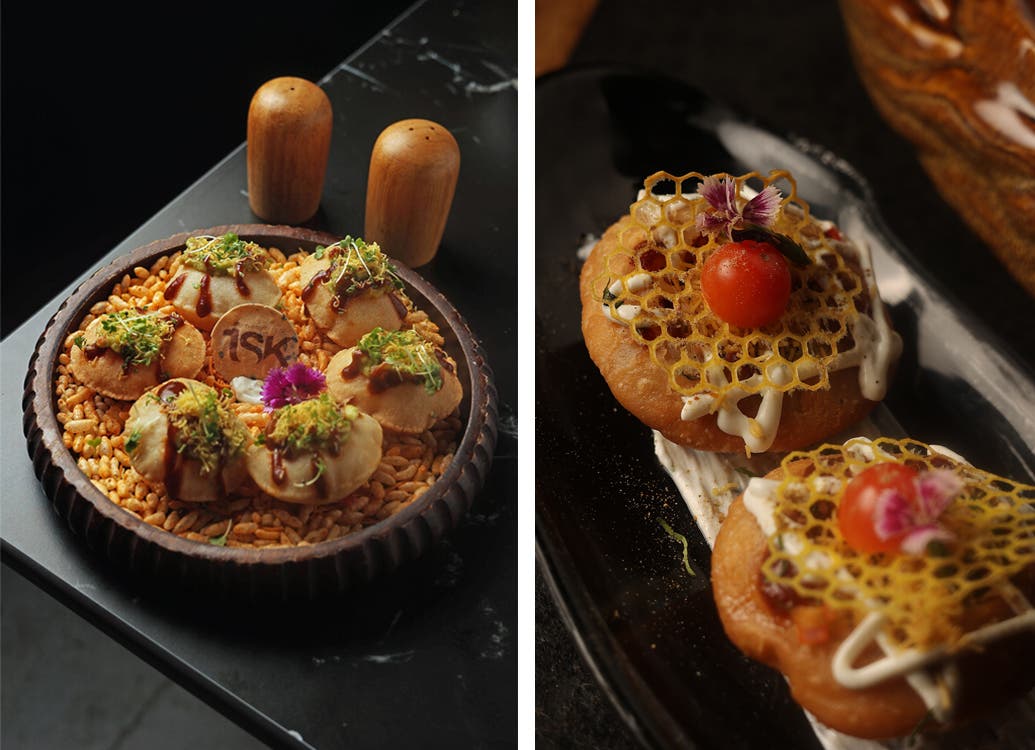
Meat and seafood diners are equally well-served. The Nawabi Lamb Chop Tajdar — royal-style chops marinated in nawabi spice blends and tandoor-cooked — is everything its name implies: lavish, deeply spiced, ceremonial. The Mutton Rogan Josh, simmered in its rich Kashmiri gravy, carries the weight and warmth of centuries of Himalayan cooking. Kotak’s signature Delhi-style Butter Chicken, a dish she has refined across several continents, arrives here under its full TSK designation: creamy, tomato-rich, buttery without being cloying, a version that has made believers of purists.
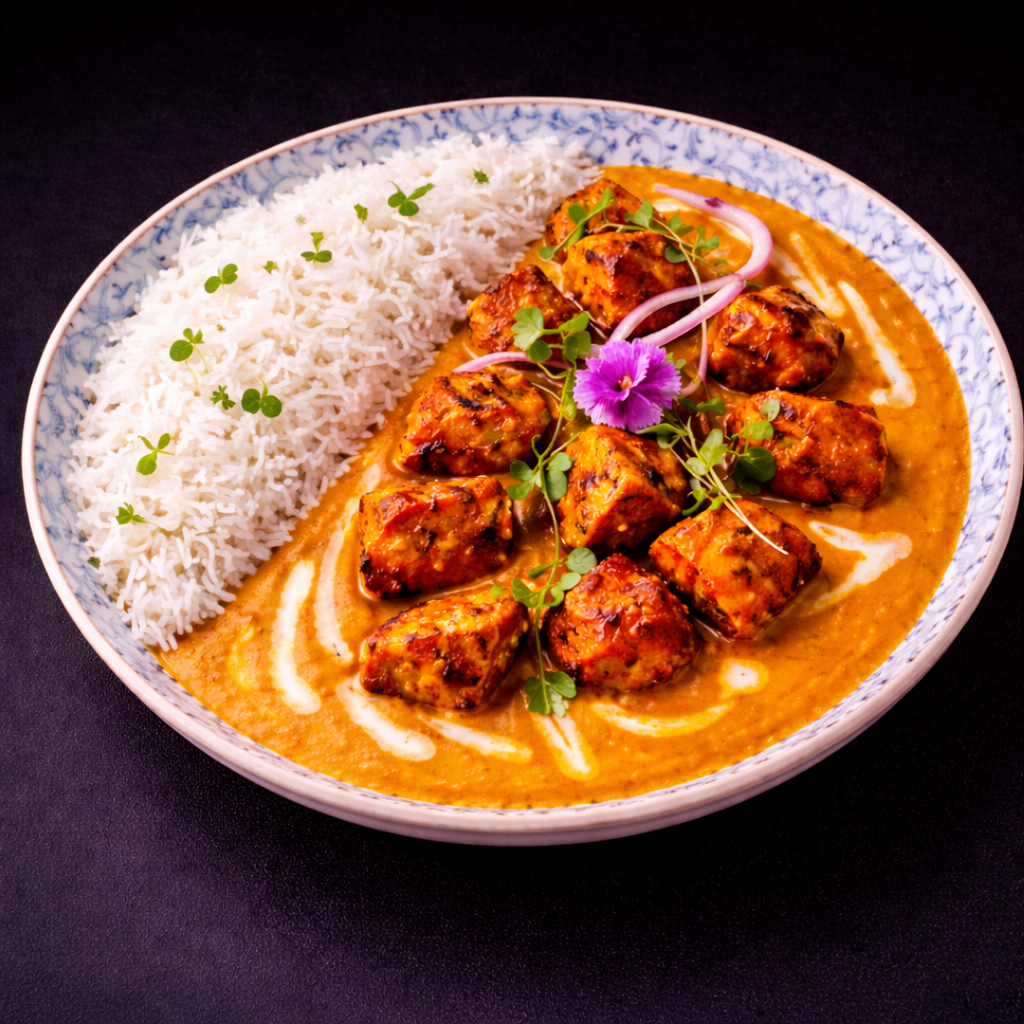
The biryani section, housed within The Comfort Plate, presents the Awadhi Gosht Biryani — slow-cooked, fragrant, sealed with saffron — alongside the TSK Dum Veg Biryani, a vegetarian biryani that takes its saffron-sealed dum-cooking as seriously as any meat preparation on the menu.
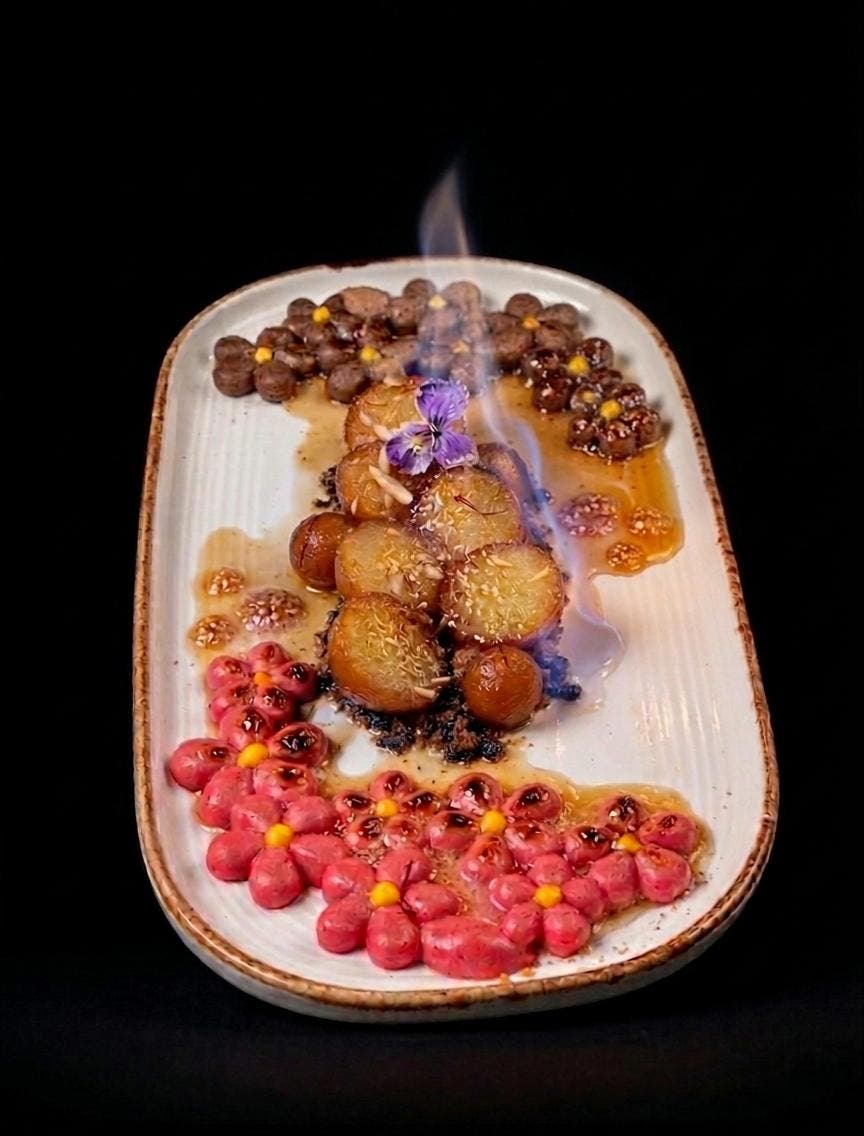
Dessert at The Secret Kitchen is not an afterthought. The Gulab Jamun Flambé — a Chef Special — arrives warm and caramelized, the classical Indian sweet transformed by tableside fire into something dramatic and indulgent. The Kesar Mango Rasmalai, soaked in saffron milk and crowned with dry fruits, is gentler but no less considered.
“Food should be an experience — a journey that brings people together and celebrates the flavors of the world.”
THE VISION: CHICAGO’S TABLE, AND BEYOND
Chef Kotak has been candid about her long-term ambitions. She looks at the Michelin Guide and the James Beard Awards not as abstract honors but as benchmarks — a horizon she is working toward with the same methodical intensity she brings to her spice blends. The recognition has not arrived yet, but the trajectory is unmistakable. The restaurants she has built in India and abroad have earned critical acclaim. The Secret Kitchen Schaumburg arrives not as an experiment but as a proven concept, road-tested across continents and cultures, now making its case in one of the most discerning dining markets in the United States.
“This is more than a restaurant—it is an invitation to experience the soul of India in a new way. My hope is that every guest who walks through our doors feels that story on their plate,” Kotak says. “Our goal is excellence—but the purpose is to create something people will remember long after the meal ends. If we can touch each guest’s heart, then we are exactly where we intend to be.”
ABOUT THE SECRET KITCHEN
The Secret Kitchen — the Indian saga — is a fine-dining restaurant founded by Celebrity Chef Aanal Kotak. Rooted in the culinary traditions of India’s royal kitchens and reimagined with contemporary technique, The Secret Kitchen operates locations in India (Vadodara, Ahmedabad, Rajkot, Patan, and Himmatnagar), Australia, Canada (Vaughan, Ontario), and now the United States (Schaumburg, Illinois). Chef Kotak handcrafts all signature spice blends used in each of her restaurants.
Visit TheSecretKitchenUSA.com for reservations.
#thesecretkitchen #thesecretkitchenusa #aanalkotak #schaumburgil #newrestaurant #bestindianrestaurants #nowopen