Obituaries
North Shore Death Notices: May 13 To May 19
Recent obituaries and upcoming services on Chicago's North Shore.


The following death notices were added to funeral homes serving the North Shore area in the past week. Those homes have provided obituaries for some of those that have passed away recently. Patch offers condolences to their loved ones, links to their obituaries and notices of upcoming services below.
Donnellan Funeral Home, 10045 Skokie Blvd. in Skokie
Charles Monroe May, 92, Evanston
Visitation May 21, service May 22
Find out what's happening in Skokiefor free with the latest updates from Patch.
Nikolaus "Nik" Wenz, 87, Morton Grove
Visitation and service May 21
John Coughlin O’Leary, 78, Glenview
Visitation and service May 22
Find out what's happening in Skokiefor free with the latest updates from Patch.
Craig Busey, 72, Wilmette
Visitation and service May 25
Robert Wallace Patterson, 83, Lake Forest
Service Aug. 3
Wynn Mason Taylor, 91, Evanston
Jerry Hufton, 76, Winnetka
Sharon Bourke née Sweeney, 71, Evanston
Roger Scott Falk, 55, Winnetka
Michael Lee Taylor, 54, Evanston
Ashkahn Haralelli, 28, Chicago
Nancy J. Staackmann née Comstock, 89, Morton Grove
Visitation and service May 20
Margarita F. Garcia née Torres, 77, Skokie
Mary Alice Fidler, 65, Chicago
Simkins Funeral Home, 6251 Dempster St. in Morton Grove
Theresia Gottfert, 88, Morton Grove
Visitation May 20, service May 21
Thomas G. Bostetter, 75, Morton Grove
Visitation and service May 21
Weinstein & Piser Funeral Home, 111 Skokie Blvd. in Wilmette
Ida W. Plofsky née Weiss, 82, Chicago
Service May 22
Nathan Goldstein, 95, Skokie
Evelyn Kalter , 82, Northbrook.
Peter Rumbold, 78, Chicago
James S. Belsky, 77, Skokie
Chicago Jewish Funerals, 8851 Skokie Blvd. in Skokie
Frima Enid Kohn née Chatkin, Skokie
Service May 21
Ann Gershanov, 84, Skokie
Service May 22
Jack Chunowitz, San Tan Valley, Arizona
Services pending
Barbara Frankel, Lincolnshire
Services pending
Menahem Ganz, Deerfield
Services pending
Fern Malinick
Services pending
Annette Starr, 100, Northbrook
Arthur E. Goldberg, 94, Evanston
Joyce Himmel, 94, Flossmoor
Robert Leader, 92, Highland Park
Howard S. Gorchoff, 90, Skokie
Marvin E. Sopkin, 90, Glenview
Harold Bland, 89, Deerfield
Barbara Cramer, 82, Saint Paul, Minnesota
Janiel F. Friedland, 79, Wheaton
Barry H. Kahan, 74, Riverwoods
Laura B. Ander, 66, Buffalo Grove
Larry I. Nelson, 49, Chicago
Kelley & Spalding Funeral Home, 1787 Deerfield Road in Highland Park
Clarence G. Vice, 92, Highland Park
Service May 24
Jerold Steinman, 84, Lincolnshire
Services pending
Seguin & Symonds Funeral Home, 858 Sheridan Road in Highwood
Carolina Stefani Biondi, 83, Highland Park
Wenban Funeral Home, 320 Vine Ave. in Lake Forest
Irene Oddi, 88, Lake Forest
Reuland & Turnbough Funeral Home, 1407 N. Western Ave. in Lake Forest
Joseph Walter Steele, 94, Lake Forest
Featured Obituary:
Wynn Mason Taylor died December 23, 2018 in Evanston. She lived in Evanston for most of her 91 years and maintained deep ties to Northwestern University. A pioneer single working mother, Wynn built a notable career while raising her beloved daughter Ann. Predeceased by daughter Ann Taylor Huey and sister Judith Mason Macomber, Wynn is survived by nieces Brigit, Sheila and Megan Macomber.
Wynn Katherine Mason was born October 31, 1927, in Danville, Illinois, where her parents, Frank and Claudine (Van Cleave) Mason, were visiting his parents. Claudine later remembered Dr. Frank Mason, Sr delivering his granddaughter as kids trick-or-treated outside. In later years Wynn’s Halloween legacy would include having birthday phone calls from nieces interrupted by the doorbell and the sound of her greeting ever newer generations with unrestricted amounts of candy.
The young Mason family lived in Chicago, where Wynn’s sister Judith was born in 1933. The two Mason sisters would maintain a closeness that withstood intense childhood competition and the travails and physical separations that came with adulthood. For 85 years—from baby of the family to stage-trained scene-stealer to Mensa-certified autodidact—Judith commanded the immediate attention of all around her. A born listener with a hold-the-vermouth sense of humor, Wynn settled early on her own winning strategy: never compete with her sister.
Wynn’s startling intelligence had made itself obvious in early childhood. Her insatiable curiosity and ability to assimilate information helped her blaze a trail of academic stardom all the way to Wellesley College. Also fully engaged in extra-curricular activities, at Evanston High School she was associate editor of the Evanstonian, served as secretary of the Victory Corps and the Social Committee, and sang in the choir. Wynn’s senior year at ETHS she performed a lead role in the spring operetta, “Love’s Sacrifice” and won a four-year Pepsi-Cola scholarship, then a national award far more competitive and precious than a National Merit Scholarship today.
The burden of expectations generated by this success resulted in Wellesley disappointing her—or rather, Wynn disappointing herself at Wellesley. When a friend suggested a junior year abroad with the Smith College program, she “jumped at the idea.” Her memories of that time would remain so vivid that she told stories about Europe well into the last year of her life.
During the first week, in Geneva, Wynn met Robert Taylor (not that Robert Taylor . . . The one Wynn found was a mathematician, not an actor). They dated for a year before she agreed to marry him, in 1948, and their daughter Ann Katherine Taylor was born in May, 1949. They returned to the States following his graduation from Oxford University. Robert obtained a teaching position at Columbia University and they lived in New York City. After their divorce in 1952, Wynn moved home to Evanston with Ann.
Wynn transferred to Northwestern University to finish her undergraduate degree; in 1953 she graduated with a Bachelor of Science degree from Medill School of Journalism. While there she pledged to the Chi Omega fraternity. Her mother Claudine, now Dean of Women at Northwestern, was an active lifetime Chi Omega member. Wynn’s younger sister Judith attended Northwestern’s Drama School during this period, before transferring to the Institute of Design.
This was the early 1950s; the category “single mothers” didn’t exist. Donna Reed and Barbie personified the ideal woman. The ‘spunky’ Laura Petri of the Dick Van Dyke Show, with her ‘daring’ capri pants, was over a decade in the future. And even she was a housewife; Mary Tyler Moore wouldn’t get to play someone with a paycheck until years after that.
But years before TV’s Mary Richards made solo life seem possible for the rest of us girls and women, Wynn Taylor had already broken that ground. Throughout the sixties, Wynn maintained a super-cool apartment; worked fulltime at a series of interesting, meaningful jobs; and raised a daughter whose compassion equaled her singular gifts.
Once Ann reached school age, Wynn moved them into their own apartment on Central Street in Evanston. Wynn was working at Hollister Papers (now Pioneer Press) as a general news reporter: a journalistic jack-of-all-trades. She attended and wrote stories about village planning and zoning meetings, school board meetings, and anything else that fell under the broad rubric of civic and business news for Winnetka, Northfield, Glencoe and New Trier Township. She sometimes got to step in and serve as her own staff photographer, taking pictures to accompany stories.
In 1960 Wynn moved to the American Institute of Baking; working in the publicity department first as assistant to the director and then director of publicity. In 1968 the Chicago engineering firm DeLeuw Cather & Co. hired her as a report editor; Wynn drew on her formidable range of skills, experience, and writing talents in order to turn complicated engineering reports and proposals into readable material.
Ann remained the jewel of her mother’s life. Once Ann decided as a teenager to pursue a career in speech pathology, her desire to help others—specifically children with schizophrenia—carried her through college (in three years) and grad school. When she developed chronic breathing problems, the first symptom of the rare disease insidiously colonizing her respiratory system, she did not tell her colleagues so as not to jeopardize this dream. She kept working with her young subjects even after her lung collapsed.
Ann’s capacity for empathy mirrored her mother’s. Throughout their childhoods, Aunt Wynn provided her three nieces a safe space from a competitive and hyper-critical family. She and her daughter showed them kindness—what it felt like, what it looked like, how it was supposed to work.
Ann married Dave Huey in 1973. Ann Taylor Huey died in June, 1975.
“Ann was the best thing I ever did,” Aunt Wynn said recently. No one recovers from losing a child. With the “best thing” behind her, Wynn still had half a life ahead of her. Never one to advertise her own successes, she fought a series of battles that revealed her courage and determination as they were tested. Her father, Frank Mason, died in 1976, and Wynn suffered through two bouts of cancer treatment.
After her father’s death, Wynn began spending more time with her mother Claudine while continuing to work. Her position at DeLeuw Cather took her on business trips around the world: Korea, Ghana, even Buffalo. She was proud of contributing to projects the company engineered, such as the Washington D.C. Metro system; whenever she talked about New Haven’s Q Bridge, a DeLeuw Cather project, she called it “our bridge.” In 1992 Wynn retired from DeLeuw Cather & Company as Chief Editor. Her grateful co-workers presented her with a gold watch, inscribed: “In honor of 24.5 years of service.” Engineers—they just couldn’t bear to round up.
Wynn did not retire to a life of ease. Wynn had moved in with Claudine in 1978 and her mother now required round-the-clock care. If anything, this proved more demanding than the job Wynn had left. By the time Claudine Mason died in December, 1994, at age 94, Wynn found herself battling depression with alcohol. The following years would see the fight of her life, as she gave up drinking and confronted the issues that fueled her addiction.
Wynn had raised a miraculous child. She had watched Ann thrive, excel, surge into adulthood. And then Ann died.
Why live after that? It’s a rational question. Wynn’s answer: other people needed her. Her mother needed her—first in the wake of her father’s death, then as her own health failed. Wynn got through these years by drinking. The drinking became obvious to others; family and friends intervened, afraid of losing her; and Wynn stopped drinking. Wynn found in AA what so many addicts seek: fellowship, support, and love not conditioned on social success or appearances. (Although the fact that she referred to the group as her “book club,” even long after everyone around her knew it was her AA meeting, suggests she still felt some pressure to conform.)
Wynn remained in recovery the rest of her life, more than two decades, an achievement guaranteed to render any other addict awestruck. Stopping is the easy part—living is what’s hard. She confronted that implacable truth every day, every hour, one step at a time.
A few years later, to accommodate sister Judith on a vacation trip, Wynn gave up smoking. She missed wine, and boy did she miss cigarettes. Nevertheless, she persisted.
Wynn Taylor filled her last decades with an array of interests. She continued to do freelance writing and some business travel for De Leuw Cather. She chaired the scholarship committee for the Northwestern Alumnae Board, and participated actively on the Evanston High School class of 1945 reunion committee until they stopped holding reunions sometime after the 60th year. In addition to AA meetings, she was an enthusiastic member of many book groups—the kind with books. Wynn’s love of reading remained inexhaustible her entire life.
She loved attending Lyric Opera and the Shakespeare Theater—first with sister Judith and later with niece Sheila—and visiting the Botanic Garden of Chicago, camera in hand. But ever since she first “jumped at” the prospect of a college year abroad, Wynn’s greatest passion was travel. From 1978 until 1988, Wynn and Claudine had taken “foreign” vacations about once a year. The family still has thousands of Wynn’s 35mm slides from trips to Egypt, Greece, Africa, the Netherlands, and Scotland. After Claudine became too frail for international travel, she and Wynn took a long trip up and down the west coast with Judith in 1990.
After Claudine’s death at age 94, Wynn embarked on finally remodeling the kitchen and updating the bathrooms in the house that was now hers. As the new millennium approached Wynn found herself in possession of a mid-century modern house and a still-tender sobriety. Both required ongoing maintenance. But the house offered her an opportunity, because improving it was a way of sustaining her sober self.
She would tinker with it for the next two decades. Wynn had supported her sister Judith’s painting career with great generosity over the years; her many purchases hung among work by other family members, making the house a Mason-Macomber gallery featuring Judith’s landscapes.
Wynn continued traveling, including several trips to Oregon to visit Judith. A carefully coordinated Mason Women trip to the Four Corners region in May, 2001, involved Wynn teaming up with Judith for sightseeing before the two of them met her nieces Megan, Sheila, and Brigit for two days at the Grand Canyon’s North Rim. In every photo of her from that trip, Wynn holds her camera before her, at the ready. Once she had gotten them enlarged and meticulously framed, Wynn’s eight photographs from that trip got pride of place on the living room wall. In recent years, rearranging them with her gave us much pleasure.
Wynn had always been THE listener in the family—the one who actually wanted to know what people thought. What they felt. What they had to say. The loss of her hearing frustrated her to the point of despair. She continued reading voraciously (family habit) but missed participating in the raucous (and fraught with mumbling) discussions of what we had read.
Wynn still made every effort to reach out. Her younger sister Judith had moved back to the Midwest in 2009. This made visiting each other much easier; Wynn would drive from Evanston with her niece Sheila. Judith had enjoyed a lifetime of nearly perfect health, so it was a shock when a catastrophic illness struck her just after New Year, 2017. With Judith too sick to travel from Ann Arbor, Michigan, for Wynn’s 90th birthday, Wynn made the trip with Sheila. It was the last time the Mason sisters would see each other. And when she learned that Judith had lost both of her hearing aids, Wynn lent her one of her own, equipping each with a singleton hearing aid and thus making it the last time the Mason sisters would not hear each other, too.
Judith died January 5, 2018. This loss, unforeseen for so long and still largely inconceivable, added to the challenges Wynn was already facing. Experiencing increasing frailty and cognitive impairment, as well as increasingly frequent hospital and rehab stays, Wynn still wanted to at home. Her niece Sheila had for years been helping Wynn and, increasingly, overseeing her care. As her condition deteriorated, Sheila made her as comfortable and safe as possible with additional caregivers and more time herself.
In late May Wynn hosted a private memorial service for Judith in her living room. Family and close friends shared stories and memories, and despite the difficulties she was facing, Wynn participated fully, remembering childhood adventures and expressing her love for “a good sister.”
Wynn’s health continued to decline, with another hospitalization in June. There was talk of a nursing home, but she dug in her heels in true Wynn fashion. Hence, more caregivers at home. She was able to celebrate her 91st birthday and Thanksgiving quietly with family, but after another fall she was hospitalized and referred to rehab nursing. Wynn was doing well there—physical therapy, visits with friends. The end came too suddenly for out-of-town family to arrive. Wynn died the morning of December 23, 2018. Her niece Sheila and Mervis, Wynn’s long-time caregiver, were with her. Wynn was 91.
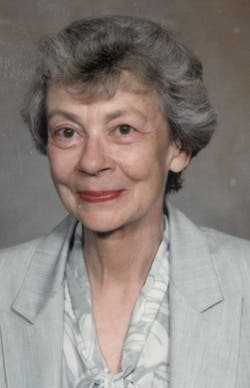
Wynn had wanted to die at home. Death deprived her of that chance. But the house remained. Over the years she had made it more and more her own, epitomized when she hung those eight photographs of the Four Corners area—the ones she had taken—on the main wall of the living room. She solicited opinions about the photos from her sister and nieces; Wynn listened to everything we suggested, nodding thoughtfully, of course.
The photographs stayed on the living room wall. While their specific arrangement was subject to obsessive revision, their prominence was not. Wynn Mason Taylor was telling anyone who might listen that she valued what she had created. Finally. It didn’t matter whether anyone agreed or not. Finally!
Services were held. In lieu of flowers, donations in Wynn’s name may be given to either of the organizations below that gave her great joy in life: Lyric Opera of Chicago or Chicago Botanic Garden.
Get more local news delivered straight to your inbox. Sign up for free Patch newsletters and alerts.