Neighbor News
Rabbi Joe Black Comes Back to Chicago: Hanukkah Concert 12/15/19
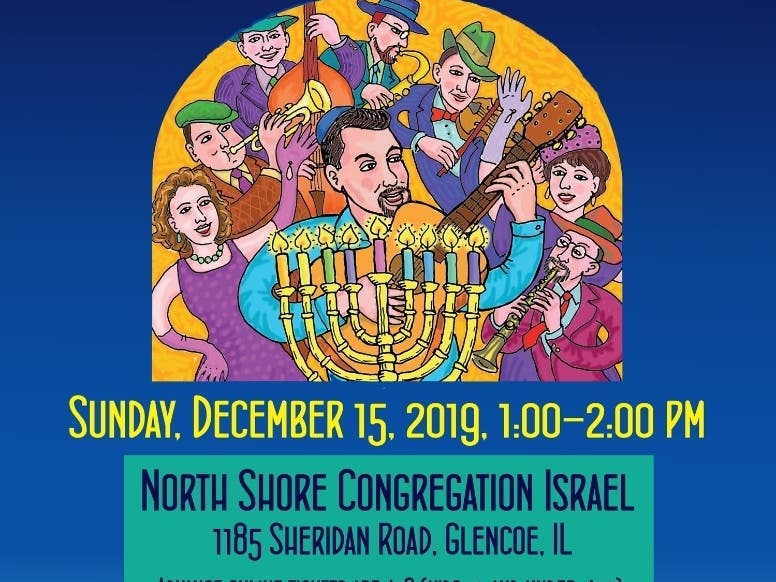
Family Hanukkah Concert with Rabbi Joe Black and Maxwell Street Klezmer Band 12/15/19 at 1:00pm in Glencoe
by Ellen Braunstein, Freelance Reporter
Rabbi Joe Black, a vibrant force in contemporary Jewish music, sees his gift as an extension of his rabbinate – funny, inspirational and thought-provoking.
“It’s a way to teach and inspire,” said Black, 60, who launched his music and rabbinical career in his native Chicago.
Find out what's happening in Skokiefor free with the latest updates from Patch.
Since 2011, he has been the Senior Rabbi at Temple Emanuel in Denver, a Reform congregation that, in addition to his clerical responsibilities, encourages him to tour, write songs and record albums. A singer, instrumentalist and songwriter, Rabbi Black joins creative forces with Maxwell Street Klezmer Band for a family Hanukkah concert at North Shore Congregation Israel on Dec. 15. Longtime collaborators, they will be performing hits from their album “Eight Nights of Joy.”
Not strictly adhering to the traditional themes of dreidels and latkes, Black also touches upon serious topics, such as finding awe in everyday life and the communal responsibility to pursue social justice. With guitar artistry, warmth and humor, Black delights audiences of all ages.
Find out what's happening in Skokiefor free with the latest updates from Patch.
Maxwell Street Klezmer Band is known for playing lively Eastern European Old-World melodies blended with jazz-age rhythms and contemporary energy. Steeped in rich traditions of Chicago jazz, the band’s polished, horn-driven sound is combined with violinist Alex Koffman's classically-inspired arrangements.
Lori Lippitz, founder and artistic director of the Maxwell Street Klezmer Band and of the Klezmer Music Foundation, has known Rabbi Black since they were Hebrew school classmates in Evanston. They have shared the stage on several occasions, and decided to create a Hanukkah performance together about a decade ago. Of Black, she says, “He combines Jewish depth with musical artistry and originality. He plays guitar with great finesse, sings with a voice reminiscent of the late great Steve Goodman, and is constantly writing new songs that range from serious to zany.”
Rabbi Black has performed for congregations and communities around the world and his music is played and recorded by many artists.
His career began as a teenager at sleepaway camp Olin-Sang-Ruby Union Institute in Oconomowoc, Wisconsin. He became known as a song leader, his inspiration being other song leaders Michael Lorge, Rob Weinberg and the late Debbie Friedman, who wrote many of her early songs at the camp.
After a trip to Israel, Black decided he wanted to make Judaism central to his life. In high school and college, he taught music at synagogues all over Chicago and served as a cantorial soloist. He taught himself the guitar, as well as piano and drums.
He was just a freshman at Northwestern University when he got a job on an educational television series produced by the Chicago Board of Rabbis for Jewish children called “The Magic Door.” He played the part of “Tiny Tov” on the beloved series that premiered in the early 1960s. The gig paid for his college studies in education.
Rabbi Black grew up as a lover of folk music in Chicago at the end of its heyday, inspired by legends Steve Goodman, Bonnie Kolak and John Pryne. He was part of the very first Chicago Jewish Folk Festival in the late 1970s. He was always drawn to acoustic music and songwriting. “With all the song leading, music teaching and cantorial soloing I was doing, I was finding that my studies were put on the back burner. So, I took a year off from college. I actually wanted to see if I wanted to be a professional musician—much to my parents’ chagrin.”
Black wrote a few tunes (“admittedly not great ones, he quips), but he decided against going back to school. Instead, he decided that he was going to become a rabbi. So he entered the rabbinate: first, studying for a year in Jerusalem, and then attending Hebrew Union College in Cincinnati. He had a steady gig at several clubs in Cincinnati. He also worked for youth programs while studying.
After ordination, he became Assistant Rabbi at Temple Israel in Minneapolis and put his performing career on hold. “Although I love writing and performing music, while being a musician, I missed the intellectual and the spiritual stimulation and education. I wanted not just to sing. I love Judaism—I wanted to help other people in ways more than musically.”
He did have an outlet for his singing in the religious school and camp at Temple Israel. Then, he was approached by parents to do a concert to benefit the Temple’s Early Childhood Center. “I said, ‘Sure!’ It was a Hanukkah concert, so I decided I should probably write some music for it. So I wrote four or five kid songs, and the concert went over well.”
The fundraiser led to his studio recording of a cassette, “Rabbi Joe Black Sings!” The recording got picked up for national distribution. Black was encouraged to record an album of original music, which he called “Aleph Bet Boogie.” The album was another success.
“All of a sudden, I got a national reputation. I’m still an Assistant Rabbi, but three years out, I started getting requests to come and do concerts around the country. I was able to work it out that I could do a few weekends a year here and there.”
He then recorded another album called “Everybody’s Got a Little Music.” This album was a transition from children’s tunes to more mature, deeper, adult-oriented music.
After nine years in Minneapolis, Black joined Congregation Albert in Albuquerque. The temple “understood that music was a big part of who I was, so they gave me a lot of freedom to tour and to bring my music to other parts of the country.”
He traveled with other musicians three or four times a year. It was then that he recorded “Leave a Little Bit Undone,” an album that marked “a whole new direction for me. It was recorded in Los Angeles with some incredible musicians who were friends of mine.” The album was produced by Sounds Write Records, which was Debbie Friedman’s record label.
Black’s songwriting deepened and grew more contemplative. “I was using what I would call ‘musical midrash’ to take my music and teach with it, and to really dig deeper and go to a higher level.”
Rabbi Black has performed with Jewish artists such as Doug Kotler, Julie Silver, Craig Taubman, Jeff Klepper, Dan Freelander and Debbie Friedman. One of his great honors was to perform with Israeli artist David Broza.
His music became a part of synagogue life. “People invited us into their communities to share what we do and to teach our music so that it could be shared in religious school, worship settings and youth groups. It was a different way of expressing Jewish ideas, of teaching Torah study.”
Rabbi Black loves writing limericks, and he wrote one for every Torah portion, eventually turning it into a book titled, “There Once Was a Man From Canaan: The Five Books of Limerick.”
“I started writing it on a dare and I said, ‘this is fun!’ Once I started doing it, I couldn’t stop.”
About a decade ago, Rabbi Black and Lori Lippitz of Maxwell Street Klezmer Band were approached by Chicago Jewish Day School to do a benefit concert at Temple Sholom. “I wrote a couple of new songs, Lori wrote a few songs, and we came up with the title track ‘Eight Nights of Joy.’ We recorded it live and made an album out of it that was picked up by PJ Library. So, the album got a ton of exposure.”
Rabbi Black has performed at least 20 concerts with the 10-piece Maxwell Street Klezmer Band over the years. “Each time it gets better,” he said. “I’m not a Klezmer musician per se, but I love Klezmer. They’re incredible musicians, and I love what they do.”
Rabbi Joe Black and the Maxwell Street Klezmer Band will perform a Hanukkah concert on Sunday, December 15th, 2019, 1:00-2:00 PM, at North Shore Congregation Israel, 1185 Sheridan Road, Glencoe. Advance online tickets are $18 (kids 12 and under $12); tickets at the door are $22 (kids 12 and under $15). Group rates are available. For tickets, click here.