Schools
Binge Drinking, Vaping, Stress Concern New Trier Administrators
New Trier High School students are binge drinking alcohol at a rate of more than twice the national average, according to survey data.



NORTHFIELD, IL — Rates of binge drinking, vaping and stress among students at New Trier High School are all growing concerns, administrators told board members last month.
One in three New Trier students — more than twice the national average — reported binge drinking at least once in the past 30 days, according to the results of last year's Youth Risk Behavior Survey. The semi-annual national survey measures student behavior in terms of mental health, nutrition, safety, sexual activity and substance use.
Assistant Superintendent Tim Hayes told the board an analysis of survey results showed positive results in terms of student overall safety, physical health and access to support for struggling students. But Hayes identified alcohol use as one of several notable concerns in the data. He said the district's demographics may increase its risk for its high rates of binge drinking, which is declining among teens nationwide but on the rise at New Trier.
Find out what's happening in Winnetka-Glencoefor free with the latest updates from Patch.
"Our community may be kind of predisposed for this kind of behavior. Binge drinking is more prevalent among suburban affluent communities that are predominantly white and college-going. And that is our community," Hayes said, suggesting a cultural change on binge drinking was needed locally.
Board member Lori Goldstein said it was a concern for the community that underage drinkers were able to so easily access booze.
Find out what's happening in Winnetka-Glencoefor free with the latest updates from Patch.
"What bothers me is that kids are getting the alcohol," Goldstein said. "I think that it is a community effort, because I think there are some parents who think that that's a right of passage or they want to get them ready for college and it takes a village, it really does."
Member Carol Ducommun said she was shocked and saddened by the numbers.
"I think we're being kind to say some of our demographic factors predispose us to higher," Ducommun said, recalling a fellow New Trier parent who confided that she had succumbed to social pressure to allow high school-age children to drink. "I think that we need to own this."
In his report to the board, Hayes said New Trier parents and students have described a school culture that "views binge drinking as a rite of passage and an outlet for students who feel significant academic pressure."
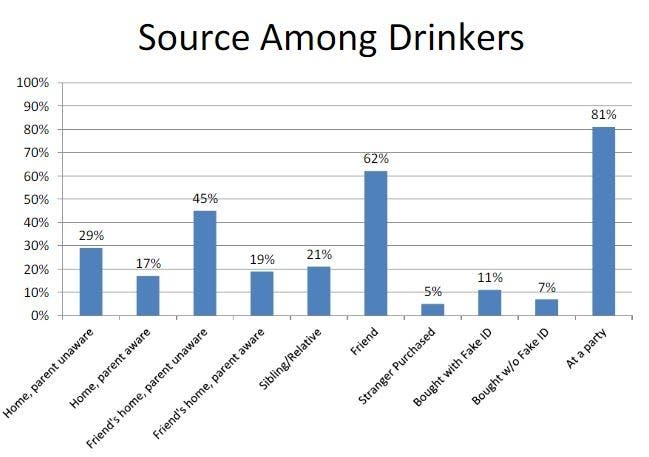
Survey data show parties and friends are the most common source of alcohol. Fewer than 20 percent of respondents reported acquiring alcohol at home or a friend's house with their parents' knowledge. However, students said getting alcohol from complicit parents was still more common than having a stranger purchase it or buying it themselves — with or without a fake ID.
Superintendent Paul Sally said risky behavior looks different in different types of communities. He pointed to studies that have shown the "exposure" approach — allowing high school students to drink as a kind of preparation for college — put students at greater risk of problems with alcohol later in life.
When broken down by grade cohorts at New Tier, 13 percent of ninth graders, 26 percent of 10th graders, 42 percent of 11th graders and 54 percent of 12th graders reported binge drinking within the month leading up to the survey. Binge drinking is defined as consuming five or more drinks for males or four or more drinks for females within a couple of hours.
"What we want them to have is a healthy relationship with alcohol. As adults, we shouldn't be binge drinking. We drink in moderation, we drink socially, we drink in ways that are responsible, and that's the relationship we want students to eventually have with alcohol," Hayes said. "And we want them to wait. Adolescent brains are still developing, they're more susceptible to addictive behaviors than mature adult brains are."
The number one reason not to drink, according to the survey results, students said, was to "be in control" of one's body and actions, with 75 percent citing it as a reason not to drink. Rules and expectations for parents were a reason for 62 percent of respondents and 61 percent identified the impact on grades and future.
Hayes said the district would again conduct the Youth Risk Behavior Survey in the spring. It also plans to partners with Loyola Academy and local mental health organization to create a North Shore coalition for drug-free communities as a first step toward applying for a federal grant from the White House Office of National Drug Control Policy to reduce rates of vaping and binge drinking.
"When students are receiving a consistent message in school — at the businesses that they might frequent, through community organizations supported by township and village governments," Hayes said. "When they're getting that consistent message across the community, it can have a really positive impact on student health behaviors."
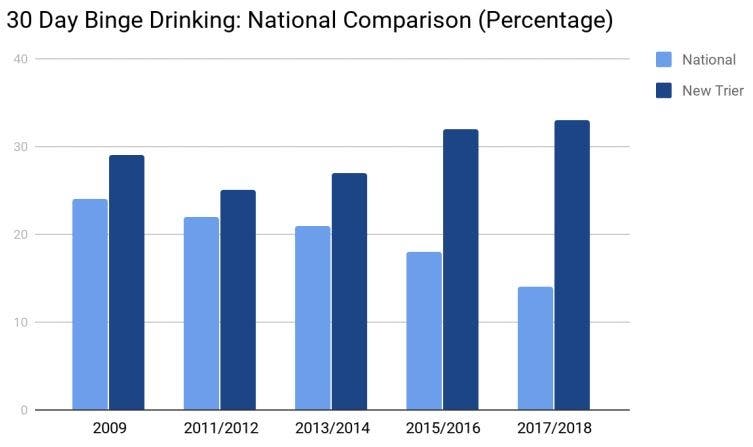
Board member Patrick O’Donoghue said it would be help to compare all risky behavior to the nationwide average rather than just alcohol.
"It just feels weird," O’Donoghue said. "I don't want it to get out there that New Trier has kids that do risky behaviors way more than the national average. They do in this category, but in the total category, I'm not sure."
According to the survey data, New Trier students use all substances other than cigarettes at rates significantly above the national average.
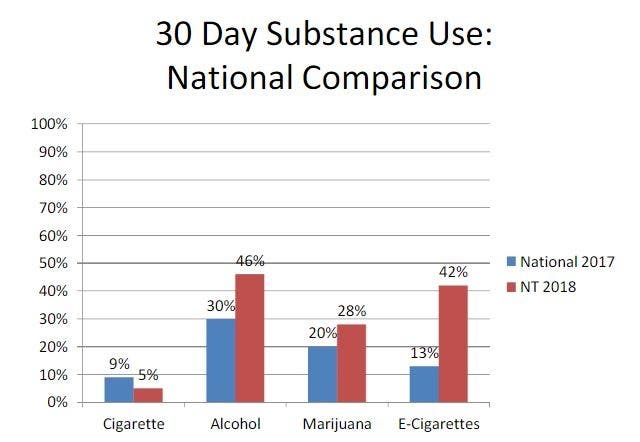
Rates of vaping have been rising sharply at New Trier, although unlike with drinking, the rise is matching the national trend. Last fall, Hayes notified the board that more than a third of first-year high school students reported e-cigarette use.
At a Feb. 19 board meeting, Hayes said discussions with students suggested health concerns connected to vaping were becoming more widely known. But some had already become addicted to nicotine, and many of those who quit found themselves replacing vaping with something else.
"Because what they're trying to do is self-medicating themselves, they're trying to manage the stress or the anxiousness they feel," Hayes said, emphasizing the importance of developing healthy techniques to manage stress. "Vaping was doing that and now they're trying to find some other substances."
Nearly a third of New Trier students have received treatment from a psychiatrist, psychologist or social worker inside or outside of school during the past year, Hayes said.
"We have a lot of students are experiencing stress and anxiety and even depression," Hayes said.
"Being an adolescent can be a very challenging thing, especially in our community where there's a lot of stress and pressure to succeed," he said. "So we want students to understand that that's actually a normal thing to do — to ask for that kind of help." Levels of stress have remained relatively stable over the past decade, he said.
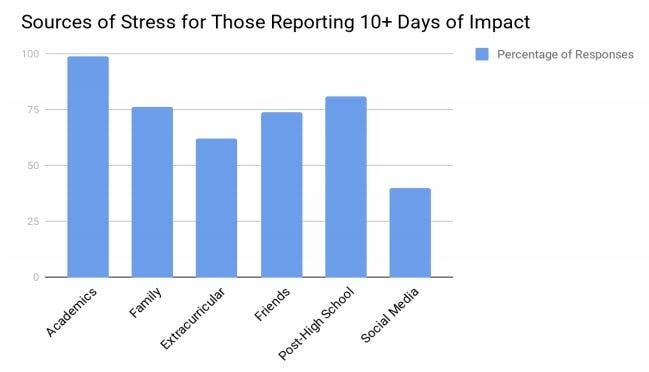
Academics and post-high school plans were the most common sources of stress. One in five New Trier students said stress impacted their ability to deal with daily activities for 10 or more days in the past month. Nearly all of those students cited academic pressures. For the first time, the survey asked students how social media contributed to their levels of stress.
Groups of teachers and some coaches have introduced programs to incorporate "mindfulness strategies" to teach students ways to help reduce stress.
Administrators were also concerned about the number of students who reported using unhealthy weight loss strategies. Of the 42 percent of students who said they were trying to lose weight, 24 percent said they had skipped meals, 5 percent reported purging or using laxatives and 4 percent said they had taken diet pills.
Overall, 24 percent of students reported feeling overweight, 21 percent reported feeling underweight and a majority described their weight as "about right."
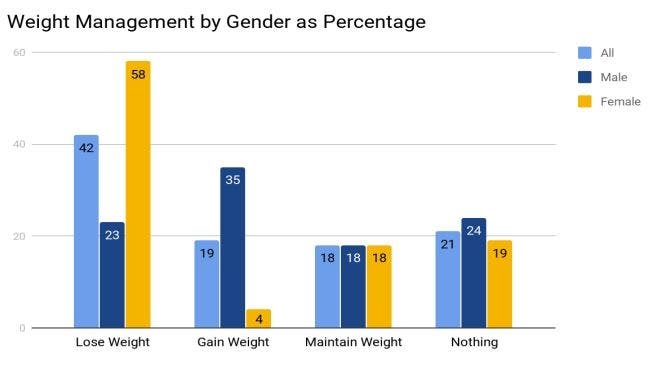
The results of the survey were reviewed by a committee comprised of the Student Assistance Program coordinator and the Kinetic Wellness Department chair along with adviser chair and faculty representatives, according to Hayes' 2019 Student Well-being Report. More than 3,000 New Trier students participated in the survey during Kinetic Wellness class in March.
See complete results from the Youth Risk Behavior Survey 2018:
Get more local news delivered straight to your inbox. Sign up for free Patch newsletters and alerts.