Politics & Government
Gov. Hogan Earns 63% Approval Rating: Goucher Poll
A new Goucher Poll gives Gov. Larry Hogan high approval ratings overall, and says businesses should provide insurance for workers.


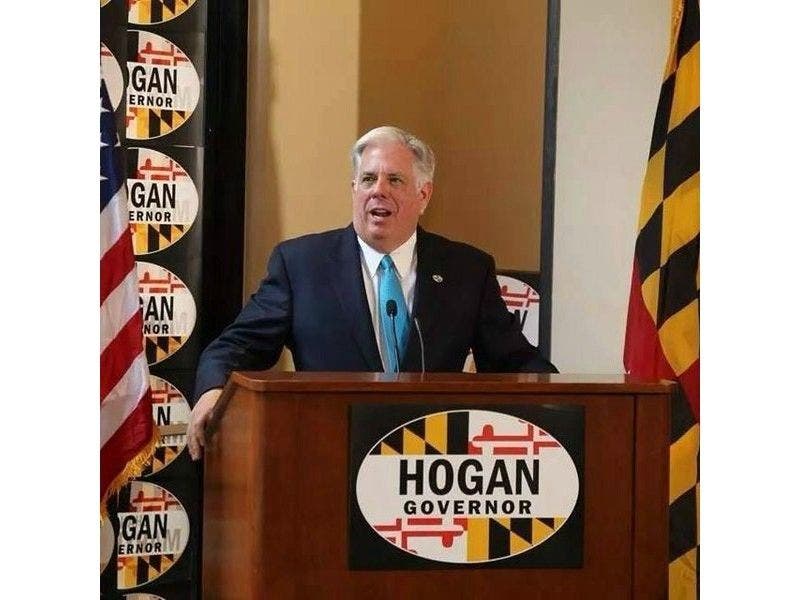
ANNAPOLIS, MD — A new Goucher Poll bodes well for the re-election efforts of Governor Larry Hogan with nearly two-thirds of Maryland residents giving him high marks for his first time in office. The high poll numbers come despite attempts by opponents to tie him to the unpopular policies of President Donald Trump — Hogan didn't support Trump and refused to vote for him in November.
The poll released Monday says 63 percent of Maryland adults approve of the job Hogan is doing as governor, 17 percent disapprove, and 20 percent don’t know. This is the identical approval rating Governor Hogan earned from Marylanders at this time last year and slightly lower than his rating on the September 2016 Goucher Poll.
Residents were also probed on the main reason why they either approve or disapprove of the job Hogan is doing.
Find out what's happening in Annapolisfor free with the latest updates from Patch.
Top reasons for approval among those who approve:
- 34 percent say his leadership and/or how he runs the government
- 18 percent say they like him personally or his personal attributes
- 14 percent say how he handles the economy/budget/state finances
Top reasons for disapproval among those who disapprove:
Find out what's happening in Annapolisfor free with the latest updates from Patch.
- 29 percent say he hasn’t done enough or the right things
- 14 percent say how he handles education/educational issues
- 12 percent mentioned an issue related to President Donald Trump
“Speculation over a 'Trump effect' on Governor Hogan’s approval ratings and re-election efforts has certainly ramped up over the last month. Although there have been direct efforts to attach Governor Hogan to President Trump and the majority of Maryland voters say that their views toward President Trump will influence their vote in 2018, the governor remains largely unaffected by national politics,” said Mileah Kromer, director of the Sarah T. Hughes Field Politics Center, in a news release. “He continues to earn high approval ratings and the majority of Maryland voters are at least leaning toward giving Governor Hogan another term in office.”
Forty-two percent of residents approve of the job the Maryland General Assembly is doing, 24 percent disapprove, and 33 percent don’t know.
Marylanders remain positive about the direction of the state. Sixty-two percent say Maryland is heading in the right direction, 22 percent say Maryland is going down the wrong track, and 16 percent don’t know. Residents were divided over whether Governor Hogan or the Maryland Democrats have better policies for economic growth and development in the state. Thirty-six percent said Governor Hogan has better policies, 27 percent said the Maryland Democrats do, and 22 percent didn’t know who had the better policies.
Governor Hogan and the “Trump Effect”
Registered voters who indicated they were at least somewhat interested in the 2018 electoral cycle were asked about Governor Hogan’s re-election prospects and whether their opinion toward President Trump would influence how they vote in the 2018 election.
Fifty-seven percent of Marylanders say they will either definitely vote for or are leaning toward voting to re-elect Governor Hogan. Thirty-three percent will either definitely vote for another candidate or are leaning toward voting for another candidate.
Maryland voters are divided over how much their views toward President Trump will influence how they vote in the 2018 gubernatorial election. Forty-two percent say that their opinion toward President Trump will not influence their vote at all or only a little and 55 percent say their views toward President Trump will influence their vote a lot or some.
Paid Sick Leave and the Minimum Wage
Requiring businesses to provide paid sick leave for their employees is a popular policy proposal among Marylanders. Eighty percent support a law that would require businesses with 15 or more workers to provide paid sick leave for their employees. Eighty-four percent support a law that would require businesses with 50 or more workers to provide paid sick leave for their employees.
Sixty percent of residents support raising the state minimum wage to $15 per hour and 38 percent oppose it.
At the same time Baltimore City is considering raising its minimum wage to $15 per hour, a bill restricting the ability of individual localities to raise their minimum wage higher than that of the state is being considered in Annapolis. Sixty-three percent of residents agree and 32 percent disagree that cities should be allowed to set their minimum wage higher than the state’s minimum wage.
Thirty-three percent of Marylanders agree that Baltimore City is the economic engine of the state and 58 percent disagree.
Other Statewide Policy Issues—Legalization of Marijuana, Redistricting, Fracking, Education Funding, and Transportation Focus
When asked about the most important issue facing the state, residents chose education (18 percent), jobs and unemployment (11 percent), taxes (9 percent) and crime and criminal justice (8 percent).
Opinions toward the legalization of marijuana in Maryland remain consistent. Fifty-eight percent of Maryland residents support the legalization of marijuana, 36 percent oppose it—similar to the Goucher Poll findings in February 2015 and 2016.
Redistricting reform continues to be popular among Marylanders. Seventy-three percent prefer a system where districts are determined by an independent commission and 20 percent prefer a system where districts are determined by the state’s elected officials. Currently, district lines in Maryland are determined by the state’s elected officials and are readjusted after each US Census.
Residents were divided and unsure over whether the state should ban hydraulic fracturing, commonly known as fracking, in Maryland; 40 percent oppose a ban on fracking, 36 percent support a ban on fracking, and 24 percent don’t know.
When asked to give their preference on where the government should focus its spending in regard to transportation, 59 percent of residents indicate the state government should focus more on improving roads and highways and 35 percent say the focus should be on improving public transportation.
Sixty-six percent of Marylanders think the state government spends “too little” to fund public education in the state and 23 percent think the state spends “about the right amount.” Only 7 percent think the state spends “too much.”
The complete results, including methodology and question design, can be downloaded here.
About the Goucher Poll
To ensure all Maryland citizens are represented, the Goucher Poll is conducted using random digit dialing (RDD) of a stratified random sample of landline and cellular telephone numbers. The Goucher Poll is conducted under the auspices of the Sarah T. Hughes Field Politics Center, which is housed in the Center for People, Politics, and Markets at Goucher College. Directed by Dr. Mileah Kromer, the Goucher Poll conducts surveys on public policy, economic, and social issues in Maryland. The Goucher Poll is fully funded by the Sarah T. Hughes Field Politics Center endowment and does not take additional funding from outside sources.
»Photo of Gov. Larry Hogan courtesy of governor's office
Get more local news delivered straight to your inbox. Sign up for free Patch newsletters and alerts.