Community Corner
Mayor's Association Advocates for Stabilized Distribution of Highway User Revenues
State Senators King, Peterson Sign on as Chief Sponsors of Bill to Modify Transportation Funding Formula.
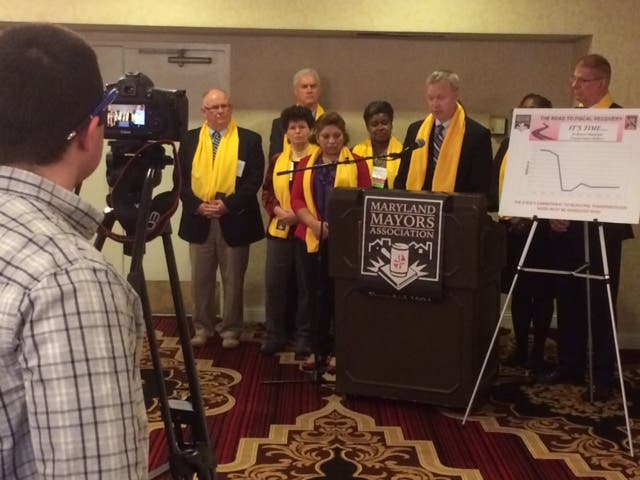
Caption: Kensington Mayor Peter Fosselman, who is President of the Maryland Mayor’s Association, discusses state legislation that is being introduced in the Maryland General Assembly to stabilize the distribution of Highway User Revenues to municipalities, after several consecutive years in which these critical transportation funds for local government have been slashed.
Annapolis, Md. (February 5, 2016) - The Maryland Municipal League (MML) – which represents the state’s 157 cities and towns, and two special taxing districts – and the Maryland Mayor’s Association today called for an overhaul of the State funding formula that provides for the distribution of Highway User Revenues (HURs) to local governments.
Mayors and municipal leaders are joined by a number of state legislators – including lead sponsors, Senator Nancy King (District 39, Montgomery County), Senator Douglas J.J. Peters (District 23, Prince George’s County), Delegate Pamela Beidle (District 32, Anne Arundel County) and Delegate Anne Healey (District 22, Prince George’s County) – in calling for General Assembly passage of a bill that would require municipal Highway User Revenues be restored to pre-recession funding levels, phased in over a period of five years. This will ensure greater predictability for municipalities that count on the funds for critical road and transportation projects in their jurisdictions.
Find out what's happening in Annapolisfor free with the latest updates from Patch.
The municipal leaders’ call for the legislative change follows several years of instability in the Highway User Revenues funding stream, dating back to a volatile period starting in fiscal year 2008, when the cities and towns’ share was slashed from a high of more than $45 million to $1.7 million in FY 11. In more recent years, Governors and the legislature have sought to increase the funding share through special grants, but the overall amount has still been far lower than it was at its peak and there has been no predictability in the amount to be provided, from year to year.
“Our cities and towns are simply unable to absorb the costs of maintaining their transportation infrastructure without a fair and stable, state-shared revenue source,” said 2015-16 MML President Spencer Schlosnagle, Mayor of Friendsville, Md. “We took a major hit in the loss of this critical funding at the time of the Great Recession and in the years since, as our State budget has been recovering from that devastating period. But we cannot continue to adequately maintain our roads, bridges and sidewalks without full restoration of this critical source of funding, which is so key to the ability of our municipalities to maintain their roads, bridges, sidewalks and other infrastructure.”
Find out what's happening in Annapolisfor free with the latest updates from Patch.
For the seventh year in a row, the MML membership decided that advocating for the restoration of a long-term stable transportation funding stream should be a top legislative priority for the League. MML endorsed a commitment to work with the General Assembly and the Hogan Administration to fully restore municipal Highway User Revenues (HURs), to ensure predictable, stable transportation funding into the future.
For well over a half century, Maryland municipalities have been recipients of state gasoline taxes and other revenue sources that provide revenue sharing to assist them in maintaining their roads. This revenue-sharing plan established in Maryland law has served as a firm covenant between the State and local governments and has provided reliability and predictability to help pay for municipal transportation needs. Sharing in revenues collected through state taxes once alleviated what has now become an unsustainable overreliance on the property tax – the primary general fund revenue source for municipalities.
Cities and towns maintain nearly 3,000 miles of road in Maryland and approximately 700,000 vehicles registered are to drivers who live in municipalities. Maryland’s municipalities are often the economic engines within the counties, which means municipal roads are more heavily travelled than other roads around the State,
As a result of the ongoing loss of funding, municipal governments have been unable to effectively plan for long-term transportation projects. Even the ability to perform routine road maintenance has become unpredictable, leaving municipal Main Streets across the state languishing in a state of disrepair. In total, municipalities have lost $221 million since funding was first slashed in FY 2009.
To address the long-term transportation funding gap, the League is looking to introduce legislation to provide a long-term, stable transportation revenue stream for Maryland’s cities and towns.
# # #
About The Maryland Municipal League:
Located at the Phipps Municipal Center in the state capital of Annapolis, The Maryland Municipal League (MML) was founded in 1936 and represents 157 municipal governments and two special taxing districts throughout the state of Maryland. A voluntary, non-profit, nonpartisan association controlled and maintained by city and town governments, MML works to strengthen and support municipal government through advocacy and the development of effective leadership. Through its membership in the National League of Cities MML offers legislative representation in Washington, urban research programs, and a national municipal government information exchange.MML is the only statewide organization in Maryland composed solely of municipal officials and devoted to the promotion of all branches of municipal administration.