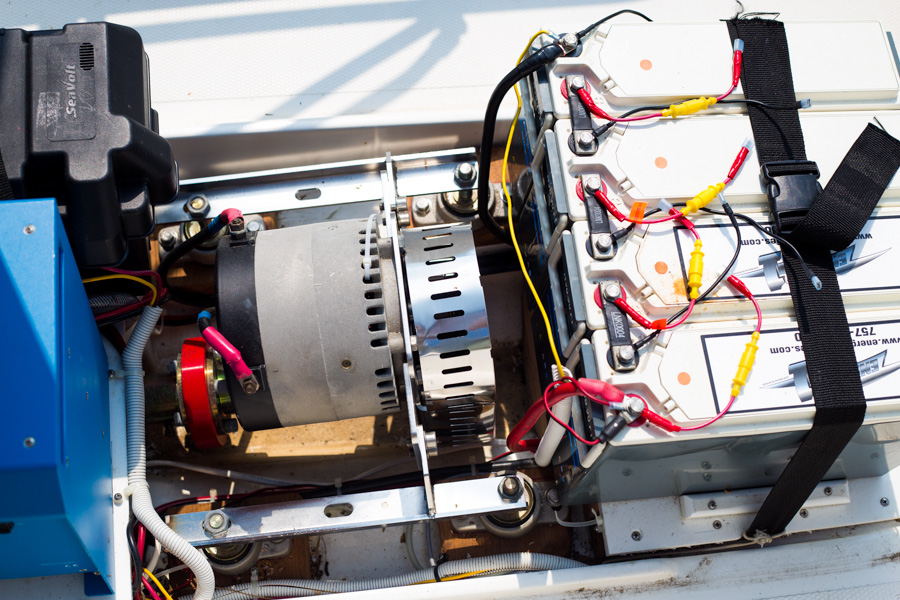


This week I have the pleasure of sharing an interview with David and Sally Reuther of Annapolis Hybrid Marine. They were kind enough to let me come for a tour of their facility and also gave me a great education on electronic propulsion systems for boats. This environmentally friendly motor, primarily used for sailboats, was brought to Annapolis by AHM and is proudly now made in the USA. It was a great experience for me and I learned so much more than I expected. The one thing I love about doing this blog is discovering all of the hidden gems in Annapolis. Within the interview you’ll find some great testimonials and after the interview you will find David and Sally's bio and their contact information.
Finally, I want to add that I was privilege to have Travis Curry of Travis Curry Photography with me during my tour. All of the pics, including the video, have been provided by Travis. His work and reputation are flawless. For all my small business readers, if you need head shots for you or your employees, or need any kind of corporate photography of products or locations, you should contact Travis.
Without further ado, here is the interview:
Find out what's happening in Annapolisfor free with the latest updates from Patch.
Find out what's happening in Annapolisfor free with the latest updates from Patch.
AHM: The Thoosa & Triton electric propulsion systems replace inboard diesel engines that spin the propellers of low-speed vessels such as sailboats, houseboats, harbor launches, small trawlers and similar craft. The systems consist of electric motors, gear-and-belt mechanisms that match the motors’ speeds to vessels’ props, controls and monitoring devices. The systems are offered at various power ratings so that they can be matched with the characteristics of customers’ applications. Like golf carts, they receive power from on-board batteries. For keeping the batteries charged, customers have several options. Daysailers, who return to the dock every night, need only charge from shore power. Cruisers typically use some form of on-board generator in addition to charging from shore power when docked. AHM offers customers as much guidance as they need in assessing their needs and selecting and configuring the systems’ components. Recently, AHM has begun appointing dealers in major sailing and boating areas and teaching them to do the same.
MBM: What are the major advantages to an electric propulsion system?
AHM: When properly configured, installed and commissioned, electric propulsion greatly improves the entire experience of owning and operating a boat. Customers enjoy less noise and vibration, reduced or, for daysailers, eliminated combustion engine exhaust fumes, more precise and responsive speed control, and reduced maintenance. The systems do not need to be winterized, and their components can operate for thousands of hours without needing anything more than an occasional visual check. In addition, sailors can, depending on the performance of their boat under sail, operate their systems in regenerative mode that converts the rotation of the propeller into charging current that helps replenish the batteries. Other advantages include:
- Improved ability to distribute weight throughout the boat – important to racing sailors – since the batteries do not need to be located next to the motors
- Increased stowage - important to cruisers – as the systems typically take up less space than diesel engines
- Elimination of the need to clean oil and grease stains and keep oil-absorbing mats in the engine compartment and bilges
- Improved energy management for cruisers and live-aboards who typically have lots of electrically powered equipment on board.
On a boat with a Thoosa or Triton system, propulsion is just another electrical load which, along with other on board electricity consumers, can draw power from a fully-integrated battery array. The battery array, then, can be charged via a set of sources configured in an optimal and efficient manner that supports the vessel’s overall energy usage profile. This eliminates, among other things, the frustrating and wasteful practice of running a 50 hp or larger diesel engine at anchor, or at a dock without shore power, just to spin a 200 amp alternator for 12-volt battery charging. It also allows skippers with on-board diesel-engine generators to operate them for bulk battery charging only and use solar panels or wind generators for “topping off” and maintenance charging. By doing so, they limit the use of the diesel engine to mostly full-load operation. This results in the diesel running mostly at rated temperature and near rated load when it is used. Diesel engines used in this manner run more efficiently, need less maintenance, produce cleaner exhaust, emit less unburned fuel into the water and last longer than those running frequently at low loads. Meanwhile, the batteries remain at or near full charge a greater percentage of the time. This extends their useful life while keeping their output voltage higher. Just about every 12-volt DC-powered device operates more efficiently at higher input voltages. With better battery and charging system performance, cruisers and live-aboards can avoid the common pitfall of trying to improve electrical system performance by increasing battery capacity when the real problem is inadequate charging and poor battery charge acceptance.
Testimonial:
“Sally has made a strong statement for integrity in selling and servicing an innovative product, electric marine propulsion, at Annapolis Hybrid Marine. I am very appreciative of the technical assistance I have received over the past year.”
William Dodds, Professor of Marketing at Fort Lewis College
MBM: How did you get involved in this industry?
AHM: Throughout their trip to the Bahamas, David struggled with diesel engine performance problems. “There has to be a better way,” he thought. Soon after, Toyota began marketing the Prius hybrid car. “This has to be doable on a boat,” they reasoned. Sally began research into whether or not anyone had begun offering hybrid boat propulsion. After several dead ends and false starts, she came upon the website of ASMO Marine in Denmark. After unsuccessful attempts to contact ASMO’s USA distributor, she reached out to ASMO’s CEO. He responded the next day with word that they were terminating their agreement with the distributor. After further dialogue, Sally formed Annapolis Hybrid Marine and signed on as ASMO’s new USA distributor in 2010.
Testimonial:
“I worked with Sally for a number of years, always finding her extremely focused on the task(s) at hand, working to bring her clients exactly what they had come to her for, and in a timely manor. Sally would go out of her way to flex her schedule to meet the needs and convenience of her clients. She has embraced the technology of the newly emerging marine hybrid drive for both initial and refit installations. She is a go-to resource for information in this field. Sally's word is her bond.”
Jeff Jorgensen, Commercial Product Specialist at Jeanneau America Inc.
MBM: What is the biggest misconception by newcomers to the electric propulsion system market?
AHM: AHM customers begin their inquiries with widely varying levels of knowledge about the technology and about boats in general. A few had done extensive research on their own – to AHM’s benefit – while others took advantage of AHM’s assessment process to educate themselves. A few common themes have emerged from AHM’s customer interaction experiences:
- Understanding batteries – the various types, configurations and performance characteristics – poses significant challenges throughout the industry. This occurs partly as a result of some of the abstract concepts involved and also as a result of confusing terminology used by battery manufacturers. Batteries, unlike water tanks, have storage capacities that vary with the amount of the stored “product” being withdrawn from storage. The faster you “draw down” on the product, the less the “tank” can hold. Some battery technologies experience greater capacity loss than others. Meanwhile, electric propulsion systems draw dozens of amps while on-board systems typically never consume more than ten. As a result, batteries that work well for powering on-board 12-volt systems often cannot support electric propulsion without significant capacity – and motoring range. Once customers become familiar with this concept, they become more educated battery buyers and owners who can weigh the pros and cons of various options for themselves.
- Understanding speed – both of boats and land vehicles – also presents a hurdle for anyone looking to move a vehicle more efficiently. In our cars, for example, we push down on our accelerators in a roughly linear manner, and our speed increases similarly – but our energy use rises exponentially. In other words, the last mile-per-hour, or knot, that you add to your speed costs the most in terms of energy. As a result, we often have bad news for powerboaters looking to head out for tuna in a 30,000-pound boat at 18 knots – a fully electric propulsion system capable of that speed in that boat would be prohibitively expensive and less efficient than a conventional combustion engine/transmission approach. At the same time, many customers find it surprising that just by reducing their speed requirement by one knot, they can drop down one full system size, such as from a 12 kW system to a 9 kW system, and save money.
- Understanding scale – of industries and companies – raises issues for customers when they compare costs. The entire marine electric propulsion industry is made up mostly of small companies, or small divisions of large companies, such that they cannot operate at economies of scale comparable to that enjoyed by diesel engine manufacturers. As a result, it has been difficult for some customers to accept that there may be a cost premium for going electric. This gives rise to the classic “chicken-and-egg” phenomenon innovators face in which they can’t get prices down to attract more customers until they have lots of customers buying. These situations often get resolved in the marketplace when the innovators’ advantages become so compelling to enough customers that they can either bootstrap or enlist investors to help get to higher volumes and greater manufacturing economies. AHM sees a similar progression unfolding in the marine propulsion environment.
MBM: Tell us about the manufacturing process. The original design is from Denmark, are these also manufactured in Denmark?
AHM: AHM began as the USA distributor, receiving fully assembled product from ASMO in Denmark. An industry colleague, Ken Harrington, had a similar arrangement for Hawaii and Canada. Together, they realized that the shipping, duties and taxes associated with shipping fully-assembled product from Denmark were adding considerable costs to the systems that had to be recouped from customers. At a meeting with their Danish partners in Copenhagen last year – following the reorganization of ASMO Marine into Clean eMarine – they proposed, and the Danes agreed, to allow assembly and, later, manufacturing, of the Thoosa and Triton systems in the USA. To accomplish this, Sally, David, Ken and an additional partner – Charlie Johnson, a highly regarded marine electrician and engineer based in St. Petersburg, FL – formed Clean eMarine Americas (CeMA). CeMA then entered into to an agreement with Clean eMarine of Denmark (CeMD) for permission to build from CeMD’s designs. The first systems produced by CeMA under this arrangement are beginning to ship to customers now. Manufacturing a Thoosa or Triton system consists of:
- Procuring motors, motor control devices known as “drives”, electrical and electronic components from trusted sources
- Arranging for metal and plastics fabrication for the motor frames, the control boxes and the “throttles” to CeMD’s designs
- Arranging for electronic printed circuit cards to be made and populated with components per CeMD’s designs
- Assembly, software loading, testing, QA/QC and packing for shipment.
MBM: What is involved in the conversion process? Is it difficult?
AHM: With proper planning, and after customers have reviewed the various options AHM provides them and they understand what the system will and will not do in the configuration they have chosen, the conversion process usually goes smoothly. Most of AHM’s customers have installed the system themselves after paying boatyard personnel to haul their boats, remove their old diesel engines and scrub the engine compartment of grease and oil stains. The motor assembly itself only weighs 45 pounds. The heaviest battery customers typically use weighs 130 pounds. One able-bodied adult can handle the motor, while two can usually handle the batteries. In most cases, the motor rails align with the cribs the diesel was mounted to. Aligning the motor shaft with the prop shaft does require some mechanical skill. Some customers have paid professional mechanics to do just this part of the installation. Electrically, AHM supplies the system with much of it pre-wired or outfitted with keyed connectors so that it is “plug and play” to the greatest extent possible. Installing and connecting accessory systems such as battery chargers, solar panels, DC-DC converters (which tap the propulsion battery bank, typically a 48-volt array, to provide current to the 12-volt house bank) requires some basic electrical experience. Some customers have either paid ABYC-certified marine electricians to wire these systems or consulted with them (or with AHM) to fill in gaps in their knowledge so they could complete the work themselves. Overall, converting to electric propulsion is much easier and friendlier to do-it-yourself customers than replacing an old diesel engine with a new one. Meanwhile, cruising and live-aboard customers who also opt to install a generator will typically arrange with boatyard personnel to set the generator in place and then take over the installation from there. Upon completion of the conversion process, AHM provides a detailed set of sea trial instructions with performance data customers are requested to log under various conditions. Upon receiving the completed sea trial form from a customer and reviewing the data, AHM either confirms the system is operating correctly and issues a warranty acceptance document or assists the customer in resolving problems so that the system passes the trial on the next attempt.
Testimonial:
“I had the pleasure of meeting Sally Reuther at the 2011 Miami Boat Show and was extremely impressed by her commitment to bringing cleaner, more sustainable energy resources to the marine world via Annapolis Hybrid Marine. Our subsequent communications and contacts have been enlightening and extremely helpful to me in my efforts to promote my own company and the need for all sailors and boaters to seek cleaner ways to enjoy the marine world.”
John W. Nelson, Co-Founder/Manager – Haveblue LLC
MBM: What is the process in operating these systems?
AHM: Owners of Thoosa and Triton electric propulsion systems operate them by pressing a button to activate the controls, turning on a key switch, and rotating the electronic “throttle” to select forward or reverse and adjust speed. A digital battery monitor tracks energy flow to the motor and dynamically calculates remaining energy and motoring time at the speed the system is set to at that moment. If the owner increases or decreases the motor’s speed, the monitor updates the calculation. In this manner, the monitor acts as a forward-looking fuel gauge for the system so that customers can plan their day on the water and plan for battery recharging based on where they are going, how much energy they will consume, and what charging options they have. Sailors preparing to enjoy a long beam reach and looking to use the system’s regeneration capability can do so by motoring into the wind to raise sail as they normally do, bearing off onto the desired course, trimming sail, setting the battery monitor to display motor current and gradually reducing their motoring speed. As the sails take over providing the thrust that moves the boat forward, the motor current declines. If the boat can sail fast enough, and the system’s batteries are hungry for recharging, the motor current displayed on the monitor will turn positive. At this point, energy is flowing back into the batteries. Owners of sailboats that can’t quite reach regeneration speeds still benefit as they find that they can motorsail with much greater control of the forward thrust the motor provides. This type of motor sailing matters to cruising sailors looking to cover a long distance to make port or anchor that night.
[video width="480" height="270" mp4="http://barnhillaccounting.com/wp-content/uploads/2013/08/meet_a_business..."][/video]
MBM: What is your biggest motivation in offering these systems?
AHM: As boat owners and sailors, Sally and David often hear stories of people who either gave up boating entirely or who own boats but rarely use them due to problems with their diesel engines. Having enjoyed some of the most fulfilling moments of their lives aboard their boat, they want to share this with as many boat owners as possible. They have also observed that owners of electrically propelled boats have a more complete experience of what it means to be on the water, and they come to have a greater appreciation of the marine and coastal environment as a result. Sound, in particular, is the greatest difference. In a quiet, electrically propelled boat, the sounds of the water, of birds, wind in the trees, etc., are not drowned out by the roar of the diesel. Sally and David experienced this firsthand when they completed the conversion of Energetic, their Martini 21 demo boat, and motored it across the Severn River toward the Taylor Research Center and headed in to explore Cooks Creek on a crisp fall afternoon. Deer grazing near the banks of the creek did not bolt, a kingfisher perched in a tree branch above the water stayed put, a great blue heron ignored them, poking around the banks for a meal, and the wind rustled gently through the tasseled tops of the marsh grasses. While they enjoy applying technological advances to improve boating and being on the forefront of a dynamic industry, they never forget about that afternoon in Cooks Creek. They work with customers so that they, too, can have “Cooks Creek moments”.
MBM: What factors are driving the increase in interest in electric propulsion systems?
AHM: AHM’s customers cite the following when asked why they first started considering electric propulsion:
- “Diesel fatigue” – they are tired of messy oil and filter changes, topping off antifreeze, tightening loose belts, cleaning raw water strainers, etc. In addition, some customers with many years of boat ownership note that marine diesel engines have become more maintenance intensive as a result of pressure from boat builders to reduce their cost. Gaskets that leak more, wiring connectors that loosen more readily and filters that clog sooner are some of the observations they have shared. Meanwhile, the composition of diesel fuel itself has grown more problematic as a result of well-meaning environmental regulations that limit sulfur content and other characteristics to reduce nitrous and sulfur oxide emissions and soot in diesel exhaust. As a result, owners of diesel engines who use them infrequently – including data center operators who use them as back-up against power outages as well as weekend boaters – are experiencing engine problems caused by fouled fuel at an alarmingly high rate. Solving these problems requires the installation, use and maintenance of costly and complicated fuel conditioning and polishing systems.
- Boat owners are increasingly seeking an overall good, stress-free experience from being on the water as opposed to focusing primarily on how fast they can go. This includes retirees living on houseboats or large trawlers who don’t want or need to go fast, have plenty of time to wend their way from place to place and find the reduced maintenance, noise and fresh smell highly attractive. It also includes married couples in which he wants her to join him on the boat, but she dislikes the noise, the fumes and how the smell of diesel has permeated the entire boat such that it’s present regardless of whether the engine is running or not.
- Fuel costs
- Some customers previously bought hybrid or electric vehicles, decided they like them, and then thought, as Sally and David did, “why not do this on the boat?”
- Some inquiries involve special situations in which the advantages of electric propulsion really stand out and its drawbacks either don’t apply or have little effect. An example is a builder of launches that accompany very large cruising power vessels that sail among the Caribbean or Pacific islands. Owners of these large power vessels would rather not have to use gasoline for their launches since one fill-up of bad fuel from a remote island can foul an outboard miles from where a capable mechanic can get to it. These vessels, meanwhile, already have large diesel-powered generators, so ample capacity to charge batteries on an electrically powered launch is readily available. The launches, meanwhile, never travel very far from the mother ship, so that they need not carry large batteries. This means that they can be kept light, flat and fast – perfect for going bonefishing in shallow waters the mother ship can’t reach.
MBM: If you could do anything else, what would it be?
AHM: Refurbish the Moody, install a Thoosa 12000 and sail back to the Bahamas.
Bio
Sally & David met at Drexel University in 1983. Shortly thereafter, David took Sally out sailing and she was hooked. David grew up in the suburbs of Philadelphia, PA, where the southern New Jersey shore is a popular vacation spot. During summer trips there, David’s father taught him to sail. Sally, on the other hand, hails from the Midwest. She did not see the ocean until she was 27. After marrying, moving to Bucks County, PA and beginning their respective careers – David became a licensed professional engineer specializing in power systems while Sally taught theatrical design – they bought their first sailboat. After enrolling their son in first grade, Sally left her teaching position and, among other activities, took sailing lessons. As they worked their way up to larger boats, Sally continued her nautical education and became a sailing instructor, licensed captain and yacht broker. In 1996, they took advantage of an opportunity for David to take a partial sabbatical from his work to go cruising in their Moody 376 for a year. They home-schooled their son, Michael, while on board and made it to the Exuma island chain in the Bahamas in 1997. Shortly after returning to Bucks County, they decided to move to Annapolis so Sally could pursue yacht sales full-time. By then, David had an established consulting practice, which he continued to build after settling into the home they purchased in Annapolis’ Eastport neighborhood. You can find Annapolis Hybrid Marine at www.annapolishybridmarine.com. For anyone interested in learning more about the Thoosa and Triton electric propulsion systems can contact Sally directly at 410-353-4348 or email her at SReuther@annapolishybridmarine.com. You can see Annapolis Hybrid Marine at the fall US Sailboat Show, Oct. 10-14 in Annapolis, MD.


