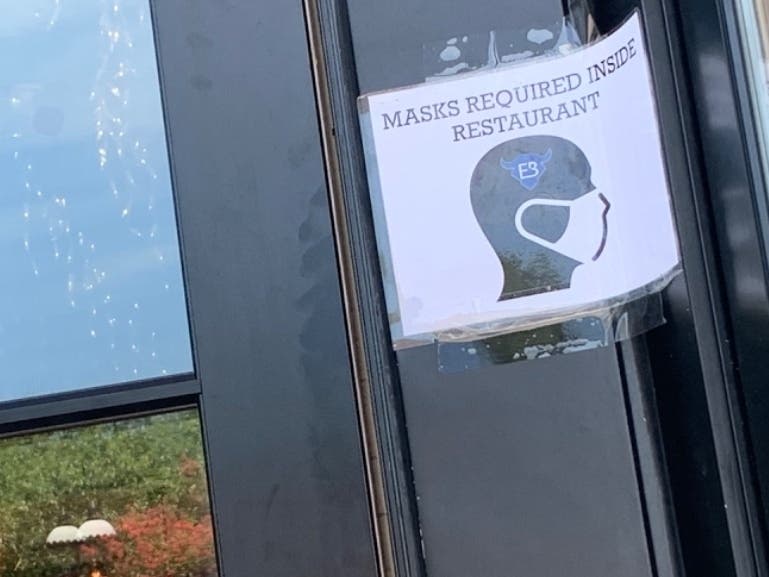
New restrictions are in effect at Baltimore restaurants and bars as of 5 p.m. Friday, Aug. 7. (Elizabeth Janney/Patch)
MARYLAND — The coronavirus positivity rate has declined in several jurisdictions, according to the Maryland Department of Health. However, as the governor and state health officials tout progress, White House Coronavirus Task Force Coordinator Dr. Deborah Birx this week reportedly issued a warning to several cities nationwide, including Baltimore.
"We are concerned that both Baltimore and Atlanta remain at a very high level," Birx said. Portland, Kansas City and Omaha were in similar situations, she added, as well as the Central Valley in California, according to a recording of the call with state and local leaders obtained by the Center for Public Integrity.
In addition to those listed above, Birx urged Boston, Chicago, Detroit and Washington, D.C., to "get on top of" their positivity rates, the Center for Public Integrity reported.
Find out what's happening in Baltimorefor free with the latest updates from Patch.
Baltimore Health Commissioner Dr. Letitia Dzirasa has stated before that there were pockets of the city with higher rates of people testing positive. In the 21224 ZIP code — which includes Canton, Highlandtown and Patterson Park — Dzirasa said in late July the positivity rate had been as high as 22 percent.
Responding to the comments by Birx, the city's health commissioner told The Baltimore Sun: "I have concerns as well." New restrictions around large gatherings were designed to address those, according to Dzirasa.
Find out what's happening in Baltimorefor free with the latest updates from Patch.
Indoor gatherings are limited to 25 people or 25 percent of the capacity of a space, whichever is the lesser, according to an order reopening restaurants issued Friday by Baltimore Mayor "Jack" Young. It decreases dining capacity but allows dining indoors, which was banned two weeks ago.
As of 5 p.m. on Friday, Aug. 7, restaurants could allow indoor dining up to 25 percent capacity. Service must end at 10 p.m. inside, the order says. Buffets are not allowed; customers must all be seated; nobody may be served beverages if they are not also eating; and staff is required to clean and disinfect tables and seating between uses. All staff and patrons must wear face coverings, except when eating or drinking, which is in alignment with the state's order on masking.
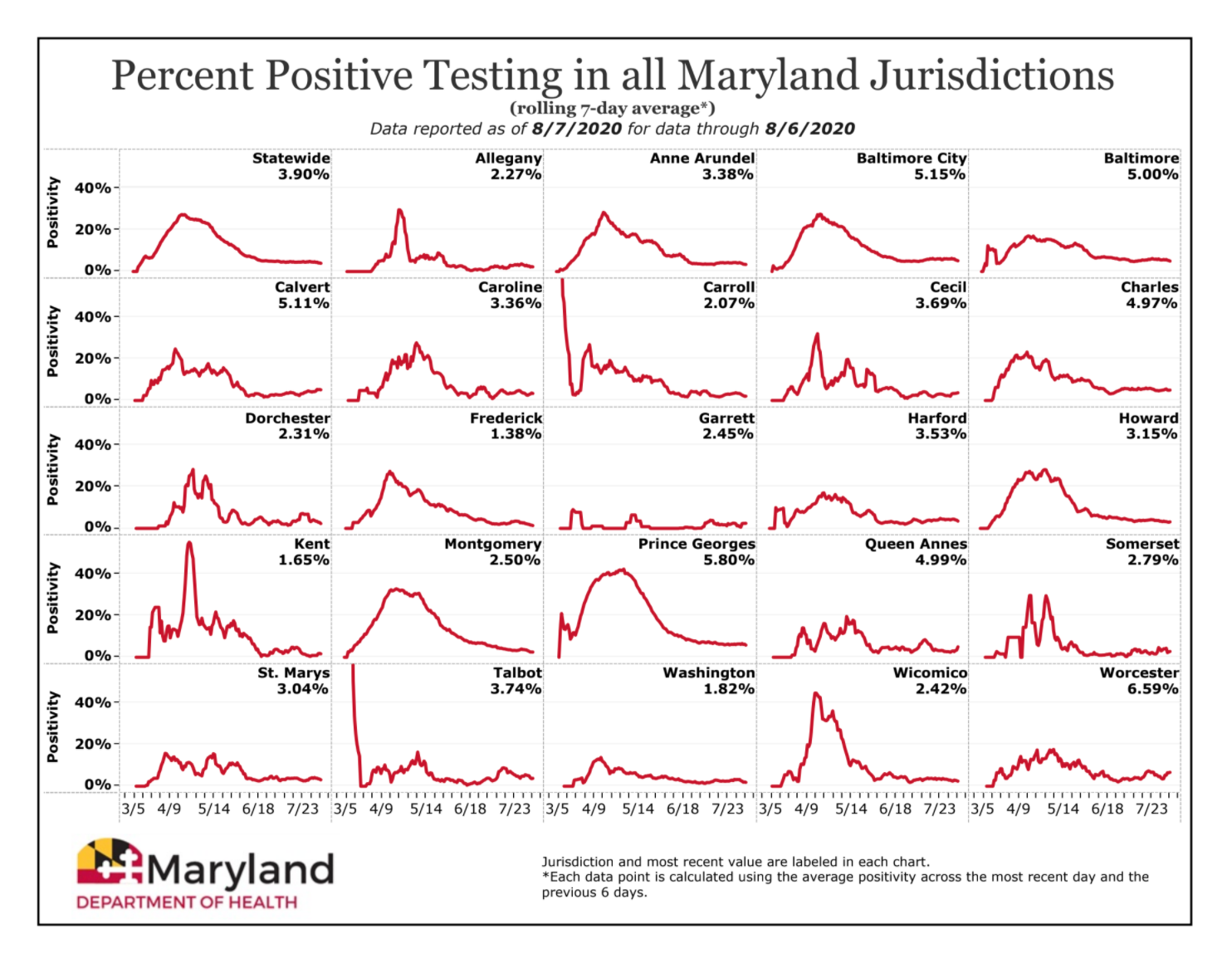
On Friday, Gov. Larry Hogan and the Maryland Department of Health announced progress on several fronts, one week after the statewide mask order took effect. The positivity rate among those under 35 years old is 5.35 percent — meaning it is starting to decline, as Hogan said it was 5.66 percent Wednesday. Meanwhile, those older than 35 are testing positive at a record-law rate of 3.19 percent, according to the governor.
In central Maryland jurisdictions, including Baltimore, he said, positivity rates were going down. For example, Baltimore City was at 5.5 percent positivity Wednesday and 5.15 percent Friday. Baltimore County was at 5.42 percent positivity Wednesday and 5 percent Friday, according to state health data.
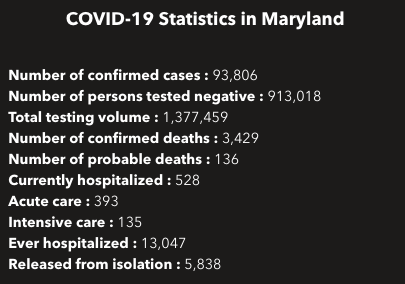
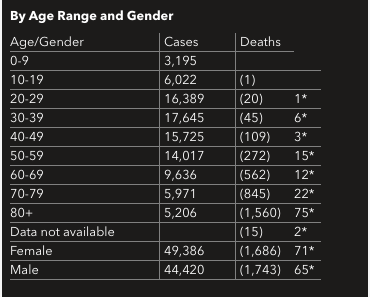
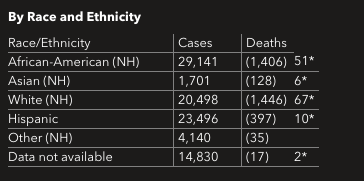
The Maryland Department of Health reported Friday that statewide there were 93,806 confirmed cases of the coronavirus and 3,429 deaths from COVID-19, the disease caused by virus.
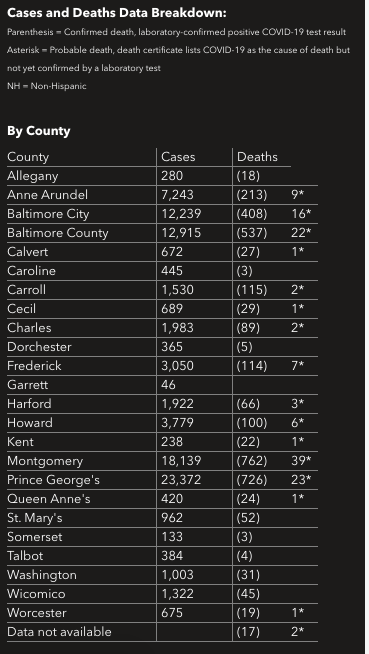
Courtesy of Maryland Department of Health.Courtesy of Maryland Department of Health.Courtesy of Maryland Department of Health.
Maryland Coronavirus Cases By JurisdictionCourtesy of Maryland Department of Health.
Maryland Coronavirus Cases By Age And GenderCourtesy of Maryland Department of Health.
Maryland Coronavirus Cases By Race And Ethnicity
Courtesy of Maryland Department of Health.
Symptoms Of Coronavirus
Contracting the coronavirus can result in mild to severe illness. Older adults and those with underlying medical conditions, such as diabetes or heart or lung disease, are the most at risk of complications from COVID-19, according to the Centers for Disease Control and Prevention.
These symptoms of coronavirus can appear two to 14 days after exposure, according to the Centers for Disease Control and Prevention:
Fever or chills
Cough
Shortness of breath or difficulty breathing
Fatigue
Muscle or body aches
Headache
New loss of taste or smell
Sore throat
Congestion or runny nose
Nausea or vomiting
Diarrhea
Those who have trouble breathing, feel persistent pain or pressure in the chest, experience new confusion, have the inability to wake or stay awake or have bluish lips or face should get medical attention immediately, federal health officials say.
To prevent getting the illness, authorities advise staying away from those who are sick, keeping 6 feet of distance between yourself and others, washing hands with soap and water or hand sanitizer that is at least 60 percent alcohol, cleaning and disinfecting surfaces and wearing a cloth face covering when around others.