Neighbor News
Bethesdan Takes 21 Medals In 14 Events At Maryland Senior Olympics
Kent Watkins earns eligibility for next year's National Senior Olympics in Pittsburgh, praises the MOCO Recreation Department and volunteers
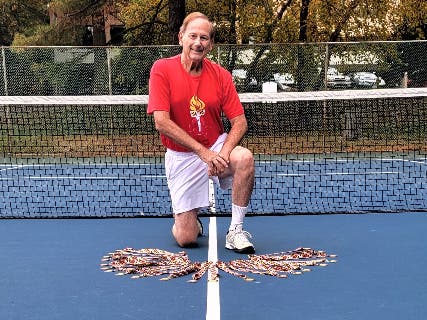

“To Participate is to Win” is the motto of the Maryland Senior Olympics. And for Kent Watkins, a resident of Sumner Village in Bethesda, it was something he took literally. Every other year, the MSOs or MSGs, as they are called, invite entries in different age groups, starting with age fifty, but not until 2018 did Watkins answer the invite, and then it was due to an outside intervention.
As he explained, “I had never heard of this competition, but I entered the tennis singles and doubles, at the invitation of a kind stranger, and the result was a gold medal in each category.” He and his new partner now Annapolis friend, Peter Schanck, traveled to the National Senior Olympics the next year in Albuquerque, New Mexico, and competed there, along with about 6,000 other athletes in many other sports. Then came the plague and the games were suspended until last year, where they were held in Fort Lauderdale. Watkins again had qualified automatically from his 2018 Maryland singles, and he paired with his long-time doubles partner, John Koskinen, of Washington, D.C. to win the gold. He also won the mixed doubles with Edie Ashton, who played out of the McLean, Va. Racquet and Sports Club.
“None of us competed in the nationals,” stated Watkins, “The tennis tournament is not a ranked USTA one, and I wanted to save my time and money for those. Plus, I still work full time, unlike some of my compatriots!” Watkins heads his own urbanist consulting firm, KW+A and is the founder and chairperson of the American Academy of Housing and Communities, an international honorary society of high achievers in that eponymous field. The next national games will be in Pittsburgh in 2023, so Maryland recently held its qualifier round, as did all the other States.
Find out what's happening in Bethesda-Chevy Chasefor free with the latest updates from Patch.
2022 MARYLAND SENIOR QUALIFIER GAMES
“I don’t know when I got the idea to compete in more than tennis,” explained Watkins, “but it occurred after the track and field, swimming, and some other of the 24 total events, so it must have been later in the summer. The Montgomery County Recreation Department runs the MSOs, under the Maryland Senior Olympics Commission (MSOC) for the entire State. Stacy Sigler is the wonderful coordinator, with many volunteers and partnerships, plus spending many voluntary hours of her own, I’m sure.
Find out what's happening in Bethesda-Chevy Chasefor free with the latest updates from Patch.
“In researching the origins, I found that in 1980, the Baltimore County and Maryland State Commissions on Physical Fitness held the first competition. In March of 1998, interested individuals filed a 501(c)(3) exemption for a non-profit with the name, Maryland Senior Olympics Commission Ltd., located in Silver Spring, Its EIN for ‘legal-beagles’ is 52-1993510 and the Classification (NTEE) is Special Olympics (Recreation, Sports, Leisure, Athletics). Its aim is to help those 50 years and over to better stay active and healthy. The marketing brochure further states, ‘Our athletes compete for the love of staying active, the camaraderie of the games and their own personal achievement.’ So, I then decided to cancel an insane registration I had done to bicycle across Iowa (called Ragbraii) and enter a few more MSO events and suddenly, I was competing in table tennis again (as that was one that I had done before), with a lot more after that!”
MSO TABLE TENNIS EVENT
“The table tennis event on July 23, 2022, was held at the Potomac Community Recreation Center next to Little Acorns pre-school where my grandchildren had once attended, fond memories there,” Watkins mused, “You walked in and saw all of these excellent players batting away and you wondered, what am I doing here? I had gotten a 4th place ribbon last time, so I was hoping to do better this time. I had played plenty in my younger days, had a table in my home in Iowa, and more recently played with my daughter and her family at their house in Bethesda, all of whom are excellent players, better than I. This time, I was lucky to receive a bronze medal in the singles and a gold in the doubles with another stranger whom Stacy paired me with on the spot. Thank you, pardner! So, now I was on a roll!”
As Watkins viewed the vast superiority of the strokes of the regulars that day, he remembered his research that the game itself seemed to have originated in England in the late 1890s as an indoor derivative and as a more inclusive alternative to tennis.
Thus, more persons could play socially, as pickleball has done recently. Ping-pong has been credited to several sources, but legally Parker Bros. has trademarked and owned that moniker. “I learned to play with a sandpaper paddle, but now the modern way is to use one with a rubber sheet combined with an underlying sponge layer and pips to enhance the slice stroke and speed of the celluloid ball leaving the paddle. With the tables spread all over the gym of the Community Center, we frequently had to chase the ball to another table area. It became an Olympic sport in 1988 and the ball was slightly enlarged to increase the ball’s air resistance and slow down the game. Other changes in rules since I started playing included: no hiding the ball while serving, reducing the scoring from 21 to 11, and the serve rotation reduced from five points to two.”
MSO BASKETBALL SKILLS EVENT
The rest of the summer and into October, the Games went on at different dates. Watkins had entered basketball skills for Sunday, August 21, at the Meadowbrook Athletic Complex in Ellicott City. Exclaimed Watkins, “I did not try for the 3-man teams, thank goodness, those guys were really fantastic.” Instead, he received three golds in free throws, shooting from a certain spot, and shooting from a number of pre-selected spots. “My playing varsity basketball in high school and now ‘horse’ with my incredibly talented grandson Hayden, who is on the varsity team as a sophomore at Walt Whitman in Bethesda, certainly helped. And the day before, I had practiced free throw shooting at the Middle school across from my daughter’s house. These were not NSGA events, but the bling is fun to have, anyway.”
MSO BOWLING EVENT
Then, it was bowling on August 29 at Bowlero Normandy in Ellicott City. “I used to bowl in the 150 range in college and played – with bumpers – with my grandkids more lately, “smiled Watkins. Still, he managed to win a bronze in singles, with a 144 in one of his three games.
And where did bowling come from? “Glad you asked,” answered Watkins, “in Egypt about 6000 B.C.! I love the historical tidbits like this and others. For example, about 2,000 years ago, in the Roman Empire, a similar game evolved between Roman legionaries entailing the tossing of stone objects as close as possible to other stone objects, which eventually evolved into Italian Bocce, or outdoor bowling. I had entered that MSO event, but was unable to make it, unfortunately.
“And this one is really interesting - around 400 A.D., bowling began in Germany as a religious ritual to cleanse oneself from sin by rolling a rock into a club (kegel) representing the heathen, resulting in bowlers being called keglers. How many persons know the origin of that word? Protestant Reformation founder Martin Luther set the number of pins (which varied from 3 to 17) at nine. He had a bowling lane built next to his home for his children, sometimes rolling a ball himself. On 19 July 1588, English Vice-Admiral Sir Francis Drake allegedly was playing bowls at Plymouth Hoe when the arrival of the Spanish Armada was announced. He replied, ‘We have time enough to finish the game and beat the Spaniards too.’
"And of course, we all have read Washington Irving’s Rip Van Winkle and how he wandered into the Catskills and met the ghosts of the crew of Henry Hudson’s Half-Moon, drank their liquor, and bowled nine-pins with them. He awoke twenty years later to many changes in his village. Every time, I hear thunder, of course, I am reminded of his bowling. Child memories like that are hard to fade away.”
MSO PICKLEBALL EVENT
Watkins continued, “For pickleball singles, which I had never played, but figured my tennis skills would get me by, I showed up on Wednesday, September 7, at the Germantown tennis bubbles that Jack Shore had converted into pickleball courts and was amazed to see over 500 players there. I quickly learned the rules and skills of the game from my first competitor. Thankfully, he was from another State, so my loss didn’t count, and I went on to win a bronze. I’m looking forward to playing more now.” Although it has only a tenth of the number of tennis players nationally, its growth has been exponential, with many tennis professionals adding training to their skill sets. The number of injuries from pickleball has skyrocketed as well, with newbies not using certain muscles that rebel against the sudden overuse. It is now the 4th largest number of injuries seen in emergency rooms. Watkins admitted, “I felt a little the next day, but fortunately, it didn’t linger.”
Pickleball is a very recent invention, 1965, in fact. This is from the USA Pickleball Association website, “After playing golf one Saturday during the summer, Joel Pritchard, a congressman from Washington State and Bill Bell, a successful businessman, returned to Pritchard’s home on Bainbridge Island, WA (near Seattle) to find their families sitting around with nothing to do. The property had an old badminton court so Pritchard and Bell looked for some badminton equipment and could not find a full set of rackets. They improvised and started playing with ping-pong paddles and a perforated plastic ball.
“At first, they placed the net at badminton height of 60 inches and volleyed the ball over the net. As the weekend progressed, the players found that the ball bounced well on the asphalt surface and soon the net was lowered to 36 inches. The following weekend, Barney McCallum was introduced to the game at Pritchard’s home. Soon, the three men created rules, relying heavily on badminton. They kept in mind the original purpose, which was to provide a game that the whole family could play together.” And so, it has evolved, although national and international tournaments, with club players and paid professionals, have begun to emerge. The world champion men’s singles player, Ben Johns, is from Bethesda, Maryland, and formerly a graduate of the University of Maryland.
MSO RACQUETBALL EVENT
On the heels next came racquetball on Thursday, September 8, at the Severna Park Racquetball and Fitness Center. “I drove past Ft. Meade and borrowed a racquet from the friendly desk clerk and played both singles and doubles, winning a bronze and gold, respectively. I found that I didn’t like it as well as squash, as the good players kept trying to hit the ball along the side wall or the back wall and it seemed much harder to retrieve. My newly matched doubles partner was a gentle man, but quite the competitor. I was lucky.”
According to Wikipedia, “Racquetball is a racquet sport and a team sport played with a hollow rubber ball on an indoor or outdoor court. Joseph Sobek invented the modern sport of racquetball in 1950 adding a stringed racquet to paddleball to increase velocity and control. Unlike most racquet sports, such as tennis and badminton, there is no net to hit the ball over, and, unlike squash, no tin (out of bounds area at the bottom of front wall) to hit the ball above. Also, the court's walls, floor, and ceiling are legal playing surfaces, with the exception of certain hinders.”
MSO BADMINTON EVENT
Badminton, held September 10, at the Bauer Drive Community Recreation Center in Aspen Hill, Rockville, was another sport with a net, so Watkins said he figured what did he have to lose – or gain? “I managed to receive a gold medal, but that was a fluke, dependent on my age group participation,” he admitted. Watching some of the other players hit the ‘bird’ (shuttle cock) nearly 100 mph stimulated him to order a set from Amazon to keep over at his daughter’s house for future sports days of the family.
Watkins explained that “The game is named for Badminton, the country estate of the dukes of Beaufort in Gloucestershire, England, where it was first played about 1873. The roots of the sport can be traced to ancient Greece, China, and India. It finally came here about 1929. Since 1992, badminton has been an Olympic sport.”
MSO GOLF EVENT
Then came golf on Monday, September 12 at the Laytonsville, Md., golf course. Watkins said, “there were 18 very long and very short holes, and we barely escaped the rain. I did manage to get a bronze and then two silvers in putting skills and chipping (not NSGA-eligible categories), using five golf clubs from my high school days – #1 wood, 3,7, and 9 irons, and a putter. Others seemed to need 15 clubs, ha! I used them last when I played in a benefit at the Omaha County Club in the 1990s and was put in a foursome by my high school classmate, Woody Howe, then editor of the Omaha World Herald. The other two were the club pro and…Warren Buffett!
“I dedicated the medals to my biological father, Herman Krupinski, whom I discovered through a DNA test several years ago. And found that he was, among other business ventures, a golf touring and club professional! So, that’s where I got those genes, I guess.” I don’t think he was a leftie, however. His photo is in the Fremont, Nebraska, clubhouse, with plaques of all the scholarship winners who benefited from a fund set up by his buddies, when he died unexpectedly.
Krupinski did not learn golf in his country of origin, Poland, but after it was introduced in America about 1650 by the Dutch to Fort Orange (near Albany), NY. Scotland takes the honors for expanding on what apparently started in The Netherlands, Watkins explained. “I like to read about how in the 1261 Middle Dutch manuscript of the Flemish poet Jacob van Maerlant's Boeck Merlijn, mention is made of a ball game "mit ener coluen" (with a colf/kolf [club]). And in 1360, the council of Brussels banned the game of colf: "wie metlven tsolt es om twintich scell' oft op hare overste cleet" (he who plays at colf pays a fine of 20 shillings or his overcoat will be confiscated). Well, if Wikipedia says it, how can Scotland refute it. I am a Wiki editor and will defend a well-documented piece there anytime. Of course, a Scots editor might have the next say.”
THE TENNIS WEEKEND!
The main draw for me was of course the tennis, held at the Olney Recreation Center on September 15-17” Watkins explained. “I had lined up my previous partner Koskinen for the men’s doubles again and a strong player for the mixed doubles, from the Chevy Chase Club, Julie Dahlberg. However, both had warned me that they would not be able to play if the draw happened on the weekend, as they had other more important events to attend. I took my chances that there might be some way – rain, preferably – but it was not to be. I played and won the gold in singles and teamed up with another player, George Vetticad, whose partner cancelled at the last minute, and we won the gold in doubles. I searched for a substitute for Julie, but was not successful, so had to withdraw. Only two out of three categories can be chosen for the nationals, anyway, but it would have been fun to have that dilemma!”
Watkins is no novice when it came to tennis, having started to play when he was nine in his hometown of Sioux City, Iowa, and he subsequently played for the varsity tennis team at the College of William & Mary. Over the years, he played the game, but it wasn’t until he reached his 70s that he began to play in the U.S. Tennis Association (USTA) sanctioned tournaments again. He gained a number one ranking in the Mid-Atlantic region for the 70s, then 75s, 80s, and currently the 85s.
“I always liked to play singles, although I will play doubles when I need to or the right opportunity arises,” Watkins averred. That is mostly when he can play with his daughter, Heather, also of Bethesda. She learned the sport from guess who, but then went on to being coached correctly by such professional teachers as Nancy Ornstein (who lives in my apartment complex, Sumner Village), Jack Shore, and the late Bob Pass. Heather was also on the varsity team at Trinity College in Hartford, Connecticut, and currently is a 5.0 level player for her Mid-Atlantic teams – one of which just won the 5.0 national sectionals tournament in Phoenix, Arizona. When the father-daughter team plays in USTA’s eponymous senior national ‘circuit’ (four a year, each on a different playing surface in a different part of the country), they have risen as high as number two in the national ranking.
MSO SHUFFLEBOARD EVENT
Now the end of the net sports meant some indoor competition, starting with shuffleboard at the Holiday Park Senior Center in Wheaton on Sunday, October 2. “I am not sure that this is an Olympic sport,” joked Watkins, “but it is always fun to do, since my days as a kid in church youth group. However, we did not then use the tall thin sticks issued to us that Sunday and the rules were a bit stricter. Still, I managed to take home the singles gold in my category.
Again, Wikipedia informs the following (with other sources citing a different history): “The full history of shuffleboard is not known. Though there is some knowledge of its development, its actual origins, the place and date where it was first played, remain a mystery. Inevitably, this uncertainty gives rise to some debate, even disagreement, about which country can claim to have invented it. However, there is no dispute concerning its age as a form of popular amusement, and in Europe has a history that goes back over 500 years. The game was played and gambled over by King Henry VIII of England, who prohibited commoners from playing; evidently, he did not always win, as the record of royal expenses for 1532 shows "Paid to Lord William, for he won, by the king's grace, at shovelboard."
“In its goals, form and equipment, shuffleboard shares various features with (and perhaps influences by or upon) many other games, including air hockey, bowls, bocce, curling, croquet, caroms, and billiards. Although it is very popular on cruise ships and retirement homes, its miniaturized tabletop variant in bars and pubs is very popular with the younger generation.”
MSO CORNHOLING EVENT
October 16 at 9 a.m. meant it was cornhole competition at the Schweinhaut Senior Center in Silver Spring. Watkins noted, “As I walked in to receive my assignment, I noticed a photo on the registration desk that featured the last national winner, and he was standing a few feet away explaining the rules for the day. Thankfully, he was in another age bracket, and I was able to obtain my last gold medal.” And no, it is not an Olympic event. Some say it was invented in 14th century Germany. Others credit the Blackhawk tribe of Illinois. Still others point to a Kentucky farmer in the 1800s. Whatever its origins, the game cornhole emerged as a favorite pastime in Cincinnati about 15 years ago and soon spread like wildfire to backyards, beaches, breweries, and campgrounds across the United States. In 2011, the New York Times declared that the Midwest’s favorite game is 'sweeping the Northeast.'
SOME LAST REFLECTIONS BY WATKINS
In conclusion, Watkins wanted to thank the patience and consideration of the volunteers, in addition to Ms. Sigler, and looks beyond Pittsburgh to 2024, when he can start earlier on the sports he missed. “Let’s see,” he mused, “there’s the 100 dash, 440, cross-country, swimming and diving, archery, 5k run, plus all the ones I have entered this year. I can’t wait to learn more sports cultures and communities. I am surprised there are not more multiple entries, although there were some like me, I learned. If they got more medals, then I would like to know – ha! I wish there would be a get-together luncheon before the nationals, like some other States, but I will leave that up to the dedicated workers, who have to endure us for months on end. But, most importantly, let’s all help to get more and more participants into this wonderful activity.”
Watkins summed up the experience by saying, “You know, there are plenty of persons on the ‘streets’ who can most likely beat me. But I say to them, then do it in the field of sanctioned competition like the USTA or NSO worlds. That’s when it counts.” Also, one might conclude with that motto of MSO – TO PARTICIPATE IS TO WIN.