Seasonal & Holidays
Poison, Ecstasy and Razors In Halloween Candy: The Holiday's Biggest Lie
Montgomery County officials offer practical safety tips for Halloween costumers, decorations and trick-or-treating.


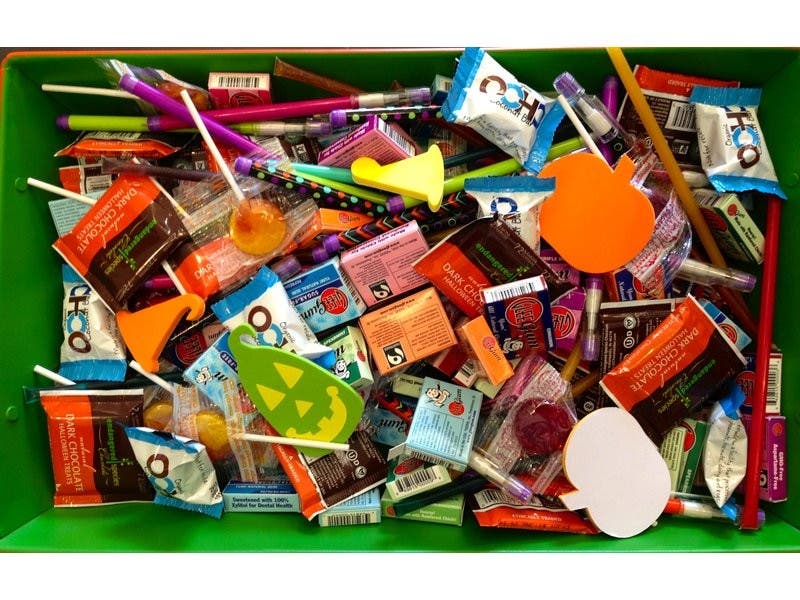
This year’s warning was equally as unlikely as in past years but came from a source you would expect to be reputable.
“If your kids get these for Halloween candy, they ARE NOT CANDY!!!” the Jackson, MS, Police Department warned on Facebook, below a photo of some candy-like pieces shaped like skulls, the nintendo logo and dominos.
“They are the new shapes of ‘Ecstasy’ and can kill kids through overdoses!!!”
Find out what's happening in Bethesda-Chevy Chasefor free with the latest updates from Patch.
True enough. But not as drugs disguised as candy handed out to trick-or-treaters.
Local Authorities Share Halloween Safety Tips
Find out what's happening in Bethesda-Chevy Chasefor free with the latest updates from Patch.
Montgomery County Fire and Rescue Services shared these safety tips for costumes, decorations and trick-or-treating:
- Purchase only those costumes, wigs and props labeled as flame-resistant or retardant. When creating a costume, choose material that won’t easily ignite and avoid billowing or long-trailing features.
- Be sure children know the stop, drop and roll technique in case their clothing catches fire. (Stop immediately, drop to the ground, covering your face with your hands, and roll over and over to extinguish flames.)
- Apply face paint or cosmetics directly to the face. It is safer than a loose-fitting mask that can obstruct a child’s vision. If a mask is worn, be certain it fits securely. Cut the eyeholes large enough for full vision. Make costumes short enough to avoid tripping. Dress children in shoes that fit. Allow children to carry only flexible knives, swords or other props.
- Provide children with lightweight flashlights to carry.
- When planning party decorations, bear in mind that dried flowers and cornstalks are highly flammable. Keep crepe paper and other decorations well away from all heat sources, including light bulbs.
- Let children be the artists and leave the pumpkin carving to adults. Children can draw the face of the jack-o-lantern, but only parents should handle the knives.
- Use flashlights as alternatives to candles or torch lights for decorations. They are much safer for trick-or-treaters, whose costumes may brush against the lighting.
- Use flashlights to illuminate Jack-o-lanterns. If you must use candles, use votives and be sure to place the pumpkin on a sturdy surface away from flammable objects.
- Remove outdoor safety hazards such as toys, bicycles and lawn ornaments. Make sure the driveway and stairs are cleared of leaves, which can be a slipping and falling hazard. Make sure that the driveway and walks are well lit for incoming trick-or-treaters. Replace burned-out or broken light bulbs.
- Before heading out to trick-or-treat, apply reflective wrist bands, tape, and stickers to costumes, bags and sacks and use a flashlight with fresh batteries to see and be seen.
- Children are four times more likely to be hit by a car on Halloween than any other night of the year. Accompany children and remind them to stop at all street corners before crossing, cross only at intersections and crosswalks. Teach them to look left, right and left again before crossing the street and to continue looking both ways as they cross.
- Instruct children never to enter a home or an apartment building unless accompanied by an adult. Restrict trick-or-treating visits to homes with porch or outside lights illuminated.
- Remember to keep exits clear of decorations, ensuring nothing blocks escape routes.
- Instruct children who are attending parties at others’ homes to locate the exits and plan how they would get out in an emergency.
- Set a time for children to return home. Tell children to bring their treats home before eating them. Parents should check treats to ensure that items have not been tampered with and are safely sealed. Be careful with fruit. Inspect the surface closely for punctures or holes and cut it open before allowing a child to eat it.
It seems like every Halloween a story gets around about candy laced with some sort of harmful substance along with a message urging parents to be vigilant lest their children fall prey to an evil scheme.
But is there really anything to worry about?
Experts tracking candy deaths tied to strangers can find no evidence that such acts have taken place.
Digging Into Folklore of Candy Tampering
Dr. Joel Best, a sociology and criminal justice professor at the University of Delaware, has been researching what he calls “Halloween sadism” — the passing of contaminated treats to trick-or-treaters — for 30 years by studying articles in major newspapers dating back to 1958.
The grand total of incidents in which a child was killed or seriously injured by contaminated candy handed out by a stranger during trick-or-treating: a big, fat zero.
“It’s a great thing to worry about, because it happens one day a year,” Best told Patch. “People are imagining this terrible person, who lives down the block, is so crazy that he poisons little children at random. But he’s so tightly wrapped that he only does it one day a year.”
Only there’s no record this person exists.
The Centers for Disease Control and Prevention does not keep statistics on Halloween candy-poisonings, a spokesperson told Patch.
Best isn’t alone in his findings. MedFriendly.com listed several illnesses that initially caused Halloween hysteria but none of those cases were caused by tampered candy obtained via trick-or-treating.
Two Halloween candy deaths are frequently cited. Strangers, though, were not involved.
The first case, in 1970, involved a 5-year-old boy in Detroit who was thought to have died from heroin hidden in his candy. The boy had actually mistakenly found the heroin in a relative’s home. In an attempted cover-up, the family put heroin in the rest of his candy to make it look like an attack.
Four years later, an 8-year-old boy in Texas died from a cyanide-laced Pixie Stix. An investigation revealed that the boy’s dad had intentionally poisoned the candy to claim a $20,000 life insurance payout. The dad was found guilty and later executed.
Otherwise, in three other deaths, the culprit was thought to be Halloween candy but ended up being only coincidental.
There have been two high-profile cases of attempted candy shenanigans by strangers.
A Fremont, California, dentist in 1959 handed out candy-coated laxatives to 16 kids. None were hospitalized, but six got nausea and diarrhea.
In 1964, a Long Island woman handed out arsenic pellets used to treat ants to kids who she thought were too old to be trick-or-treating. No one was injured, but she was still arrested. She told police it was just a joke.
Parents Urged to Be Vigilant
The Consumer Product Safety Commission warns children “not to eat any treats before an adult has carefully examined them for evidence of tampering.”
The evidence and history show that unless you’re trying to poison your kid or have some spare heroin lying around, you’ve got nothing to worry about.
“One of the things this has taught me is humility,” Best said. “You realize that announcing that you have research really doesn’t make much difference. The contemporary legends are harder to kill than werewolves.”
A State Farm study found that on October 31 kids have the highest chance of being hit by a car compared to any other day.
The CDC offers tips: always travel in in groups, make sure kids can see out of their masks and look both ways before crossing the street.
And yes, it does advise to check for tampered treats.
“You’ll see these lists of safety tips that will get published … And there’s always the thing, ‘Inspect all the treats.’ My attitude is, well, you can skip that one.”
Patch’s Deb Belt contributed reporting.
Get more local news delivered straight to your inbox. Sign up for free Patch newsletters and alerts.