Community Corner
May Day: A Brief History Of Maypoles And The Haymarket Massacre
May 1 is a celebration of spring – and a day dedicated to celebrating labor – though usually, not together. Except maybe in Baltimore.

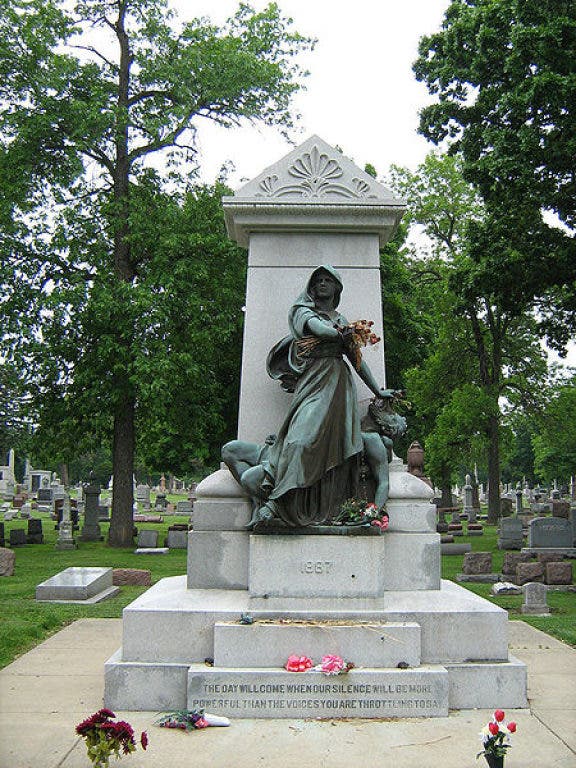


May Day is a funny day. It’s really two distinct holidays, one a celebration of spring and the other a celebration of workers, which happen to fall on the same day, May 1.
The original May Day, a pagan holiday, predating the birth of Jesus, became an important day of celebration for British Isle Druids, Scandinavians and Germanic tribes. It split the year in half, so to be speak, coming exactly six months after Oct. 31-Nov. 1 festival of Samhain, which later, combined with All Saint's Day, got rolled into Halloween.
On May Day, towns and villages traditionally erected a tree-like totem, a maypole, with men, women and children celebrating spring with folk ribbon and circle dancing.
Find out what's happening in Dundalkfor free with the latest updates from Patch.
The May Day celebration, naturally, was brought to America with the earliest European settlers. Customs varied from country to country, but in some places people made May Day baskets filled with flowers, leaving them on a neighbor’s doorstep. According to the legends, if a person was caught placing a May Day basket in front of a home, then a kiss was to be exchanged.
In the U.S., Americans have a somewhat ambivalent feeling about May Day and maypole dancing. In some places, like the Mission District in San Francisco and Minneapolis, festivals, music and dancing around the maypole remain annual celebrations. In other places, the tradition goes by hardly noticed.
Find out what's happening in Dundalkfor free with the latest updates from Patch.
Different as night and day, the other May Day is the May 1 celebration of International Workers Day in countries around the world. Specifically, it is the commemoration of the May 1, 1886 rallies by U.S. labor unions declaring a general strike in support of a standard eight-hour workday.
Those demonstrations in Chicago continued on May 4, which later became known as the Haymarket Massacre, when Chicago police fired on workers. Eight striking workers were killed and dozens of others wounded during , according to "The Lexicon of Labor," by R. Emmett Murray.
The Chicago police were responding to an explosive device thrown in their direction by an unknown individual Afterwards, eight anarchists were tried for murder. Four men were convicted and hanged, and one committed suicide in prison, although none of the defendants were actually charged with tossing the bomb.
The strike, shootings and subsequent trial became a seminal event in U.S. labor history and is widely considered the genesis of International Workers Day celebrated May 1. Worker demonstrations today include a rally in New York City’s Foley Square, organized by local unions protesting attacks on public employees, threats on jobs from overseas outsourcing, and the exploitation of immigrant labor.
In Baltimore, Mark Reutter, journalist and author of "Making Steel: Sparrows Point and the Rise and Ruin of American Industrial Might," will lead the fourth annual May Day Roll, a bicycle tour of local factories and shipyards. The event begins at the employee-owned Baltimore Bicycle Works.
Come to think of it, Reutter might be on to something. Maybe spring and worker celebrations should go together.
Get more local news delivered straight to your inbox. Sign up for free Patch newsletters and alerts.