Arts & Entertainment
A Portrait of the Artist: Eric Celarier
Eric Celarier's hand-stitched multimedia circuit board quilts span across space, time and recent computing history.
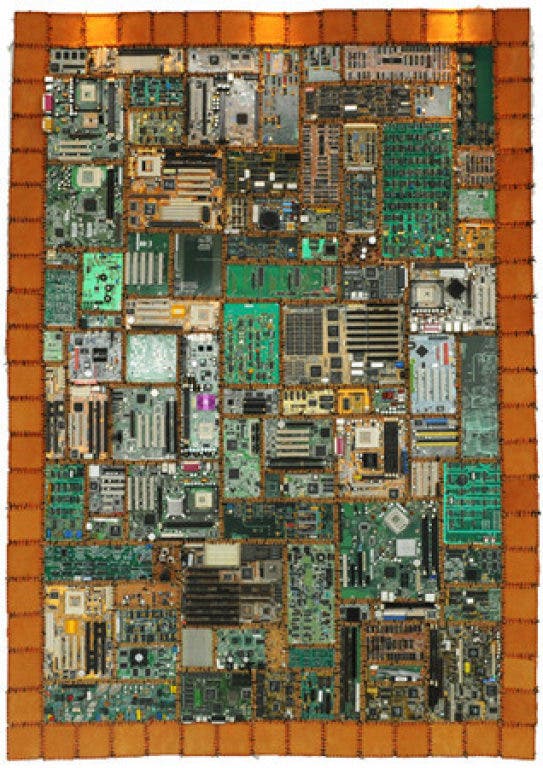





Eric Celarier builds durable yet flexible circuit board quilts that combine a postmodern machine aesthetic with hand-crafted leather binding. Reusing computer and audio-visual equipment circuits, he has perfected the art of cutting, binding and framing them into both large- and small-scale formats.
"It has taken me four years to refine my working process. I've tried different materials and cutting tools, and now I know what works best," said Celarier who won the James Renwick Alliance Craft Award of Distinction at the 2009 Artomatic, held annually in Washington, D.C.
Part of a series titled "Wasteland," Celarier's quilts provide a window into a densely textured, multicolor gridded pattern woven as a macrocosmic patchwork. The perceptual mechanism works both ways, however; each individual circuit tile is a self-contained microcosm that can be closely examined individually.
"At the moment, I am working on a mural-size piece," said Celarier. "People have told me that my quilts simulate the experience of flying over a metropolitan area and seeing the industrial framework below."
Providing an immersive experience, Celarier's quilts function both as environments and hand-crafted objects. The Williamsport-based Freedom Recycling company supplies him with the computer parts, and he creates a permanent repository for what would otherwise be throw-away or recycled material. Sometimes he also receives circuit boards from individuals looking for an adaptive reuse of their outdated technology.
"Planned obsolescence is a big issue these days. My quilts end up integrating older computer boards with newer ones."
Not only are Celarier's quilts akin to cityscapes or microscopic cellular organisms in a petri dish, but they also draw from a wealth of contemporary art references in their conception.
Eric Celarier received a B.A. in Art Education and a Bachelor of Fine Arts degree from the University of Maryland in 1991. He taught art at Duval High School in Prince George's County for four years and then moved to Ohio to attend the University of Cincinnati for his Master of Fine Arts degree.
Focusing on drawing and sculpture, Celarier demonstrated a predilection for detail and texture in any medium since his days as a student. He started building creatures for his Alternative Evolution series, which explored ways to piece together obsolete technology and flexible materials into reconstructed and reconstituted models of a post-industrial biological organism. These Wierdly Evolved Creatures were the artist's foray into art that breathes new life into salvaged materials.
Some of his influences include the minimalist grids of Piet Mondrian, the abstract pattern-based paintings of Tomma Abts, Lee Bontecou's multimedia organicist sculptures, Alexis Rockman's future landscapes, and Nancy Rubins's public art installations, which reuse common objects to create new, unfamiliar formworks operating at a monumental scale.
"Repetition is a very important aspect of conceptual abstract art. I've always thought there was something to it," said Celarier who is always looking at new ways to build things and make disparate parts fit together into larger systems.
Currently working as an elementary school art teacher at Mill Creek Towne Elementary School in Derwood, Celarier has worked as a graphic and web designer in the past. Multimedia systems thinking has always been a part of his professional life.
He has shown his work at Artomatic in Washington, D.C., Flik Interactive online, Alvear Studio and Mark's Kitchen in Takoma Park.
To learn more about Eric Celarier, visit his websites:
http://celarier.com/
http://alternativeevolution.com/