Arts & Entertainment
A Portrait of the Artist: Michael Irvine
Michael Irvine's coding hand translates into polychromatic wave patterns that capture difficult transitions in the digital medium.


In his 1793 essay "On Newton's Hypothesis of Diverse Refrangibility," the German Romantic poet Wolfgang von Goethe formulated his stance that color is perceived by a human subject at the intersections of light and shadow, contradicting Sir Isaac Newton's theory that light is composed of individual colors and that darkness is the absence of light.
Unlike Newton's, Goethe's color wheel is symmetric, posits complementary colors in opposition to one another and makes room for the full range of warm and cool color spectra produced by light/dark boundary conditions.
A pioneer of a color theory based on human experience rather than pure physics, Goethe inspired many artists to take into account how the eye sees when rendering color relationships.
One of these artists is Michael Irvine:
"Goethe's empirical observations on color have been extremely useful in working out ways to construct color palettes for my images. His ideas about the effects of contrasting colors from different positions in color space are especially appealing as they are very easy to quantify and, thus, to code."
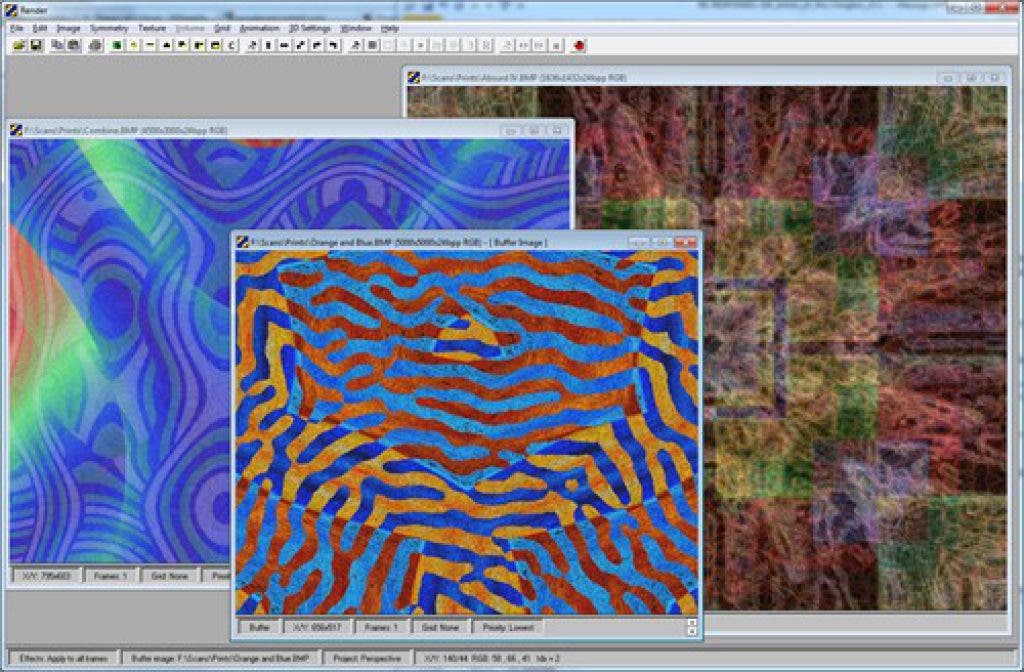
Irvine applies concepts like abstraction, emergence and iteration to his artwork, but in his case, they are not just concepts. Using the programming language C, he writes his own software, which provides him with the back-end functions and Graphic User Interface to manipulate images - much like Photoshop.
"In my software, a simple filter might traverse an image and examine every pixel and its neighboring pixels. Then, based upon a property or relationship derived from the RGB of the pixels, it might make a change to the pixel. I have written hundreds of these filters. They all look for different things and make different changes. Furthermore, each of these filters can be combined with other filters to create new filters, which, in turn, can be used in combinations," explained Irvine.
His digital images are symbolic of emotional states, making use of color relationships to evoke transitions in thought patterns. "Breakthrough IV" reflects the process by which understanding emerges from confusion, and "Frustration III" uses divergent waves to simulate losing one's train of thought, said the artist.
"My artwork is a celebration of abstraction and the complexity and emergence it yields," he said.
Originally from Ottawa, Canada, Irvine moved to the Washington, DC - area when he was six and eventually attended the University of Maryland where he studied Computer Science.
"My first significant brush with the formal art world came through an art history class I took as an elective," said Irvine. "I was fascinated in particular by the Impressionists and spent a great deal of time looking at paintings from artists like Paul Signac, Georges Seurat, and Claude Monet and trying to come up with ways to get the computer to make convincing simulations of their brush strokes."
Irvine left the University of Maryland without completing his degree to work as a programmer for Silver Spring-based Apollo Optics & Kinematics, Inc. There he worked with Jesse Bunch, husband to Sonia Bunch, his current art liasion and representative of Irvine's digital gallery, RingWave™ Gallery.
"Jesse was a fascinating guy and we’d spend hours discussing philosophy and physics when I wasn’t busy coding. Although the artist in me remained latent over these years the conversations Jesse and I had, and the ideas that we discussed, would later form the foundation for what I wanted to express through my artwork," recalls Irvine.
In the early 1990s, Irvine moved west to attend Evergreen State College in Olympia, Washington. The school's interdisciplinary approach united his background in computer science with his interest in visual art and encouraged him to develop his own style.
After graduating, the artist went on to work for Microsoft as a programmer, but his arts training led him to start his own creative company with a partner.
"Synthesoft had the first fully integrated media player, spectrum analyzer, and visualization system for Windows. It became popular in part because it was first, but it also received very good reviews. It got a lot of use in clubs and raves. The software is pretty dated now – once the big players get into the fray, it’s hard to match them feature for feature in a media player," said Irvine who is still working on updating the visualizations to make them compatible with any media player.
Fluent in the art of abstraction, whether he is writing code or imagining its visual confluence, Irvine works from photographs he has taken himself, existing artwork, modeling software he writes himself and wave functions in C.
His abstraction of Hieronymous Bosch's "Garden of Earthly Delights" uses complex geometry to convey the transition into damnation, said Irvine.
In an ideal situation, he would present his work on a high-resolution screen, but for now he uses Vivyx Printing out of Denver, Colorado for large photo prints.
"I was attracted to Mike's art because of its power," said his Art Liasion Sonia Bunch who specializes in marketing and sales. "I was not necessarily looking to pick up a digital artist. When I saw his work, I was both humbled and mesmerized."
Irvine has been published in Desktop Video World and had a digital exhibition at the The ShadowMoon Creative Arts Center & Cybernetic Gallery™ in the mid-90s. He was a member of SIGGRAPH during the 1990s, and is owner of RingWave™ Gallery and Synthesoft.
His sister, Kerri Irvine has also had a profound influence on his work. With a fine arts background, she has provided invaluable input on layering and blending techniques, said the artist.