Neighbor News
Dear Montgomery County: Please inspect HOA-owned trees on request
If a tree threatens a nearby house, could a homeowner get a little (expert) help compelling an HOA to ensure public safety? (Chapter 42)



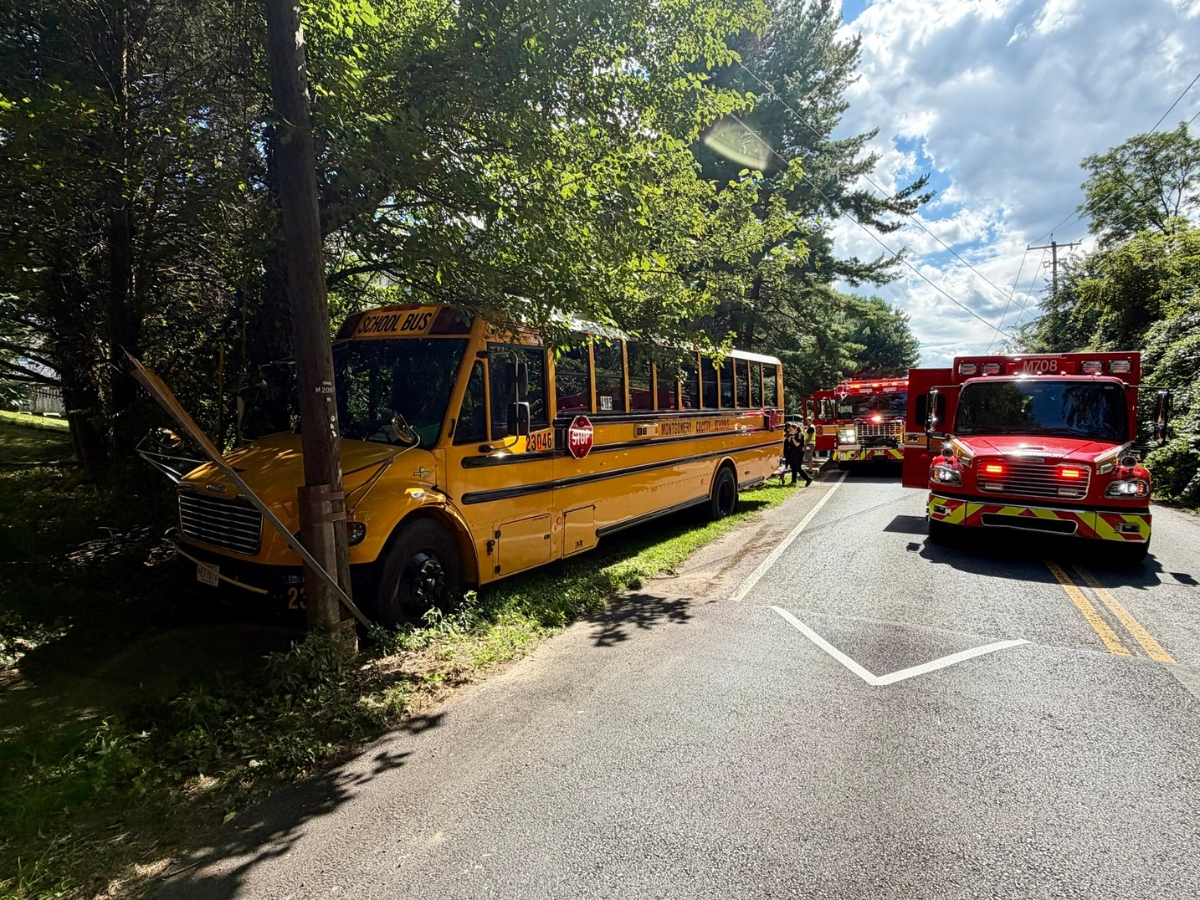
UPDATE 8/8/2022: The HOA has had a tree company survey all of the trees on the common-ownership property and identify hazardous trees that need removal. This looks like progress. We are hoping this new list of targeted trees overlaps 100% with the (shorter) list of trees that residents have expressed concerns about, such as those described here. Stay tuned. –S.L.
AN OPEN LETTER TO COUNTY OFFICIALS
TO: Montgomery County Planning, Housing, and Economic Development Committee (PHED) members Hans Riemer (chair), Andrew Friedson, and Will Jawando; Transportation and Environment Committee (T&E) members Tom Hucker (chair), Evan Glass, and Hans Riemer; County Executive Marc Elrich and other county councilors; MoCo Department of Transportation (DOT) Director Chris Conklin; MoCo Department of Environmental Protection Acting Director Adriana Hochberg. cc: District 39 state delegates Lesley Lopez; Gabriel Acevero; and Kirill Reznik
Officials & other readers are invited to comment using the REPLY feature at the end of the article.
Find out what's happening in Gaithersburgfor free with the latest updates from Patch.
Dear County Officials,
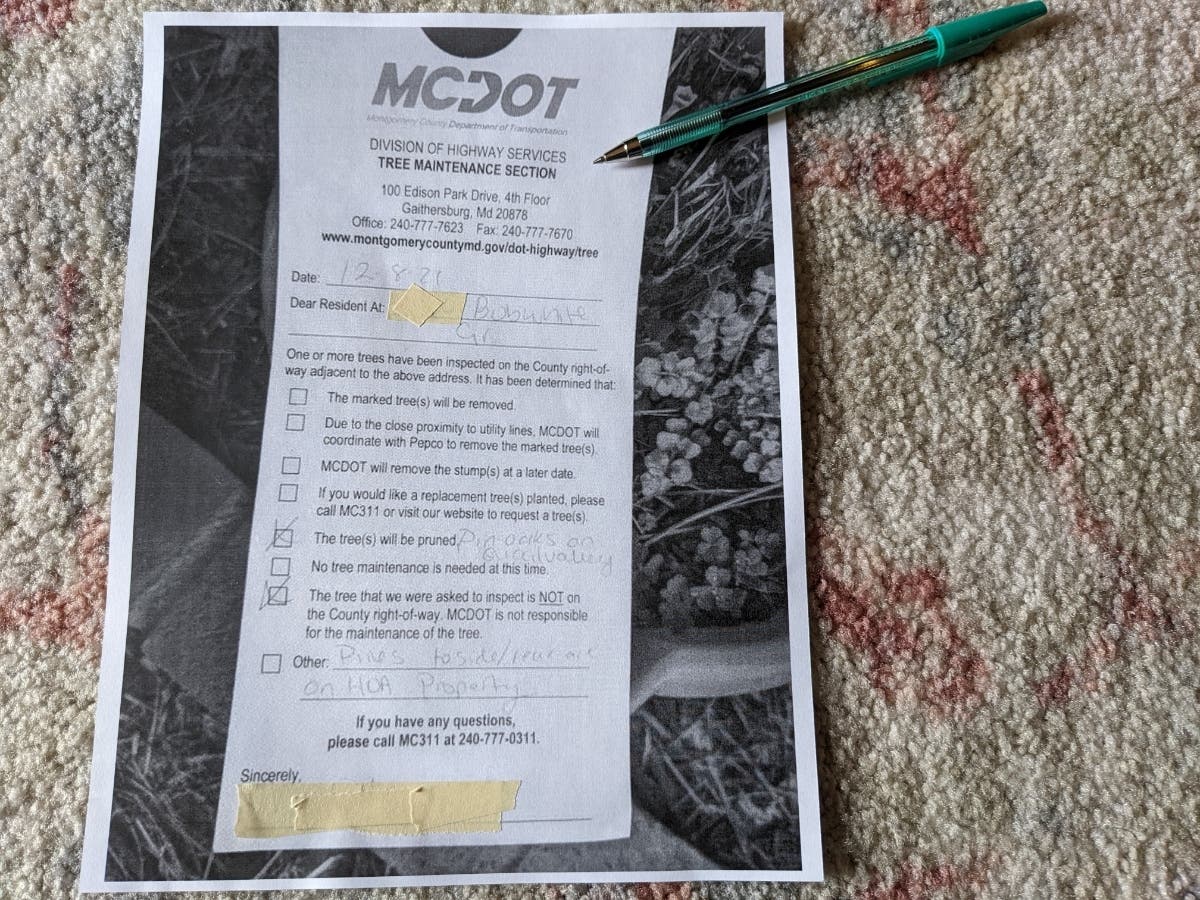
We, the residents, need our county government to provide facts. Recently, a county professional, an ISA-certified arborist, looked at a potentially hazardous white pine tree, and then checked boxes on a card (photo 1) informing the homeowner that the tree belongs to our HOA. The homeowner already knew that fact from the online GIS map, and from the owner's property plat.
It seems a waste of time for a county professional, an ISA-certified arborist, to drive to Quail Valley, check a couple of boxes on a form, and then fail to provide what we really need–a real inspection of the tree. (Note 1, re DOT and DEP.) We need a rating from the four-point "ISA Basic Tree Risk Assessment," which reveals whether there is low, moderate, high, or extreme risk of tree failure and/or property damage.
Find out what's happening in Gaithersburgfor free with the latest updates from Patch.
Several of my neighbors, living in the shadows of elderly, giant trees, have expressed concern for their family's safety. They believe they are endangered by some of these huge, 30-year-old white pine trees, many of which are owned by our HOA. White pines have a record (generally, and in this neighborhood) of splitting, breaking, and uprooting. (See photos 2-4 and six previous blogs in this series). An arborist recently had this to say about one tree upon briefly studying my photos of it: "Yes, it's a problem." So please bear with us as we make the case for stepping up the county's involvement in public safety and environmental management. Too often, as is the case now, these issues end up as a dispute between residents and their own HOA, with the negligent HOA holding all the power cards ... while withholding needed services from the dues-paying residents. (Note 2, re OCOC.) Something has to change.
What we need (at a minimum) is for the county's expert, the arborist, who is already on location that day, to inspect the tree and provide the Montgomery County resident (and the HOA) with a completed ISA report form. We need that to happen any time a resident calls to ask about the health and stability of a tree, 20 feet in height or more (per state code), when their home, fence, or car is within the fall line of that tree.
Despite repeated pleas from residents, despite incidents of serious damage to homes caused by trees, and despite six previous blogs (posted in this series) reporting details of this urgent problem in Quail Valley, our HOA refuses to remove specific HOA-owned trees; or to offer a schedule of when a tree might be taken down; or to provide (on its own dime) an arborist's written evaluation of specific trees of concern to homeowners. Instead, we get obfuscation. Inaction. (Note 3)
Very strangely, our HOA neglected to remove these trees this winter while it had all the heavy equipment on location. The HOA removed a dozen other huge white pine trees nearby as part of a $27,350 tree maintenance project. (Note 4 re. $$) Yet trees next to houses on either end of Bobwhite Circle (photos 2-4) were left standing. We are mystified by the HOA board's inaction and lack of transparency on this issue. Is there a plan somewhere? Did an arborist sign off on such a plan? Can we see it?
Despite collecting more than $600,000 annually in dues (HOA assessments) from 592 home owners, our HOA continues to ignore its duty to "promote the health, safety, and welfare of the residents" in this matter ("Purpose and Powers," Article IV, Articles of Incorporation). Does each resident, one by one, need to pay $60 or $70 to hire an arborist, then initiate a prolonged fight to protect their home from a hazard that the HOA created? What is the HOA for? In this matter, the residents would get better service without the HOA. They would be safer if the county managed the community's trees.
Why is the county hiring a highly trained arborist to perform the elementary task of looking at boundary lines? Please give them a more meaningful task.
This is a widespread issue. All across Montgomery County, HOA communities built in the 1970s and 1980s are watching their "cute little white pines" and Bradford pear trees reach their (often dangerous) maturity. The hazards and costs increase with each year. Now is the moment to describe the problem, face up to our shared responsibilities, and make a decision. It would be easy to wrangle, for two or three years, over who ought to be doing what. The tottering trees won't wait.
Here is our Ask: Could the county act here–not as a mediator–but simply as a fact-finding agent? The residents are hoping you can step up to the plate, quickly, and turn the visit by its arborist into a real tree inspection when the safety of a tree is in question. In this way, the county could provide some important facts on the ground, for all who ought to be concerned, and promote public safety. Quick action by the county executive, the council, or department head might achieve this goal.
Alternatively, in the cause of public safety, the council could pass a law requiring HOAs to act quickly and foot the bill for an inspection of a tree. The HOA should obtain and share with the public an ISA Tree Risk Assessment within 30 days after any resident requests that an HOA-owned tree 20 feet or higher be inspected. Then, within 30 days of receiving the arborist's report, if any HOA-owned tree is deemed to be of "high or extreme risk" of tree failure and/or property damage, then the HOA must remove it.
Thank you for your concern in this matter. --- Steven S. Lapham
NOTES
1) In this county, the management of trees usually involves the Department of Transportation (see the form in photo 1) and/or the Department of Environmental Protection (DEP).
2) My disappointing experience with the OCOC is described here. Other neighbors have had similar experiences. Imagining that the OCOC is empowered to address an issue like this would be disingenuous. Their track record shows otherwise. And, in all fairness, it would not be realistic to ask that agency (which focuses on mediation) to act quickly in this technical matter.
3) It seems that HOAs often hire "tree-care companies" for this or that task, but rarely hire a true ISA/LTE arborist to advise them (i.e., a professional with both an International Society of Arborists certification and a Maryland State Licensed Tree Expert certification). That is unfortunate, as residents live with the resulting errors for years or decades. A recent Washington Post article advocated that communities develop 30-year plans, under an arborist's advisement. The planting of dozens of cute little white pine trees on common land 30-or-so years ago was one huge mistake. A smaller example is shown, in photo 5: an evergreen tree that was once a cute little "bush," now gets an annual, ugly pruning so that its lower branches don't block the sidewalk. The HOA planted that tree in that prominent location perhaps a decade ago. The tree is now slated to be removed and chipped. Suggestion: Let's just relocate this otherwise healthy tree to a better spot, and let it fill out to its mature shape where there's room for it to grow.
4) For 2005-2020, QV HOA spent $368,000 dealing with tree removal, equal to about $23,000 per year. As I suggest here and in earlier article, a healthy slice of this money is wasted because work on trees is apparently not supervised by an actual arborist. Points in proof: there is no community reforestry plan. Limbs are trimmed in 2019, and then the very same trees are felled in 2021; that's called busywork. There is no plan. Why would the HOA spend these amounts and not address the top concerns of the residents themselves?
5) Here are the hyperlinks from above, spelled out:
* DEP Tree Services, https://www.montgomerycountymd...
* DOT Tree Program, https://www.montgomerycountymd...
* ISA Tree Risk Assessment Form: http://manoa.hawaii.edu/landsc...
* Bradford pear trees, https://www.washingtonpost.com...
* Blogs in the series "Living on Cuckoo Court": http://tinyurl.com/CuckooCourt
* OCOC can be less than helpful, https://patch.com/maryland/gai...
* Washington Post article on trees is cited in https://patch.com/maryland/gai...
** ****************** **
Steven Sellers Lapham is a 21-year resident of Quail Valley. He is not an LTE. He can be reached at MuskratMusic@gmail.com. The "Living on Cuckoo Court" collection of essays is on Patch.com. Read about the nationwide problem of "HOA corruption, dysfunction, and abuse" at Independent American Communities.