Neighbor News
Donation Nation Inc. : The Gini Coefficient
Income Inequality must be addressed both nationally and regionally if we are to reduce poverty and increase the standard of living for all.


In 1912, an Italian statistician named Corrado Gini developed a statistical measure of distribution, an algorithm that till this day is used to evaluate and calculate income distribution (income inequalities amongst nations and regions). From 0-1, zero being equal distribution, and one being 100% inequality. The goal being, to get as close to 0 as possible.[i]
Out of everything that capitalism does right, from product diversity, low prices to making a ton of money, the Gini index tells a different story, a story of capitalism’s fatal flaw. What I am talking about is income inequality, greed and the consolidation of wealth at the top; what I am talking about is a lack of even distribution of resources, both regionally and nationally, increases in poverty and a fading middle class.
You see, competition drives down prices, causing overhead (necessary costs of running a business) to be reduced drastically to increase profit margins and be competitive; it is why manufacturing jobs get exported overseas, and why wages have stayed flat over time; American’s love cheap products. However, within our economic system, there is a wage paradox; market shares demand cheap products because of the markets limited buying power; the less you earn, the less you can buy, and the demand for affordable products increases. There is a reason why the United States imports so many products from China; they flood the market with cheap products because we demand it; our current wages do not support an increase in the price of goods.
Find out what's happening in Gaithersburgfor free with the latest updates from Patch.
The Gini index rating gives us a statistical measure; it does not describe how or why, but it gives us a starting point within an investigation of how our economic system is functioning; a starting point of understanding why poverty has increased and why our middle class has dwindled. We need to care about this number.
A comparative study involving ten countries called “Income Inequality,” done by the Stanford Center on Poverty, and authored by Jonathan Fisher and Timothy M. Smeeding, sheds light into the historical data of an increase in U.S. income inequality.
Find out what's happening in Gaithersburgfor free with the latest updates from Patch.
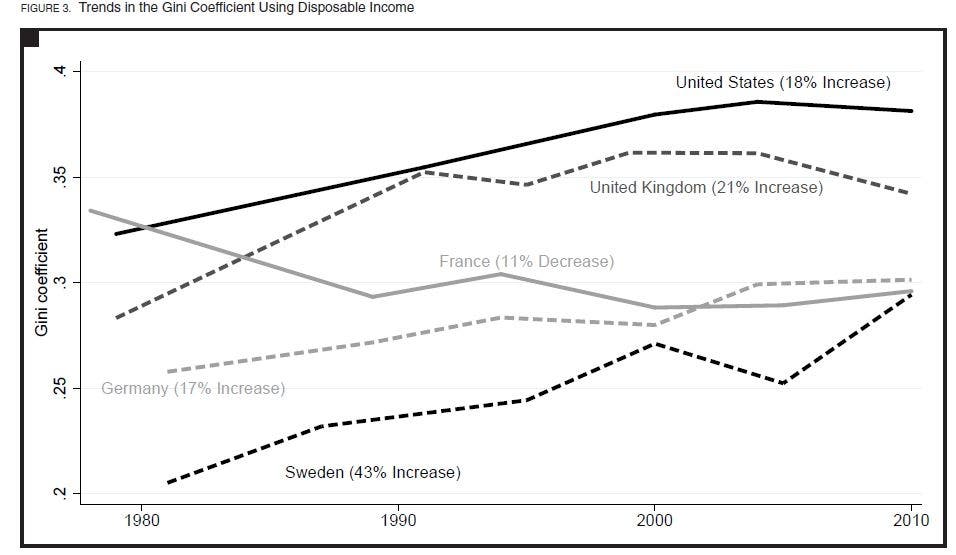
According Jonathan Fisher and Timothy M. Smeeding, as of 2010, the United States controls the title for the highest rate of income inequality among ten other modern “welfare states” (countries that have high social safety net expenditures). If you look at figure one, for the past 30 years, The United States commands an 18% increase within its Gini Index Rating. While the United States is not the only country that exhibits increases, they do have the highest level/rate of income inequality.[ii]
Now, Income inequality is a natural consequence of markets, but the real story is the ups and downs within the other countries scores, their behaviors are not like the United States where it shows constant inequality growth; proof that fiscal austerity does not work! The conclusion then must be that while income inequality is natural, the rate of which a countries redistribution of market revenues do not have to increase infinitely! High levels of income inequality do not have to be the norm; reductions in income inequality can stem from public policy changes, as we have seen the fluctuation of income inequality among “welfare-states” Gini indexes.
For the past 30 years, the United States has chased an economic theory that suggests that minimal government involvement will allow companies to have more money to hire more individuals, thus expanding the taxable base. The Gini Index rating has time and time again proven this theory false. If fiscal austerity was functioning how it is theorized, the United States should not hold the heavy weight belt of the highest rate of income inequality among modernized countries.
The Gini index tells us a different story about our failed neo-liberalist economic policies (trickle-down economics, a top to bottom distribution model). If we examine minimum wage over 30 years, we will see that wages have not increased, even while productivity and profits have soared; there is a reason why the top 1 percentile of earners hold more wealth than the bottom 90% combined; the wealth has not, and will not trickle down. Yes, we can contribute technology to the increased productivity, but wages across the board have stayed flat, while profits have soared, few have gathered the growth in revenue; this is not sustainable.
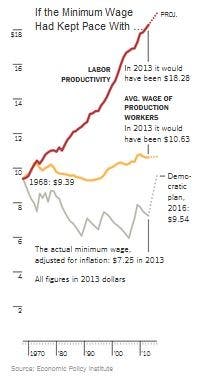
The Consumer Price Index (CPI) which measures buying power shows the real story of the effects of low wages and purchasing power over a 30-year term. If we investigate the CPI over a 36 year period, while adding inflation, 10.00 an hour in the 1980’s was worth approximately $31.49 cents in purchasing power. In essence, if you were to take your DeLorean, hit 88 miles power and travel back in time with 10 dollars in your pocket, you would have $31.49 cents in 1980; welcome to inflation, the reduction in value/buying power of a dollar over time. In 1980, the minimum wage was 3.10 cents, sounds a lot less than the current minimum wage of $7.25, right? Wrong. In 1980, $3.10 cents was worth $9.76 cents; you had more buying power in the 1980’s than you currently do. If we were to analyze the correlation between productivity and pay and kept an average pace, our minimum wage as of 2017, should be $18.26.[iii] According to the New York Times editorial “The Case for a Higher Minimum Wage,” states that if we raised the minimum wage to just $10.10, 27.8 million people with an average age of 35 would earn more money, and would raise 4.6 million people out of poverty.
It should be acknowledged that wage disparities are not the sole indicator or sole proprietor of variables that increase the Gini Coefficient; meaning there are other variables (issues) that can increase the Gini Coefficient, like education equability, the role of technology, or deunionization and globalization, among others. All of which, are factors that can and will increase the equability of how income is redistributed. Lack of education equality inhibits a person(s) ability to compete within the market, Technology replaces manual labor, deunionization reduces the power of an employee to negotiate pay, and globalization cuts pay for work.
Why do we care? When I speak of building a sustainable green community, pay equity and reducing income inequality is a part of that equation. Let's take a closer look at Montgomery County, Maryland’s Gini index.
Montgomery County Maryland is one of the most affluent communities in the United States, with a median income of $98,917, with just over a million residents within the confines of its borders. Things look pretty good for our region, but perhaps it is an illusion. When measuring our area’s economic redistribution, our Gini index rating is 47.0, just one point lower than the national score. If we look at the other variables that can increase the Gini Index, we see the importance of raising wages.
Montgomery Counties’ high school graduation rate is at 89.9 percent, 58.0% have bachelors or higher; unemployment is at 3.3%. However, what exactly does this mean? It means that when we compare Montgomery County to National averages; Montgomery County has lower statistics in every variable that are known to increase the Gini coefficient rate, but share almost identical Gini index scores when compared to the national averages which are affected by all other variables. Thus, the conclusion must be that the Gini Index rating of 47, must be contributed to low wages. [iv]
As for causation, this explains why our region's poverty rate is at 7.5 percent. You see, when living in an area with high-income inequality, rates of poverty will increase, the middle class will dwindle, and those living just slightly over the federal poverty line will perhaps struggle the most (they cannot get government assistance). However, why is this? Poverty happens when a society is not distributing its resources evenly, and income inequality is when you are not dispersing income equitably, it is a cause and effect relationship, a symbiotic relationship that only has one outcome, the rise of poverty.
You see, it does not matter if you are employed making 7.00 an hour, and it does not matter if you are making 10 dollars an hour, if the cost of living demands 15.00- 20.00 an hour, you will be in poverty. Even if you earned 10.10 dollars an hour and worked full time at 40 hours a week in Montgomery County, you would make $1,616 a month, just $19,392 a year(pre tax); Montgomery Counties average rent alone is $1616.00; wages matter; good paying jobs matter.
Think of unequal resource distribution like this; you have ten people picking apples, they select a total of 10 apples from the tree. Income inequality makes it so that the redistribution of the apples looks like this: 1 person takes nine apples, while the other nine people share just one apple; a lack of redistribution of resources. In consequence, 9 out of 10 people will still be hungry and still be food insecure. Perhaps this is a very simplistic example, but it gets to the fundamental aspect of the lack of resource dispersion. Instead of apples, we are talking about market revenues; we are talking about money not being distributed evenly, causing a lack of buying power to match inflation.
Here is the kicker, while corporations and businesses continue to have low wages, we all pay for the gap between the cost of living and pay. If a company pays employees 10 dollars an hour, but the cost of living demands 15.00, we all pay into a system that closes that five dollar gap; it is called taxes. Tax dollars are spent on social safety net programs like Medicare, Medicaid, Food Stamps, and Rent Control to help feed, provide shelter and provide health care for those in poverty.
While companies like Walmart keep low wages to decrease the cost of goods, we pay the gap within Walmarts wages; it is a tax subsidy. If you are one of those people who care about our national deficit, decreasing poverty through decreasing income inequality should be priority number one. How much money would we save each year if we reduced poverty and decreased the demand for safety net programs? Reducing poverty will increase your taxable base, increase government revenues through taxation, and open up market shares of people who will now have an increase in buying power; building an economy from the bottom up. The Irony is that the benefits of growth from the bottom up have the same advantages that trickle down economics once promised, but did not provide. While this economic analysis may seem gloomy, there is a shining point to it; Montgomery County has already acknowledged our Gini index rating and has increased our minimum wage, but we have to do more!
On January 1, 2016, the minimum wage in Montgomery County was risen to $10.75 an hour, with a gradual increase to $11.10 that started this year. However, as of one day ago, Montgomery County vetoed a bill that would further raise the minimum wage to 15.00 an hour by at least 2020; the same gradual rise in wages that we saw from 2013-2016 from 7.25-11.10, According to a Washington Post article by Bill Turque.[v] The cost of living within our community demands a higher minimum wage, we must strive and support our local government officials to reinstate legislation to support the wage increase!
If we are to build a sustainable green community, increasing wages and supplying good paying jobs, have to be a part of the equation. We must acknowledge that income inequality plays a significant role in increasing poverty, and we must challenge preconceived notions of the status quo. We know how difficult it is to raise wages to 15.00 an hour; we did it in March of last year because we believe we have a moral obligation to pay a livable wage. Has it been difficult? Yes, but at the same time, our companies morale and productivity have increased, and we still experienced our seventh straight year of 20 percent growth.
Raising wages is not just up to businesses, it has to also be up to you, the consumer, the market share. We as a community must acknowledge that where we buy our goods matters. Support companies that pay a livable wage and buy from small businesses. If we do this, we will encourage economic growth from the bottom up, support small business growth and reduce poverty within our region. Reducing poverty is the most efficient economic policy decision we can make, and at the same time we can improve the standard of living of all individuals within our region!
References
[i] Monitor, Magazine. "Who, What, Why: What Is the Gini Coefficient?" BBC News. BBC, 12 Mar. 2015. Web. 28 July 2017.
[ii] Fiser, Johnathen, and Timothy M. Smeeding. "Income Inequality." Income Inequality (2016): 1-7. Web
[iii] Board, The Editorial. "Opinion | The Case for a Higher Minimum Wage." The New York Times. The New York Times, 08 Feb. 2014. Web. 28 July 2017.
[iv] "Montgomery County, MD Detail Profile with Open Data Performance Dashboard and Indicators." CivicDashboards. OpenGov, n.d. Web. 28 July 2017.
[v] Turque, Bill. "Montgomery Council Supporters of $15 Minimum Wage Try Again." The Washington Post. WP Company, 25 July 2017. Web. 28 July 2017.