Community Corner
Tools of the Trade: The Thermal Imaging Camera
A look at one of handiest "new" technologies used by your local fire department.


Over the years, the technology behind fighting fire hasn’t changed much. You take away the fancy fire engines, modern water grids, miles of hose and foam additives, and fighting fire has pretty much been the same since, well, cavemen first rubbed two sticks together. You pretty much just add water.
Of course, I say that tongue-in-cheek. While the job remains the same at heart, the fire service has–with the use of, in some cases, some pretty neat gadgets– evolved in our approach to fire suppression and rescue. In this “Tools of the Trade” segment, I’ll be talking about one of my favorite gadgets: the thermal imaging camera.
(An aside: why the thermal imaging camera, you ask? Well, just like every fireman has his favorite tool, every little kid has not only his favorite superhero, but also his favorite superpower. My favorite superhero was Spiderman–in fact, my bunk at the station can commonly be found adorned with a Spiderman sheet set. And my favorite superpower? His ability to see at night. It’s my column and I’ll relive my youth if I want to.)
Find out what's happening in Hunt Valley-Cockeysvillefor free with the latest updates from Patch.
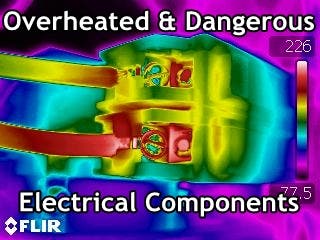
OK, back to business. TIC or simply “thermal imager” for short, works by “reading” the heat of an object–or, the energy it puts out, which travels as infrared light from the object to the camera’s “lens.” The camera’s software takes this energy reading and transfers it into a picture, which shows the relative temperature of the objects in a room.
Disclaimer: I’m no scientist. For a more precise explanation from the good folks at Howstuffworks.com, please go here. If that’s not enough for you, try the physics department at your local university.
Find out what's happening in Hunt Valley-Cockeysvillefor free with the latest updates from Patch.
When you shine a thermal imaging camera at a normal room, you’ll see it has typical warm spots: electronics, electrical outlets, heating ducts. If someone walks through a hardwood or tiled room barefoot, you’ll see footprints.
The thermal imagers commercially available and used by the fire service–at a cool $10,000 a pop, on average–work by reading the different levels of energy emitted by objects that are being heated in a fire. Since objects that are plastic and wood, for example, will behave differently when heated, thermal imagers work by interpreting those different heat profiles. In a room that is commonly furnished, this provides a “picture” for the firefighter.
In common firehouse jargon, we’ll call the firefighter carrying a thermal imager as the man with the “eyes.” But, that’s a misnomer. Thermal imaging cameras read surface temperatures, and while they can help reduce a major obstacle, –smoke that we normally can’t see through– they hardly eliminate it. As any firefighter worth his salt will tell you, thermal imagers are just another tool in our repertoire, useful only when the operator knows its uses and limitations.
So, it is important to underscore that thermal imagers create this “picture” by interpreting the relative heat of the objects in a room. If the objects have no relative heat differences –for example, an abandoned structure that is unfurnished and has no electric, heat, or windows–a thermal imager becomes less useful at painting a “picture.” It will, of course, still lead a firefighter to a person, or give the firefighter the ability to follow heated gases to the seat of a fire.
While I do not endorse any specific thermal imaging camera manufacturer, Bullard has a pretty neat set of pictures that show common firefighting applications here. The second photo, labeled “Fire Attack,” shows fire spreading behind a wall and into an attic– something firefighters wouldn’t see without the use of a thermal imager until the fire grew enough to emit visible smoke. This and the other examples show the practical uses of this tool.
The thermal imaging camera began to make its way into the fire service in the 1990s, which is fairly recent when you compare it to good ole’ fashioned tools of the trade like water and axes. Used initially in military applications, it’s increasingly common to see these devices in use in the fire service today. Initially cost-prohibitive for many community-supported fire departments, the Assistance to Firefighters Grant program administered by the U.S. Department of Homeland Security has helped hundreds of fire departments purchase thermal imagers.
Very simply put, thermal imagers are used to help firefighters find fires and find people in burning buildings. Compared to how we’ve been doing those two tasks for hundreds of years (essentially, blindly), it can easily be argued that the thermal imaging camera has transformed and modernized a key life–and property saving–task in the fire service.