Politics & Government
Blimp Program Under Fire
Two surveillance blimps above Baltimore and Harford counties: protecting the East Coast or a bunch of hot air?


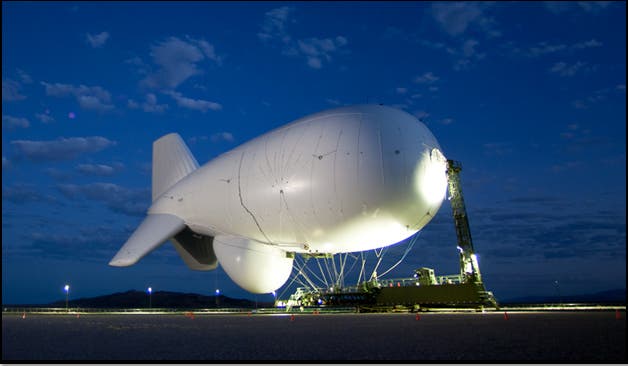
Could the pair of blimps anchored at Aberdeen Proving Ground be giant money pits for the American taxpayer?
That is what Tribune is arguing in a recent investigation into the airships.
Read the Tribune article: “...$2.7 Billion In, Pentagon’s High-Tech Blimps Fail to Deliver on Promise.”
Find out what's happening in Perry Hallfor free with the latest updates from Patch.
Launched in the past year, the blimps—technically known as “aerostats”—are said to detect threats from missiles, drones and rockets from North Carolina to Boston while soaring 9,950 feet in the air.
One blimp uses radar to surveil and the other is supposed to feed threat detection information to the North American Aerospace Defense Command, which can respond with air, ground or computer-based defenses, according to the U.S. Army.
Find out what's happening in Perry Hallfor free with the latest updates from Patch.
Working in tandem, the aerostats make up what the Department of Defense calls “JLENS” (Joint Land Attack Cruise Missile Defense Elevated Netted Sensor System).
One sign of complication for JLENS was evident out of the gate.
The two blimps were supposed to be launched six weeks apart.
In reality, one blimp went up in December—and came down frequently during the winter months—while the other became airborne in August.
“The main reason for the delay was construction,” Kelly Luster, spokesman for Aberdeen Proving Ground, told Patch last month. “Due to the nature of the area, extra precautions were taken to ensure the safety of personnel working in the location.”
Another official, speaking to the Tribune, attributed the delay to “software issues.”
- Second Blimp Launching Soon in Harford County
- First Blimp at Aberdeen Proving Ground Launching Soon
- Blimps to Fly Over Aberdeen for 3 Years
- Congressman: APG Selected for Missile Surveillance Program
The first blimp was anchored in Graces Quarters; the second, in the Edgewood area of Aberdeen Proving Ground.
It cost $20 million just to pour the concrete for the blimps’ anchor pads, according to Tribune.
The blimps are part of a three-year test to see how well they can be integrated with defense technology systems to protect a large area, according to the U.S. Army.
Defense contractor Raytheon, which designed the aerostats, claims they can detect objects like missiles, unmanned aircrafts, ground targets and swarming boats.
However, Tribune reports that Army officials have been saying since 2010 that the threats they need protection from in the Middle East are not missiles but rockets, improvised explosive devices and artillery, and that the Pentagon has rated the reliability of JLENS technology as poor.
Neither Raytheon nor Aberdeen Proving Ground immediately responded to a request for comment from Patch on the program.
JLENS was on the chopping block in 2010 but Marine Corps Gen. James E. “Hoss” Cartwright, then vice chairman of the Joint Chiefs of Staff, threw his support behind the blimp program, and a three-year test run was approved in 2011, according to Tribune.
The newspaper reported Cartwright retired that year and five months later, joined the board of Raytheon, from which he received more than $800,000 in cash and stocks by the end of 2014.
See the Tribune article detailing how that went down.
Cartwright did not immediately respond to a request for comment from Patch and declined to take questions from Tribune.
Photo Credit: U.S. Army.
Get more local news delivered straight to your inbox. Sign up for free Patch newsletters and alerts.