Schools
Q&A: Perry Hall High Principal Calls for Community Support
Patch spoke with George Roberts, principal of Baltimore County's largest high school.

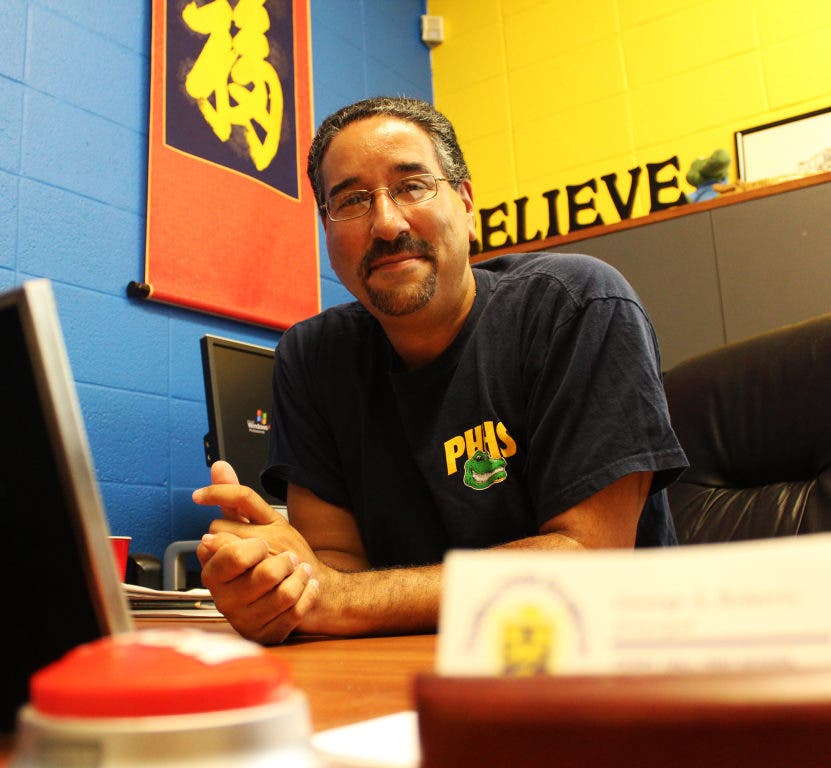
On a recent Friday afternoon, wore a T-shirt and jeans. He didn't walk from the library to his office, he jogged.
There were no students in the school, but Roberts talked about their return with excitement. He anticipates an enrollment of about 2,150 students this school year, ensuring that will remain the largest school in Baltimore County.
Before he was appointed the fifth principal of Perry Hall in 2008, Roberts worked as principal of Golden Ring Middle School and as an assistant principal throughout Baltimore County from 2004 to 2007. He worked as a teacher and administrator in Prince George's County from 1995 to 2004.
Find out what's happening in Perry Hallfor free with the latest updates from Patch.
Roberts holds a bachelor's degree in education from then-Towson State University, as well as a master's degree from Bowie State University and a graduate certificate from Johns Hopkins University. A native of Prince George's County, Roberts lives in Towson with his wife and three daughters.
The principal spoke with Patch about challenges facing the high school, as well as ways the community can help support the students.
Find out what's happening in Perry Hallfor free with the latest updates from Patch.
Roberts' responses have been edited for length and content.
Patch: Do you feel you've changed or adapted since taking on this position? How has it affected you personally?
George Roberts: It's a lot more to manage. It's a lot more to lead in terms of adults and students. I've always considered myself a patient person, but I think I've learned to fine-tune even that part of myself.
I've increased my own flexibility and perseverance. When managing such a large organization within a large community, you have to be very well-planned.
Patch: What is the most challenging part of your job?
Roberts: The most challenging part is the administrative aspect of the job, and what I mean by that is the paperwork, the budget, the paperwork that comes along with the budget and evaluations of staff.
When there's a need at the building, a leak in the ceiling or something in the fields, it's my job to make sure that's taken care of in a timely manner. Day-to-day, the biggest challenge is making sure the kids and the staff come into a clean building, that it's operational and that it's the proper setting for what they need to do.
Patch: What are the biggest challenges facing Perry Hall High School?
Roberts: There aren't a lot of problems, but if we're talking about challenges, it's consistently making sure we're meeting the needs of all of our children. Our current enrollment is over 2,150 and that's a tall order—making sure 2,150 children are being met where they are and pushing them forward.
We have an amazing staff of teachers and support staff, but I think if you were to ask them, the biggest challenge is making sure that all those children are getting to where they need to be in the four years that they stay with us.
It's not an easy thing, but it's not because of the children, it's because there's so much that they need to learn in that four years and it's incumbent upon us to make sure they get what they need, to understand and to be able to do something with it when they leave Perry Hall.
Patch: Is that because it's such a large group, or because it's such a diverse group in terms of needs and cultural differences?
Roberts: I think it speaks more to the nature of education. If you're the principal of any other high school that has 1,000 or even 500 children in it, it's still the nature of education to feel challenged by addressing the students' needs. The things we're competing against—they have the television and the phone and the technology, but they also need to open a book, they need to know how to read and take notes and do certain things that still hold true to this day.
It's not the number of children; it's still a challenge no matter what the number is. It's about making sure you take one child at one level and one at another level, not necessarily better or worse, but make sure they both progress toward having the skills they need to graduate or go to college or do whatever it is they feel they want to do when they leave here.
Patch: You've been known for bringing a lot of the history back to Perry Hall High School. Could you tell me more about that?
Roberts: That was one of my first "aha" moments when I first found out I was going to be appointed here. Perry Hall is extremely fortunate, as are many other communities in Baltimore County, to have such a rich history.
Some of my inspiration was when I worked at Woodlawn and I would have experiences going to Catonsville High School and some other high schools in very old communities on the west side—walking through those high schools and seeing how they harnessed that history of the community.
Perry Hall is right there with those communities. So many alum, about 20,000 graduates, have gone through since we opened in 1963. So many teachers come back, so many college kids come back to start families here, so we have two, three, four generations of students here. It was important for me that our current students feel that connection, to not just wander the halls but to understand that their parents, their cousins, their friends always walked these hall, that there's a lineage in this community. When they look at those pictures on the wall, of those graduating classes, they should see the connection and make that connection of a friend or a relative who graduated.
That was very, very important to me. It remains one of my primary focuses, to expose the kids as much as possible the history of the community.
Patch: Is there anything you're looking forward to this year?
Roberts: The foremost is continuing our efforts academically, raising our goals in advanced placement and high school assessments and PSATs and the rate of our students going to college and the rate of our students getting internships; so for those who aren't planning on going to four-year school or a two-year school are prepared through internships.
We're starting, through our business department, a new initiative to get kids placed into more quality internship programs, as well as our school-to-career program.
We're also looking forward to working with our 50th graduating class who are now going to be sophomores. We're really looking at how we're going to celebrate our 50th graduating class in 2014.
Patch: What can the community do to support the high school?
Roberts: The community can do I would say anything, but specifically, we're always looking, first and foremost, for people to support the children.
For those parents who have children here, that support means always asking them what they did throughout the day and always challenging their children to go forward. They need to ask, "What did you do today?" "What did you learn in this particular class?"
In terms of coming into the building, we could always use support in tutoring efforts. We could also use support with more logistical things like homecoming. We can always use things like support for our parade that we have every year.
Joining the PTA is probably, if I had to rank them, probably one or two. Just paying the $7 to join the PTA sends a message to the kids and to the teachers that the community is supportive.
Joining the school improvement team, joining any of the stake-holding groups is also important. We certainly always welcome the community support.
Beside that, it helps just supporting the kids in general, coming out to a football game or a baseball game, coming to an It's Academic taping down in Baltimore City, coming to any type of school play, the winter instrumental choral concerts. Anytime we can get the community to come out and support those things, that always benefits the kids and the school.
Get more local news delivered straight to your inbox. Sign up for free Patch newsletters and alerts.