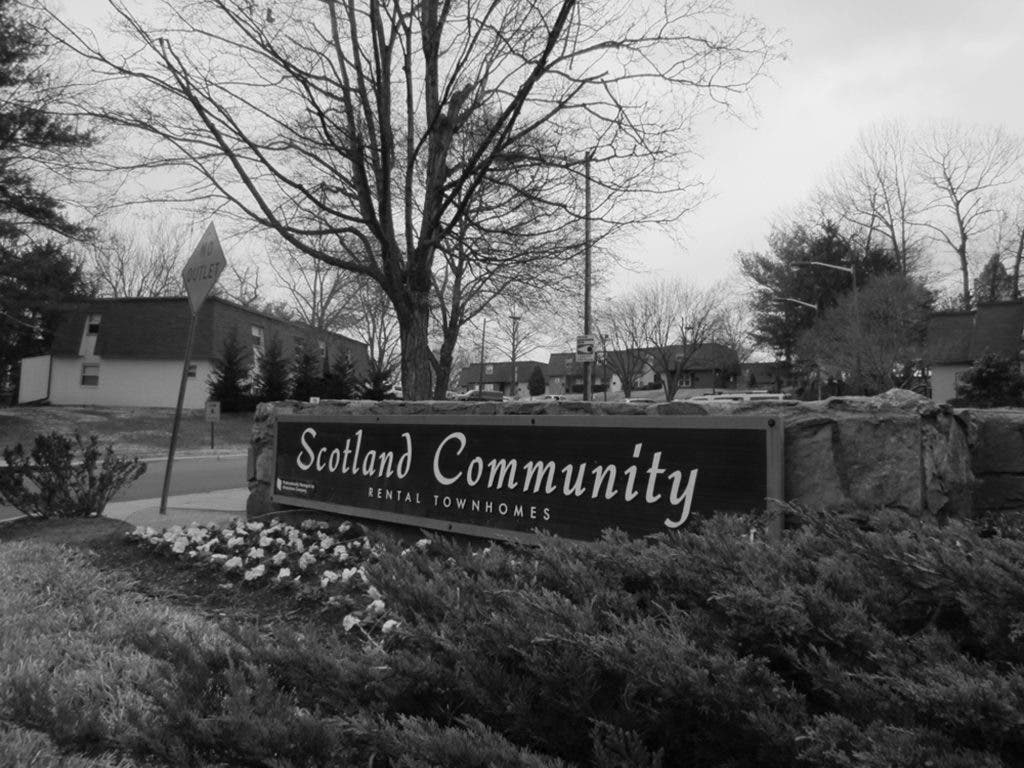
When National Public Radio local affiliate WAMU broadcast a feature about traditionally black neighborhoods this past February, Montgomery County’s Scotland community was highlighted. The self-established housing community dates back to 1880. Yet, many CHS students and teachers harbor misunderstandings about it.
CHS has a diverse population, with approximately 40 percent of students classified as non-white. Many students from Scotland are comfortable in CHS and do not perceive major differences between themselves and the rest of the student body, beyond the fact that the neighborhood is less affluent than many others in the cluster.
In interviews, several Scotland students commented that their neighborhood is an unusually cohesive community.
Find out what's happening in Potomacfor free with the latest updates from Patch.
“We’re very close-knit,” sophomore and Scotland resident Oumar Soumah said. “We know all the neighbors. When you walk outside, everyone will know each other’s name.”
Students and teachers recognized beneficial friendship but also noted a possible pattern of self-separation. Non-Scotland students may see the neighborhood differently from those whom live in it.
Find out what's happening in Potomacfor free with the latest updates from Patch.
“People hear rumors and stuff about gangs, but it’s not like that,” freshman and Scotland resident Briana Martin said. “It’s like an average neighborhood.”
The relationship between the school and the community has, however, been bumpy at times. There are differing opinions on whether there is a meaningful divide between Scotland students and non-Scotland students. As a whole, the adults in the school interviewed by the Observer usually perceived greater differences in the student body than did the students themselves.
“I feel, to a small percentage, there are some Scotland students who may perceive that they are treated differently,” security team leader Terry Bell said. “Whether or not this is true, I don’t know.”
In interviews with teachers from different departments within the school, all said that they do not seek out information on students’ addresses, although some noted that they feel there is an assumption within the school that all of CHS’s black students reside in Scotland, even though that is not the case.
One teacher, who asked to remain anonymous, said he goes out of his way to view all students without prejudice.
According to the teacher, he has “never seen” a divide between students who live in Scotland and those who do not, but “maybe [he does not] want to see it,” he said.
Several teachers observed that Scotland students tend to be underrepresented in AP and honors classes. While the reason for this is open to debate, most agree that lower socioeconomic status can have an impact on student performance. Many CHS students, for example, have access to high-priced private tutors who give their clients an edge in the classroom while equally intelligent students with fewer financial resources may not have the same chance.
As a result of varying socioeconomic levels, there may be differing expectations for academic performance, and these expectations can have a negative impact on achievement.
“I hear kids talking about Scotland kids getting bad grades and it’s funny to other people,” Soumah said. “People think that they’re not up to the ‘Churchill standard.’”
Those low expectations can be so pervasive that some students may find it difficult to rise above the low standard others have for them. For example, one Scotland student who was not comfortable with giving his name noted that “my GPA is pretty high for a black student.”
Despite the perception of some, according to Principal Joan Benz, there have been “a lot of” Scotland students “who have been academically superior, gone on to great colleges, graduated, gotten excellent positions in the community and given back to CHS.”
One of the resources unique to the Scotland neighborhood is its community center. CHS used to support after-school tutoring sessions, and other outreach programs at the center until it was closed for renovation in 2011. Long delays in the center’s renovation left many in the CHS community frustrated, but this past March construction began with a groundbreaking ceremony featuring members of the County Council.
Rockville resident Caroline Touchton volunteers with the James Macdonell Scotland Community Scholarship that offers scholarships for college-bound students.
“I liked meeting the students in the community center because it was a vibrant and lively place with lots of things happening,” Touchton said. “It was also very convenient.”
According to Benz, tutoring is “harder now that the center is closed,” so, as a temporary solution, citizens from the community and CHS students tutor kids of all ages once a week for a “Power Hour” at Bells Mill.
“The ‘Power Hour’ [helps] build up a strong education foundation,” special education resource teacher Tishya Soni-Chopra said. “We have 43 coaches.”
This added support coupled with CHS’ student resources helps its students of all socio-economic backgrounds be successful, while attempting to make everyone feel as comfortable as possible despite differences.
According to Bell, Dr. Benz and administration “go out of their way for minority participation” and community involvement.
“We appreciate what the school does for us,” Martin said.
Many Scotland students agree, including senior and Scotland resident Darrion Locke, who believes the school and the neighborhood have moved past any previously perceived conflict.
“People see that [Scotland is] not any different,” Locke said. “I think the school is doing fine with Scotland kids.”