By Kyle Hobstetter on March 21, 2021
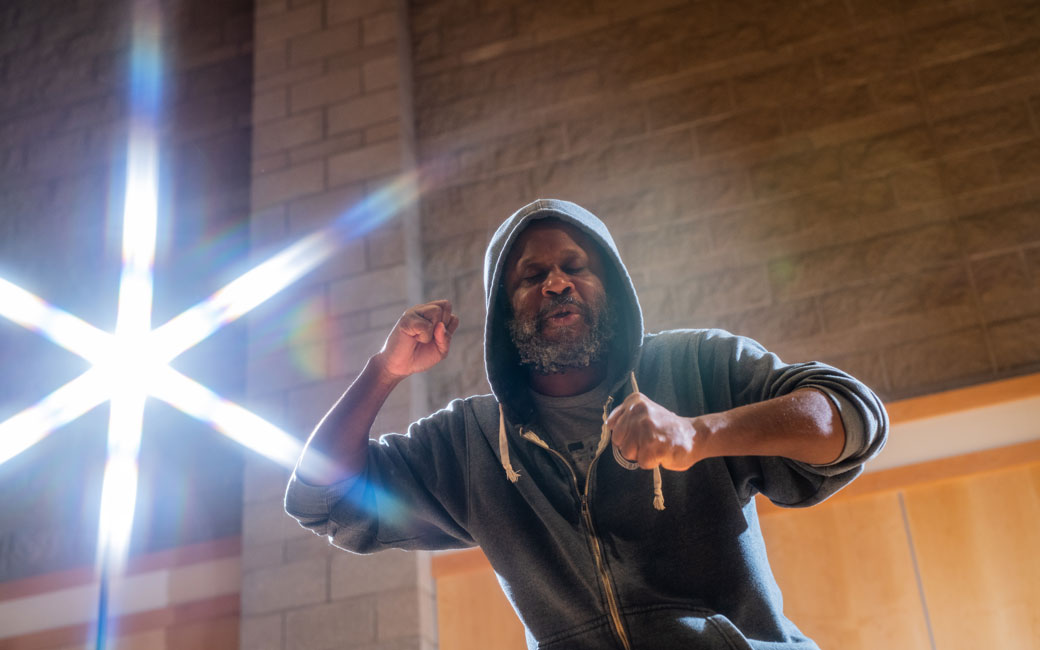 Hip-hop artist and College of Fine Arts and Communication's Innovator-in-Residence
Shodekeh Talifero found an escape in beatboxing. (Photo by Lauren Castellana)
Find out what's happening in Towsonfor free with the latest updates from Patch.
Dominic Shodekeh Talifero, the College of Fine Arts & Communication’s innovator-in-residence, was almost just a statistic.
When he was younger, Talifero fought intense battles with suicidal ideation.
Find out what's happening in Towsonfor free with the latest updates from Patch.
A 2018 study performed by the National Institute of Mental Health showed suicide is the second-leading cause of death among Black children, ages 10–14,
and the third-leading cause for Black adolescents aged 15–19.
After experiencing physical, psychological and sexual abuse throughout his childhood
and teen years, Talifero thought suicide was the only answer.
But he found another—beatboxing.
Growing up in Prince George County, Maryland, he watched legendary beatboxers Doug
E. Fresh and the Fat Boys’ Buffy the Human Beatbox and emulated them while hanging
out with friends.
“Having beatboxing in your skillset was like having a badge of honor,” Talifero says.
“I was hanging out at another kid’s house, and he started to beatbox. Then the other
kids started egging me on.
“They would say to me, ‘You could beatbox. You’re always practicing; you should do
it.’ So, I got the gumption to demonstrate what I could do. Once I was done, the other
kids looked at me and said, ‘Yeah, you can beatbox.’ After that, it stayed with me.”
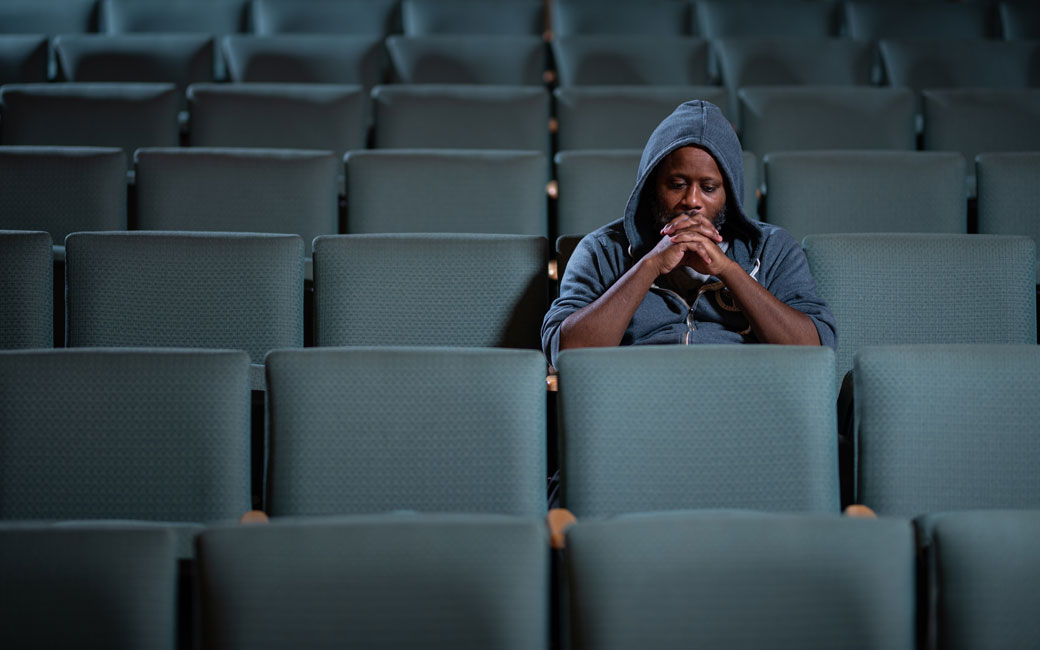 Growing up with an abusive childhood, Shodekeh had thoughts of suicide. But thanks
to hip-hop, he found his life's path. (Photo by Lauren Castellana)
As a teenager, he considered himself a “cultural practitioner,” who beatboxed for
fun. But after his freshman year of college, he decided to make music his career.
Now going by the stage name Shodekeh, he has performed professionally for the past
two decades.
He’s beatboxed with the Baltimore Symphony Orchestra, at the Salzburg Global Seminar
in Austria and has been a regular performer at clubs and events in the Baltimore area
where he usually serves as the musical accompanist for poets and rappers.
One night in 2006, Towson University dance professor Vincent Thomas was at a poetry slam where Talifero performed. Afterward, the two exchanged business
cards, and the beatboxer has been working with Towson University ever since.
“I thought he meant teaching a few master classes, but he wanted me for the entire
semester as a regular musician for the entire program,” Talifero recalls. “Since 2006,
this has continued to be a really fantastic and grand experiment. “When I perform with the dancers, they are using their bodies as instruments, I’m
using my body as my instrument and we definitely connect on some very dynamic wavelengths
coming from that shared paradigm.”
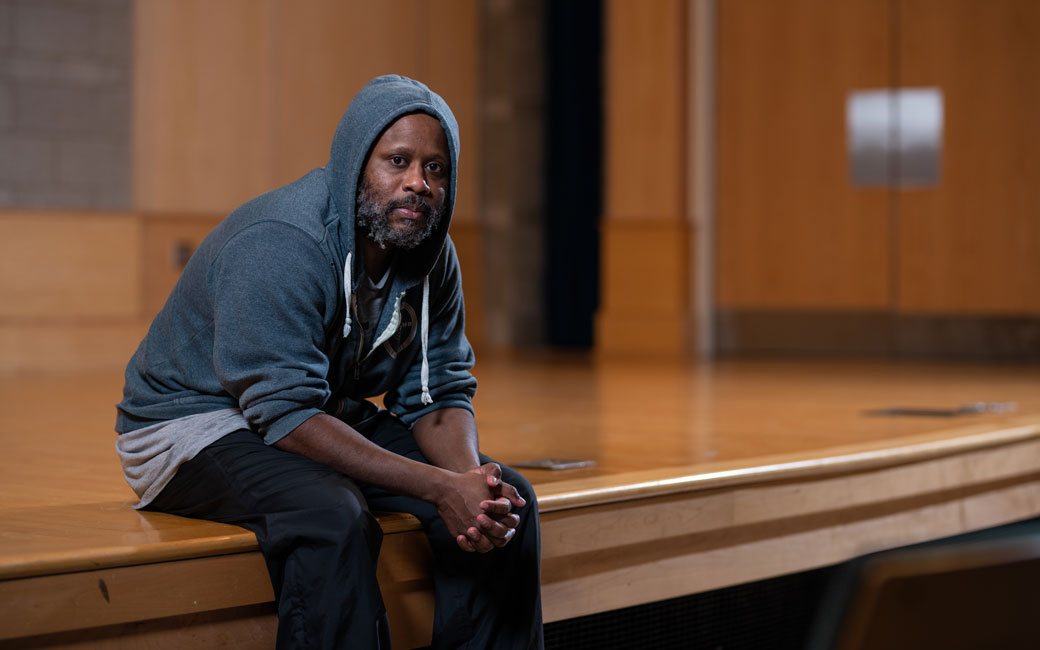 Starting in 2006, Shodekeh started working with Towson University's College of Fine
Arts and Communication. This partnership has continued, with him being named COFAC's
Innovator-in-Residence. (Photo by Lauren Castellana)
As an adult, he understands why he was drawn to beatboxing.
“The people I saw on TV and movies, they were inspirations, but the real reason was
so I could turn my body into something I could use to fight back against the abuse
I experienced as a kid,” Talifero says.
“That’s the real reason why I keep doing it, so that I can keep my body in check.
And I’ve been doing it mostly for myself, but now it’s time for me to do it for kids
who might need inspiration.”
To share his story, Talifero is partnering with Albert S. Cook Library to produce an archived collection that features his work, inspirations and collaborations
through his life and music career.
Titled Ideations of Potential: Shodekeh's Innovation Lab of Embodied Scholarship & Hip Hop
Imagination," the collection serves as a capstone project for Talifero as COFAC’s innovator-in-residence.
It also makes him the first hip-hop artist in Maryland to have their work archived
and the first beatboxer in the world to have a special collection dedicated to their
work.
One of the Cook Library staff members who has been working with Talifero is Ashley
Todd-Diaz, assistant university librarian for Special Collections and University Archives (SCUA).
When working with those who donate materials, the archives staff usually doesn’t get
to work closely with the donor. But Talifero was ready to collaborate.
“Shodekeh has been very involved and invested in the development, organization, description
and promotion of the collection,” Todd-Diaz says. “This lays the foundation for a
richer collection since it allows us to combine our archival expertise with his subject
expertise.”
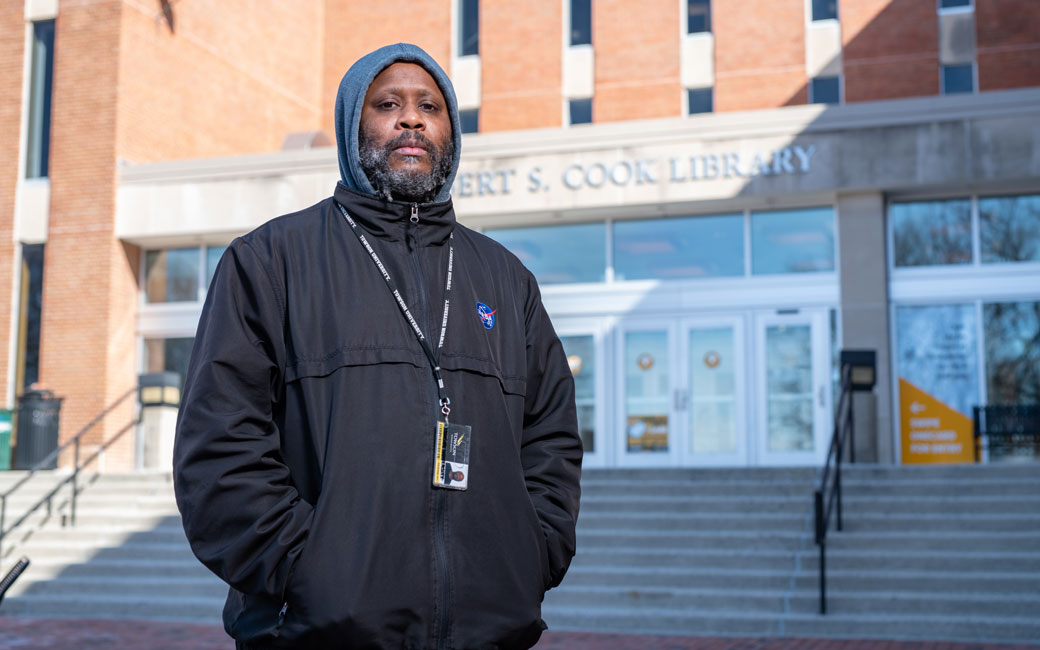 Shodekeh is partnering with Albert S. Cook Library to produce a special collection
that archives his work. He is the first hip-hop artist in Maryland to have an archive
of his work. (Photo by Lauren Castellana)
The collection also lets the library continue adding diverse and unique viewpoints
to its archives. And what better way to celebrate the upcoming 50th anniversary of the creation of hip-hop than to host the first archive in Maryland
dedicated to a hip-hot artist.
“Our department has been looking to diversify our collections and Shodekeh’s partnership
with TU makes us ideally suited to host his body of work and to provide access and
reference for students, researchers and the public,” says John Esh, processing archivist
for SCUA.
“His collection will exist as a living entity and we can’t wait to see what we can
accomplish in collaboration, outside of the traditional archival model, to showcase
it for the world.”
The collection is scheduled to be launched in late March but isn’t complete. Talifero
and the SCUA team are working hard on the digital side; getting images uploaded, compiling
video, making annotations, creating a timeline and putting together a bibliography.
They are also gathering up physical artifacts (CDs, books, etc.) that evidence Talifero’s
artistic endeavors. Once all of that’s squared away, the next step is to start assembling
it on SCUA website.
At just 43, Talifero wants it to grow with his career. He will be constantly adding
materials as he continues to perform at Towson University and beyond.
He’s also using the collection to raise awareness for Black youth suicide, a subject
he's been more aware about after working with the McSilver Institute for Poverty Policy and Research at New York University's Silver
School of Social Work
Talifero is dedicating the collection to the memory of a family member who took their
life in the 1980s; to those affected by Black youth suicide; and to anyone who's struggled
with suicidal ideation and systemic racism.
Through his passion and gift, he wants others to know it’s possible to take back control.
“I was abused, and I’m taking my body back. Now I’m protecting it for the rest of
my life, and, hopefully, I can inspire other people to do the same,” Talifero says.
Counseling Center
Suicide Prevention Information
If you, or anyone you know is thinking about suicide, please know there is help available.
The Counseling Center can provide a variety of services for students who may be feeling hopeless or thinking
about suicide. They can also assist you if you are concerned about someone you know.
Contact the Counseling Center at 410-704-2512 for an initial appointment to help determine
what type of services best fit your needs.
Along with the Counseling Center, the following resources are available to students
who are concerned about suicide:
When the Counseling Center is closed, students in crisis who need immediate support
can call the Center after-hours, during evenings and weekends. Phone: 410-704-2512.Grassroots Crisis Intervention Telephone Hotline: A telephone counseling that uses
volunteer and peer counselors, funded by Baltimore County. Phone: 410-531-6677
National Suicide Prevention Lifeline: A 24-hour, toll-free suicide prevention service
available to anyone in suicidal crisis. Phone: 800-273-TALK (8255)Learn more about Suicide Prevention, including warning signs, protective and risk factors through the Towson University
Counseling Center.
This press release was produced by Towson University. The views expressed here are the author’s own.