Schools
Students Continue Service-Learning With Baltimore City Community Schools
The TU partnership with Baltimore City Public Schools adapts to meet community needs.
By Rebecca Kirkman on July 6, 2020
At the start of the spring 2020 term, nearly 50 Towson University students enrolled
in service-learning courses were volunteering at six Baltimore City community schools.
Find out what's happening in Towsonfor free with the latest updates from Patch.
Community schools serve as neighborhood hubs that connect families with additional
support and services, including healthcare, food access and after-school programs.
Undergraduate students enrolled in “Historical and Contemporary Perspectives: America’s
Urban Schools,” a Core Curriculum course taught by associate professor Jessica Shiller, were
just weeks into their work with several local schools when the coronavirus forced
classes to move to distance learning.
Find out what's happening in Towsonfor free with the latest updates from Patch.
TU student work in community schools is supported through a priority investment from
BTU—Partnerships at Work for Greater Baltimore.
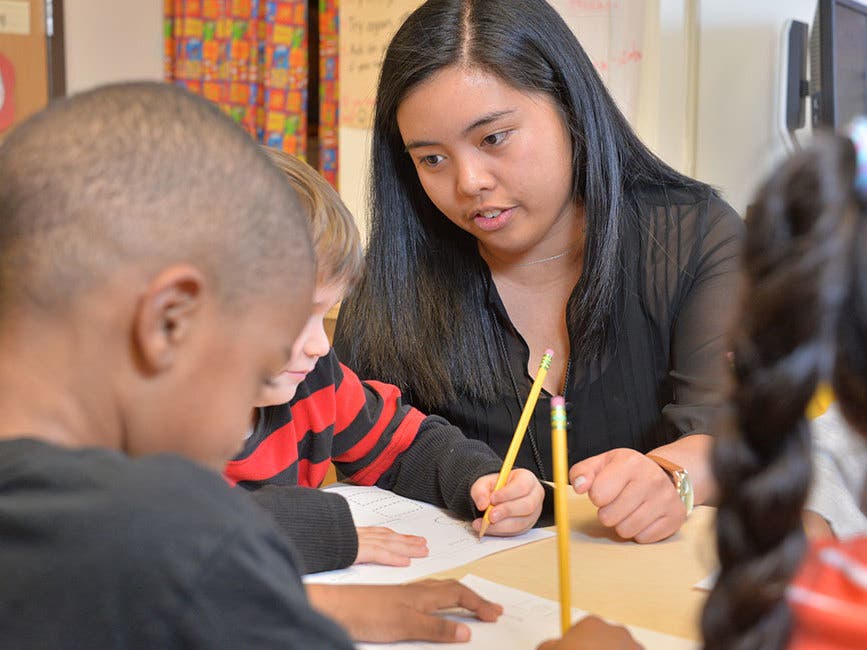
After three or four visits to a kindergarten class at Robert W. Coleman Elementary
School in Baltimore’s Mondawmin neighborhood, psychology major and Honors student
Grace Hehir ’22 was beginning to make connections with individual students. Hehir
and other TU students would join classroom time, helping students read and sound out
words, or would sit with students while they ate breakfast. They also helped unload
deliveries of supplies for the school food pantry.
“We were so disappointed,” Hehir recalls of learning they couldn’t return to the schools
in person due to the coronavirus pandemic. “We were just starting to form relationships
with students and families.”
But TU students continued to find creative ways to engage with school partners from
a distance.
After consulting with the community school coordinators about where they needed assistance,
TU students continued to engage by supporting instructors during live online teaching
sessions and by offering virtual “office hours” for help with homework and other assignments.
TU students working with middle and high schools made videos about the college experience
to share with students.
“Doing an online class with 30 first graders is not the same as teaching in person,”
says Shiller, who teaches in the College of Education’s Department of Instructional Leadership & Professional Development. “So our students are helping to do breakout groups and to live tutor in real time
at the elementary level where kids need support with reading or phonics or math—basic
stuff like adding 2 plus 3 or reading picture books to them, things that can really
support their basic skills.”
TU student Ronnell Bates stepped up to help Reginald F. Lewis High School Spanish
teacher Maria Quintana during the transition to online learning. “He has helped me
immensely with setting up my Google Classroom, as well as helping me maintain the
classroom,” Quintana says. “Mr. Bates has been very knowledgeable, professional and
patient with me in mainstreaming and digitizing my material for my students.”
Hehir, who enjoys music, created a short video lesson for the kindergarten class where
she had been volunteering in which she teaches students how to sing the octave scale
and use hand signs for each note, going on to sing “Do-Re-Mi” from “The Sound of Music.”
While the spring term didn’t end how anyone envisioned, Hehir says it offered an important
learning opportunity. “We learned the importance of flexibility, resilience and being
adaptive,” she says. “It’s not the end of the world, but it is the end of something.
Being able to hang onto the pieces that still feel normal is really important.”
Shiller says her students value helping others during an uncertain time.
“The biggest lesson is that you don’t give up when things get hard. And when there’s
a major crisis, you don’t just sit back and do nothing. Our job is to lean into that,
step in and figure out what we can do,” she says. “Even online there’s a lot of assistance
that we can provide, and in some ways it might be better than we could have done before,
because my students are able to connect individually to students in Baltimore City
that they might not have before.”
This press release was produced by Towson University. The views expressed here are the author’s own.