Schools
TU Faculty On How Local News, Media Literacy Can Combat Disinformation
TU faculty experts discuss how to rebuild trust in media outlets.
Press release from Towson University: By Cody Boteler on February 8, 2021
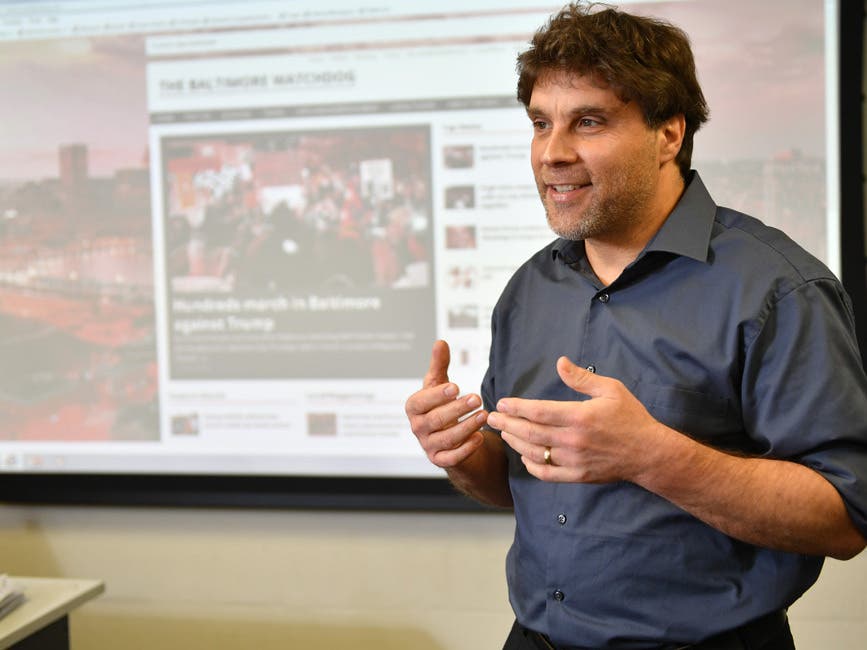
John Kirch teaching in 2016. Kirch teaches a course on the history of American journalism.
Fewer than 50% of Americans trust traditional media outlets, according to a new poll from Axios. Lawmakers and others dismiss stories they don’t like as “fake news.” Adults are
getting more of their news from social media, according to Pew Research.
Find out what's happening in Towsonfor free with the latest updates from Patch.
The situation has become so drastic, says John Kirch, an associate professor in the
Department of Mass Communication and unit coordinator for journalism, that “the country
no longer has a universal set of facts that everyone agrees to and everyone acts on.”
That kind of disagreement is partly to blame for the political animus in this country
and the insurrection at the Capitol, Kirch says. He says an event like that may not
have been possible in the 1970s or 1980s, because most people were watching one of
the same three network TV stations and reading from the same big newspapers.
Find out what's happening in Towsonfor free with the latest updates from Patch.
“Everyone was drinking from the same fountain, if you will. You would have folks like
Walter Cronkite report the facts objectively,” Kirch says.
While the current media climate may not resemble recent history, there are strong
historical parallels, Kirch says.
“For the first 150 years or so, it was pretty much partisan media. Newspapers were
either Federalist or Democratic-Republican,” Kirch says. “Even when the commercial
press started in the 1830s, reporters weren’t supposed to be objective. They could
express some opinions; it’s just that those newspapers weren’t as explicitly partisan.
They weren’t funded by a party.”
It wasn’t until the 1920s that the idea of objective journalism started to come about.
While political parties aren’t actively funding newspapers or other news outlets today,
Kirch says the increasing slant of some outlets is a clear historical similarity.
There are two clear differences between now and early American history, aside from
political funding: the advent of social media and so-called “news deserts.”
Elia Powers, an associate professor in the Department of Mass Communication, says
division on social media is “nothing new.”
“People who study social media have seen this polarization. Algorithms prioritize
things that are more engaging,” he says. “The louder you are, the more reach you have.”
In a local news vacuum, that’s where you start to see people turn toward more biased,
more extreme sources.
”
Elia Powers, associate professor
There’s nothing wrong with political discussions on social media, Powers says, but
people can get stuck in bubbles or silos where users only see content and ideas they
already agree with.
“I think people are increasingly aware that what you’re seeing on social media isn’t
always necessarily representative of a range of sides. It can feed you back your beliefs
or what the algorithm thinks the most ‘sticky’ stories are,” Powers says.
Kirch and Powers say the decline of strong local news outlets is a problem, because
it creates “news deserts,” areas with little to no local coverage. The United States
has lost more than 2,100 weekly and daily newspapers since 2004, according to Poynter, a journalism institute.
“In a local news vacuum, that’s where you start to see people turn toward more biased,
more extreme sources,” Powers says.
Kirch says having a strong local press in communities can build trust, because those
who create local journalism are a part of the same communities they’re reporting on.
“People can make accusations [about fake news or bias], but then people say, ‘No,
I know the publisher’ or ‘I know the journalists, they wouldn’t do that,’” Kirch says.
Neither faculty member thinks there is a silver bullet solution.
“If you had a vibrant local press, which we don’t have anymore, I think it would have
a big impact, and it would blunt some of the things you have coming at the national
level,” Kirch says.
Powers agrees. He says it’s possible to draw some sort of connection between “the
diminishing presence of local news and people searching for information that’s not
credible.”
Both also say there should be some more regulation on social media. Powers says he
supports efforts that would bring journalists, editors and fact-checkers to social
media platforms to increase credibility.
Kirch says bringing back the Federal Communications Commission (FCC) fairness doctrine,
which required broadcast networks to air issues of public importance in a manner that
was honest, equitable and balanced, could help restore trust in broadcast media.
“The FCC could not deny you a license because they didn’t like your political opinion.
It was content neutral. It was looking at how much public affairs broadcasting did
you do, and how balanced was it,” Kirch says.
The doctrine was removed in the 1980s, and it may be difficult for it to apply to
cable networks, newspapers or online publications.
Also important, both faculty members say, is increasing media literacy.
“People should be really aware of how social media and the algorithms prioritize certain
news,” Powers says.
Kirch says media literacy and critical thinking skills should be taught more, nationwide.
“If you want to have a healthy democracy, you have to train people how to debate and
how to recognize false arguments,” he says. “You need to train people in that the
same way you’re going to train them in algebra.”
Want to learn more?
Study journalism, advertising and more at Towson University
The Department of Mass Communication has an undergraduate major and minor, and a master's
program. Click here to learn more.
This press release was produced by Towson University. The views expressed here are the author’s own.