Schools
TU Helps Students With Community-Engaged Research Opportunities During The Covid-19 Pandemic
Students support faculty community-engaged research projects as BTU partnerships pivot community engagement toward COVID-19 response

By Kyle Hobstetter
Find out what's happening in Towsonfor free with the latest updates from Patch.
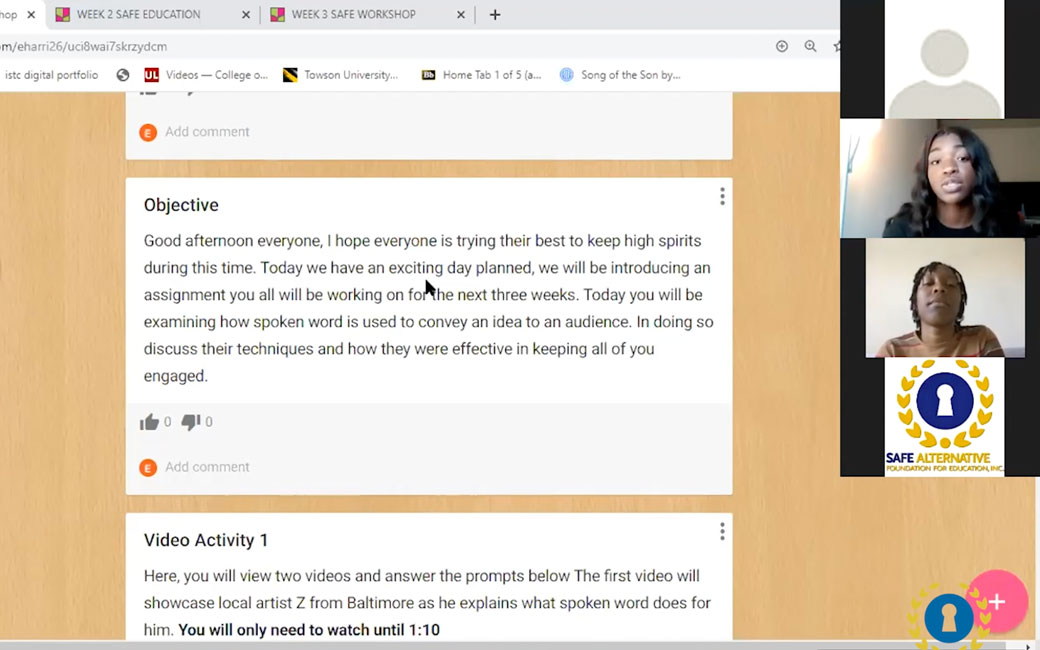
Towson University students used zoom to work with the SAFE Alternative Foundation
for Education which was facilitating a spoken word workshop online for the Baltimore
City public school youth.
During the 2020 spring term, Towson University students made a lot of adjustments.
Many had to move off campus, adjust to distance learning classes and assimilate the
new normal created by the COVID-19 pandemic.
Find out what's happening in Towsonfor free with the latest updates from Patch.
Aside from their studies, the pandemic dramatically impacted students’ employment.
According to a survey by the Towson University Career Center, 79% of students who responded to the survey have had their part-time employment affected
by COVID-19.
“I started hearing it from my students that ‘I've lost my job, and I don't know what
I'm going to do in terms of paying for tuition,’” says Matthew Durington, professor
in the Department of Sociology, Anthropology & Criminal Justice and director of community engagement and partnerships for the Division of Strategic Partnerships and Applied Research.
“So, I asked my colleagues on the BTU partnerships team ‘What can we do in the immediate?’
That's where we came up with the idea of creating a student employment fund not only
to give students a possible vocational opportunity but also to add some direct applied
research to the pandemic.”
The initial idea was sparked by discussions with Lisa Plowfield, dean of the College of Health Professions, who moved unused funds toward research for CHP faculty to redirect their work towards
COVID-19.
The BTU partnerships team, which manages BTU—Partnerships at Work for Greater Baltimore, took the concept further and reallocated some of its unused funds to help mitigate
the effects of student unemployment. It not only facilitated the hiring of TU students
by interested faculty across the university but also funded community-engaged research
directed toward COVID-19.
The call went out to members of the BTU Council, faculty project leads for current
BTU investments and the college deans on Monday, May 11. Within one week the BTU partnerships
team facilitated the hiring of 24 student research assistants for 16 faculty/staff
projects in every academic college, including Cook Library.
According to Durington, this is a perfect example of how Towson University demonstrates
the capacity to provide undergraduate research opportunities for students, instead
of solely focusing on graduate research like most major universities.
“I think we were set up to do this because our faculty tend to work with some pretty
stellar students on research projects,” Durington says. “So, it was a natural thing
that a lot of them said ‘Okay, I’m working with a student on an independent study
or something else. If I can resource them and provide them a stipend, then that’s
going to be beneficial for everybody.’”
Along with aiding students, the BTU partnerships team and the colleges have also been
able to provide opportunities for faculty who might not regularly do community engagement-based
research.
When BTU reaches out to faculty and staff about community engagement efforts, Durington
gets a response from those who he calls the usual suspects—faculty and staff who are
consistently engaged, recognized and resourced.
But there's a lot more untapped specialized knowledge on campus that could be applied
to local and national issues, so Durington was excited when he saw the uptick in faculty
engagement.
“That's been a struggle for us since BTU started—trying to get more faculty to recognize
that a lot of their research can gear toward community engagement and partnership
work,” Durington says. “But what was nice about this particular initiative was that
we were able to capture some more projects and really extend what community engagement
work is on campus.”
Durington added that the BTU partnerships team is strategizing how to best expand
these student employment efforts and is developing resources and tools to support
these efforts. Working in partnership with the Division of Student Affairs, the hope
is to extend this type of support into the fall.
Some examples of undergraduate research projects include:
Masks during COVID-19 and speech intelligibility
Paul Evitts, professor in the Department of Speech-Language Pathology & Audiology, is researching the beneficial effects of the inclusion of visual information on
the intelligibility of speech across numerous populations. Due to the novel coronavirus,
masks are now required in many states as well as internationally. The effects of this
requirement on speech intelligibility is unknown.
Social media and stigma during the COVID-19 pandemic
Sushma Kumble, assistant professor in the Department of Mass Communication, is looking at stigma messages disseminated on Twitter about the COVID-19 pandemic.
This is an important topic of study on two levels, as stigma around this global pandemic
has resulted in discrimination of Asians globally and people’s hesitation to seek
medical intervention because they are scared to be stigmatized.
How Black churches are responding to the COVID-19 pandemic
Donn Worgs, professor in the Department of Political Science, is conducting a survey of Black churches regarding how they are navigating COVID-19.
He wants to discover what challenges they are facing and what adaptations they’ve
made to sustain their mission, maintain their institutions and continue their community
outreach and service activities. The goal is to document the challenges as well as
their adaptations and ultimately share these findings with potential resource providers
as well as their peer institutions.
What has impressed Durington the most is that when given the opportunity to help not
only students but the community as well, many faculty members stepped up.
These projects have just added to the impact that BTU—Partnerships at Work for Greater
Baltimore has made across the region. As of spring 2020, faculty, students and staff
have 410 active engagements with BTU network partners. Across all engagements, Towson
University is working with 603 partner organizations in Greater Baltimore and throughout
Maryland to create positive impacts.
“Our faculty have a really strong disposition to combine their teaching, research
and service so they all blend and inform one another,” Durington says. “It’s the natural
move for our faculty to want to do something to make an impact. It’s just been inspiring
to see those efforts directed immediately to the pandemic.”
Learn more about BTU as well the undergraduate research being done during the COVID-19
pandemic by reading Matthew Durington’s blog post in SPAR’s EngageTU newsletter.
This story is one of several related to President Kim Schatzel’s priorities for Towson University: BTU-Partnerships at Work for Greater Baltimore.
This press release was produced by Towson University. The views expressed here are the author’s own.