Schools
Towson Professor Part Of $3M Grant To Boost Virtual Teacher Training
The grant from the National Science Foundation supports preservice STEM teachers in facilitating argument-focused discussions.
Press release from Towson University: By Cody Boteler and Rebecca Kirkman
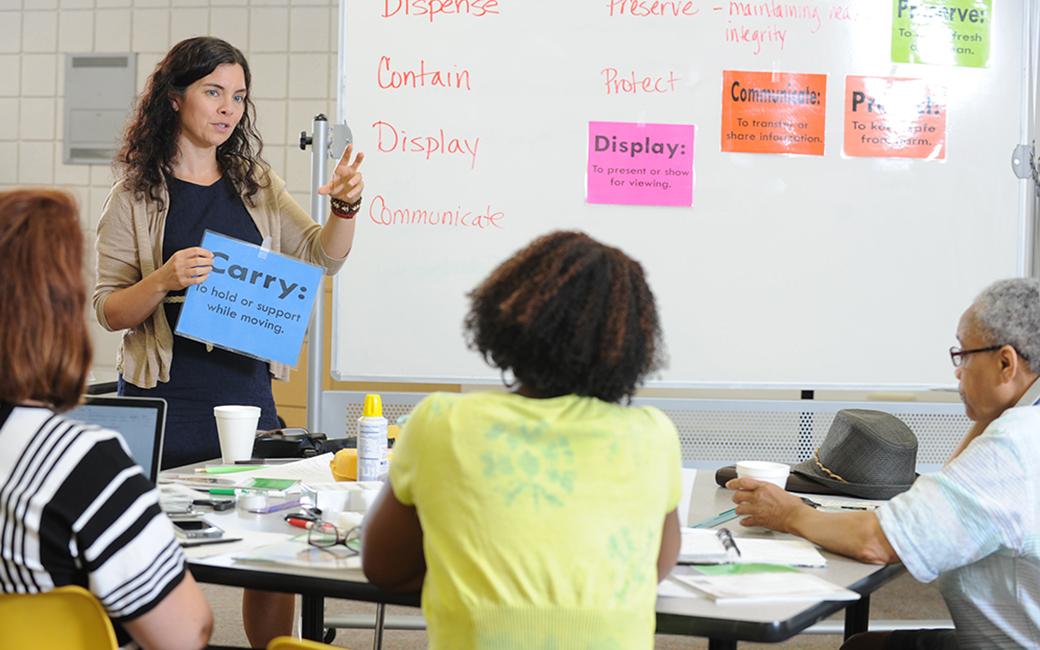 Pamela Lottero-Perdue, a professor of science and engineering education at Towson
University, conducts professional education for in-service teachers in June 2015.
Lottero-Perdue is part of a multi-institution effort to use technology to prepare
future STEM teachers. Photo: Lauren Castellana
When the novel coronavirus pandemic closed schools and transitioned students to remote
learning, Towson University’s Pamela Lottero-Perdue, a professor of science and engineering
education in the Fisher College of Science & Mathematics, had a plan.
Find out what's happening in Towsonfor free with the latest updates from Patch.
Lottero-Perdue teaches courses for future educators, where preservice teachers can
get classroom experience before graduating from Towson University.
While no longer able to interact with elementary school students in person, and through
the support of a National Science Foundation (NSF) grant (#1621344), those in Lottero-Perdue’s
class were able to use Mursion software that simulates real-time classroom scenarios.
This is the same software used in the College of Education.
Find out what's happening in Towsonfor free with the latest updates from Patch.
“It is essential that we find ways, even in the midst of COVID, to enable future teachers
to practice teaching,” Lottero-Perdue says. “It is especially important in mathematics
and science education to help preservice teachers learn to engage their students in
argumentation, justification and reasoning."
Now, sparked by her spring 2020 experience, Lottero-Perdue is part of a multi-institution
effort to use more advanced technologies to prepare future generations of science
and mathematics teachers. She’s also leveraging resources at Towson University's College
of Education, including its Mursion software.
Working with collaborators from Educational Testing Services (ETS), Indiana University,
University of North Carolina at Chapel Hill and Massachusetts Institute of Technology,
Lottero-Perdue is a co-principal investigator on a project funded by a new grant
of more than $3 million from the NSF (grant #2037983).
She will contribute to the design and study of the Online Practice Suite, a coordinated set of teaching activities that include focused practice spaces; small-group,
avatar-based simulations; and virtual-reality classrooms.
The software’s goal is to support preservice STEM teachers in developing and honing
skills for facilitating argumentation-focused discussions.
The research team will work with mathematics and science teacher educators over the
next three years to design, test and refine the full suite of activities. The findings
will be used to understand the mechanisms that support preservice teachers’ learning
within and across the OPS activities and to document an emergent set of best practices
for supporting preservice teachers’ improvement over time.
Elementary and middle/secondary school mathematics and science scenarios will be developed
and be accompanied by support materials to help teacher educators use the activities
in their courses, both online and face to face.
Lottero-Perdue, working with Jamie Mikeska and Heather Howell, research scientists
at ETS, will focus on the small-group, avatar-based simulations. These simulations
employ the same Mursion technology that she used before.
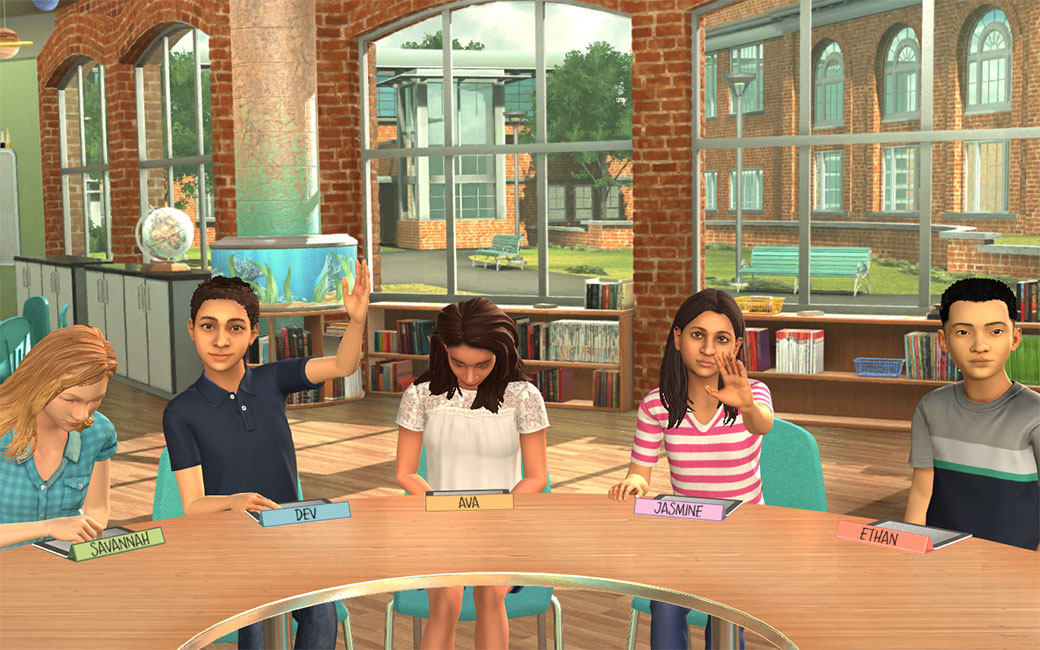 With Towson University College of Education technology, seen here in a screenshot,
preservice teachers can interact with digital student avatars in a virtual reality
classroom environment.
Lottero-Perdue says she’s received positive feedback from students who have used the
simulation technology. The simulations designed and implemented within the OPS project
will enable preservice teachers to facilitate 20-minute, argumentation-focused discussion
with five student avatars who will respond in real time. The student teachers will
be given materials to prepare for the discussion and to be able to reflect on the
experience.
This is an interdisciplinary project, incorporating participation by TU faculty in
piloting the OPS during their spring and fall 2021 courses, partnership with the College
of Education’s simulation coordinator Julia Brandeberry and employment of College of Fine Arts & Communication theatre arts graduate students to act as virtual students.
Lottero-Perdue says science education may be more important now than ever.
“We’re in a time right now where science is not trusted by everyone. I am concerned
about a lack of respect for evidence,” she says. “We need to, from the earliest grades
onward, help children reason about science and mathematics, using evidence and justification
to support their ideas.”
This story is one of several related to President Kim Schatzel’s priorities for Towson University: TU Matters to Maryland.
This press release was produced by Towson University. The views expressed here are the author’s own.