Schools
What Would An Economic Stimulus Mean? TU
Expert from TU weighs in on the merits of an economic stimulus to help with the effects of the coronavirus pandemic
By Cody Boteler on October 12, 2020
 Steven Isberg, chair of the Department of Accounting, weighs in on the necessity of
a stimulus package from Washington.
Find out what's happening in Towsonfor free with the latest updates from Patch.
Economic effects of the novel coronavirus have been clear: U.S. businesses have closed
and employees have seen their hours cut, positions furloughed or lost their jobs completely
as public health restrictions have become commonplace.
But is COVID-19 the cause or the catalyst of one of the most economically damaging
periods in U.S. history?
Find out what's happening in Towsonfor free with the latest updates from Patch.
TU’s Steven Isberg, chair of the Department of Accounting, is in the second camp,
believing the pandemic simply exacerbated existing economic conditions.
To understand how the country got here and what should come next, the TU Newsroom
had a brief conversation with Isberg.
What is your current assessment of where the country stands economically, especially
in regard to government aid related to the novel coronavirus crisis?
The U.S. economy is like a COVID-19 patient with preexisting health conditions. Growth
had been slowing prior to the shutdown as was evident in real [gross domestic product]
GDP, retail inventories and private investment spending. Income and wealth gaps continued
to widen.
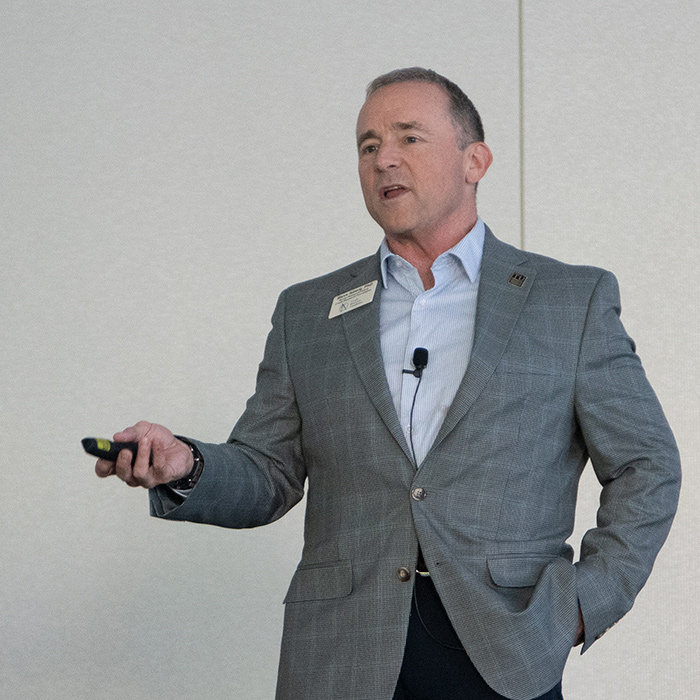 Professor Steven Isberg, chair of the Department of Accounting, says more needs to
be done to help with the economic effects of the coronavirus pandemic.
The shutdown acted as an accelerant added to a smoldering fire as it pushed declining
growth rates into a cliff dive. While there has been some evidence of a V-shaped recovery,
permanent damage to the long-term prospects for the U.S. economy are apparent. Many
retail operations will not return to business, affecting jobs in one of our biggest
employment sectors. Many reopened businesses are generating fewer revenues but often
at higher rates of profitability. In these cases, many jobs will not come back as
investors will be content with lower business volume at higher rates of profitability.
Would the stimulus plan that Congress is talking about help?
Calling this a stimulus plan is a misnomer. Like putting a COVID-19 patient on a ventilator,
the plan would help deal with the short-term symptoms of the shutdown, but it will
not lead to a period of longer-term economic growth. It may give the economy additional
time and space to recover, and it will allow many to live better lives for now, but
a true stimulus package would target long-term investment in economic growth opportunities
rather than a short-term safety net. The current plan will only forestall an inevitable
collapse if the economy does not return to healthier growth.
If Congress and the president can’t agree, what about other bodies, like the Federal
Reserve?
A key aspect of Federal Reserve Chairman Jerome Powell’s recent call to action is
the implicit message that the Federal Reserve is not equipped to deal with this problem.
The Fed has two primary tools: setting interest rates and seeding the banking system
with the reserves to fund investment spending. These tools are designed to manage
inflation, with unemployment as a secondary target, evident since the 2008 financial
markets’ meltdown. Since March, the Fed has cut rates down to zero and added more
than $1.6 trillion in reserves to the banking system. This has kept the credit markets
liquid. Without a return to substantial economic growth where benefits are shared
across the entire economy, however, the system may collapse under the weight of its
accumulated debt. Borrowing since the shutdown has skyrocketed. The U.S. debt-to-asset
ratio is at 95%, which doesn’t provide an adequate cushion against the effects of
declining long-term growth.
What is the outlook right now? What should university students be thinking?
While legislation to provide a short-term safety net for the economy is necessary
at this time, a true stimulus bill would be one that addresses the longer, rather
than the shorter-term impacts, of the conditions that preexisted and have been accelerated
by the COVID-19 shutdown.
For college students, the closer you are to graduation, the more likely this will
affect your job prospects. Be ready to adjust your game plan. Give yourself more time
to find what you want. Rethink your career options. If you're pursuing an accounting
degree, for example, broaden your search and look for companies that could use your
skills. Plan on spending more time researching your opportunities: You may find that
your original map has more interesting side roads than you previously imagined.
If you are just starting college, be on the lookout for ways to help you stay in school.
That should continue to be your goal, even if this economy doesn't come back soon.
Why? Because the fundamentals of our system won't change. Education will continue
to be valued, and those who stayed with it will stand a better chance than those who
postponed or gave up.
None of this is easy. The longer this recession drags on, the more likely we are to
recognize what improvement looks like. But a true economic stimulus plan will undo
some of the real damage of the past. Let's hope this is recognized by decision-makers.
This story is one of several related to President Kim Schatzel’s priorities for Towson University: TU Matters to Maryland.
This press release was produced by Towson University. The views expressed here are the author’s own.