Politics & Government
O'Malley 'Seriously Thinking' About Running for President
The outgoing governor says he has not made a decision yet, but is not taking Hillary Clinton's campaign decision into consideration.


By Anjali Shastry
Capital News Service
Outgoing Maryland Gov. Martin O’Malley is “seriously thinking about” running for president, he said Friday at a news conference in the Maryland State House, despite the recent blow of his lieutenant governor not being elected to Maryland’s highest office.
Find out what's happening in Upper Marlborofor free with the latest updates from Patch.
O’Malley’s future includes joining the lecture circuit and working as a visiting professor at Johns Hopkins University’s Carey School of Business, where, he said, he would be taking part in modules of classes they offer and teaching about how to apply business principles to public policy and government.
After he leaves office, O’Malley said he is “psyched” that he and his family will settle down as private citizens in their hometown of Baltimore.
Find out what's happening in Upper Marlborofor free with the latest updates from Patch.
But it is safe to say that he is not yet done with elective office.
At his final news conference as the governor of Maryland, O’Malley answered questions about the biggest issues the state and country face, as well as fielded questions his potential presidential run.
“I’m very seriously considering running in 2016,” he said, taking questions in the Governor’s Reception Room.
This decision has been complicated by the fact that his lieutenant governor, Anthony G. Brown, lost the governor’s race to Republican Larry Hogan, and that former U.S. Senator and Secretary of State Hillary Clinton may run and is considered a favorite for the Democratic nomination. O’Malley said he has not made a decision yet, but is not taking Clinton’s campaign decision into consideration.
Is ’O’Malley Fatigue Real?
Despite the fact that O’Malley disagreed with the tactical decisions Brown’s campaign made, he praised Brown for never jumping ship or betraying that he had any reservations about O’Malley’s political decisions while they were in office.
“As you all know, there were no popular choices to be made in keeping this ship moving forward and keeping it from taking on water,” he said.
Todd Eberly, a professor of political science at St. Mary’s College of Maryland, said “O’Malley fatigue” probably played a role in Brown’s loss, he said, which might hurt O’Malley’s chances in the 2016 election.
“Brown ran a horrible campaign. But at the same time, Brown attached himself to O’Malley’s hip and didn’t distance himself,” Eberly said. “He basically ran as a third term for O’Malley. If Brown ran a better campaign, maybe he could’ve balanced out O’Malley.”
Mileah Kromer, a political scientist who oversees the Goucher poll and a professor at Goucher College, said O’Malley’s record, such as abolishing the death penalty and legalizing gay marriage, will play well with the Democratic primary electorate, but he will likely be unsuccessful in his bid for the presidency.
“He has all these really great talking points, which don’t matter until we figure out what Hillary Clinton is doing,” Kromer said. “This is the battle he faces, and what every other Democratic contender faces right now.”
Positions Play Well in Primary Says Pollster
O’Malley also highlighted education and the economy as the biggest issues the state and country face.
“The problem we need to solve is how to make the economy work for all of us again,” he said, pointing to Maryland as the state with the highest median income in America and the Pew Foundation’s ranking of the state as top three for upward economic mobility.
As proud as he is of the way Maryland’s economy has begun to bounce back from the recession, O’Malley said, he is still concerned about the ripple effects of the government shutdown and sequester on the state’s economy.
In his last address to the General Assembly on Thursday, O’Malley emphasized bipartisanship as the key to keeping the government moving smoothly as the Democratic-majority legislature works with Republican Gov.-elect Hogan.
O’Malley on Friday described his own record of bipartisanship as positive with the Republicans in the General Assembly, and said that 70 percent of the legislative agenda his office submitted to the legislature was received positively by Republicans.
“The ones that make the news are the most contentious ones,” he said.
Bipartisan Partnership in Legislature Questioned
Outgoing Delegate Kelly Schulz, who will take over as secretary of Labor, Licensing and Regulation, said that the large items were not received well by the Republican members of the legislature.
“My assumption would be that it is somewhat less than 70 percent,” Schulz said.
Seventy percent of the legislation could have been received positively by the Republicans, Eberly said, but only if you consider the entirety of a legislative agenda.
“The hot button issues are where you can gauge bipartisanship, and on these issues, he was a happy partisan,” Eberly said.
“Most are mundane, routine stuff that receives bipartisan support, because that’s not what really matters. Funds, same-sex marriage, gun control, that’s where you learn if someone’s interested in bipartisanship or just pursuing their own agenda. If he runs on the basis that he can be bipartisan, there’s no record for that.”
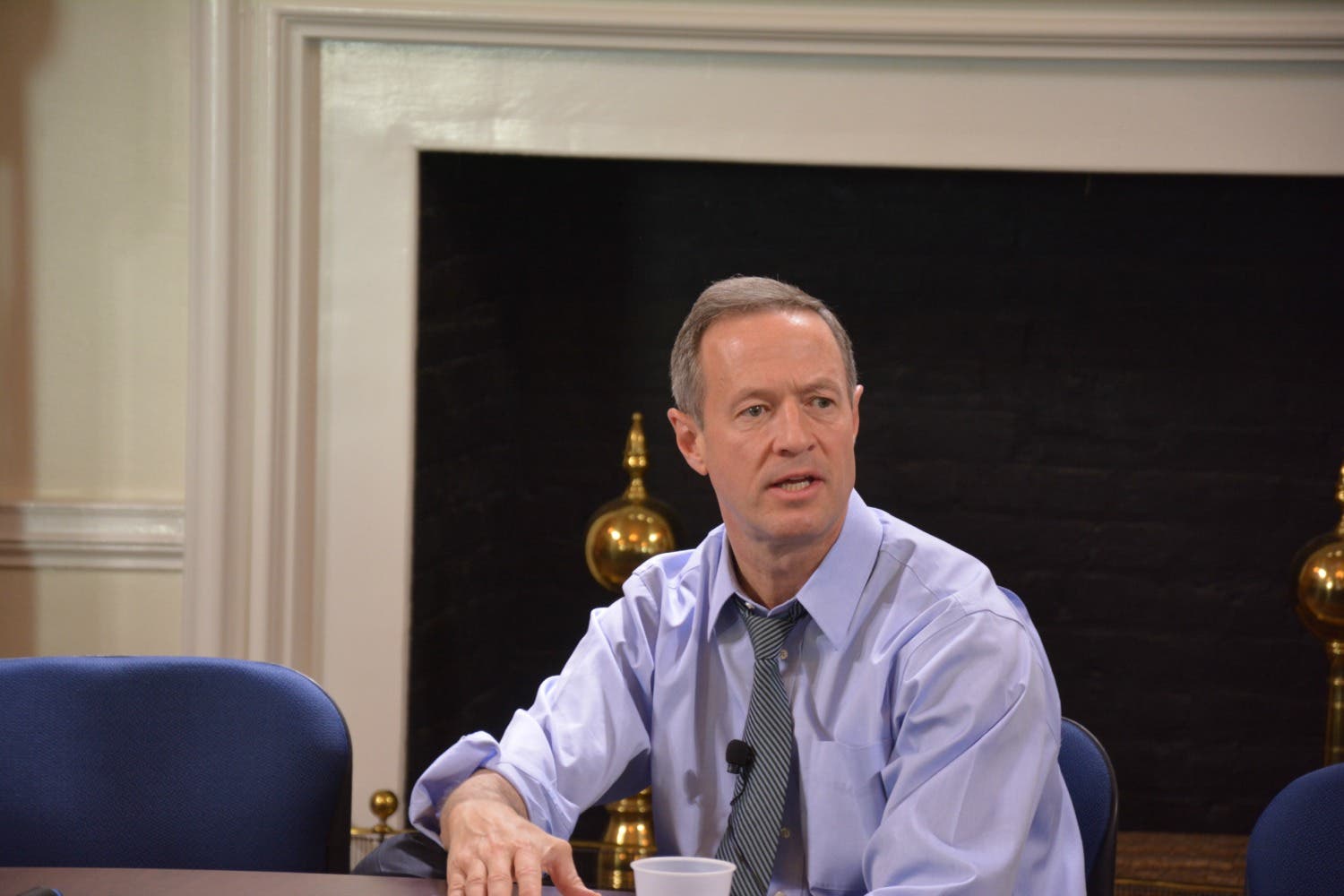
»PHOTO: Gov. Martin O’Malley answers a question while addressing the media at the Governor’s Reception Room at the Maryland State House on Jan. 16. (Capital News Service photo by Brian Marron)
Get more local news delivered straight to your inbox. Sign up for free Patch newsletters and alerts.