Schools
A-B Schools' "Unique" Anti-Bullying Efforts Discussed at Forum
Panelists offer advice, information to parents.
Bullying. It’s not a new issue, but one at the heart of many high-profile incidents and news stories across the country—and of many parents’ late-night, worst-case-scenario imaginings.
And while no one claims to have all the answers to the problem of bullying, Acton is ahead of the curve in developing a key anti-bullying policy that school administrators say offers some unique approaches for victims, aggressors and the schools themselves.
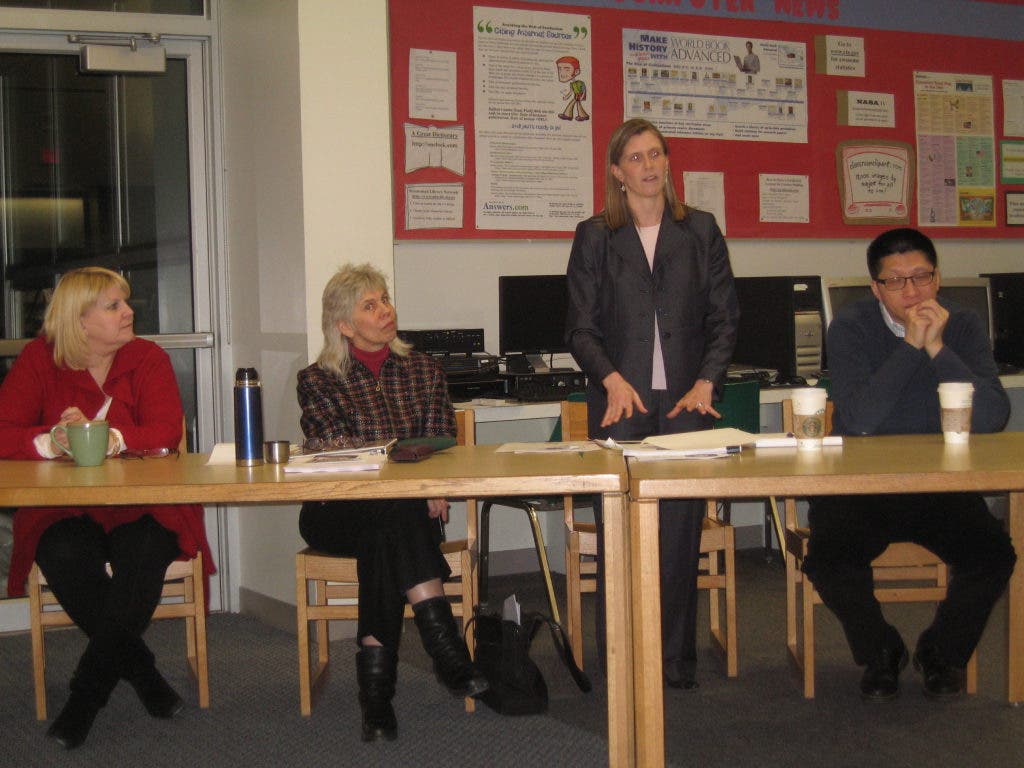
At a recent panel presentation at , parents braved frigid temperatures to learn about the recent anti-bullying legislation and Acton’s efforts to comply with it, as well as how to more effectively address the ever-present threat of cyber-bullying with their children.
Find out what's happening in Actonfor free with the latest updates from Patch.
“Bullying and Cyber-Bullying: What It Is and What You Can Do To Prevent It” included speakers Melissa Baima, an assistant district attorney and Onyen Yong, an assistant district attorney and director of information technology, both with the Middlesex District Attorney's office; Liza Huber, director of pupil services, Acton/Acton-Boxborough Public Schools; and featured speaker Carol Wintle, child and family therapist and author.
Huber emphasized the A-B school district’s relative speed in meeting specific mandates of the act relative to bullying, signed into law last May by Gov. Deval Patrick, which stipulated, among other measures, that schools must draft and adopt a prevention and intervention policy by December. In her presentation, Huber said Acton’s Bullying Prevention and Intervention Policy has been completed after more than two years of study by the 25-member Bullying Intervention Task Force, which spent “tremendous time” researching and drafting the document.
Find out what's happening in Actonfor free with the latest updates from Patch.
“In Acton, our (efforts to formalize anti-bullying) began in earnest in June 2008, when we decided we needed to create proactive guidelines,” said Huber, adding that the task force, comprised of parents, administrators, educators and other community members, “spent two years educating themselves on all aspects of bullying. And it’s because of the work of the task force that (Acton) is far ahead of the legislation.”
As a result, said Huber, “Unlike (many other school districts), we weren’t spending the fall designing the plan. We were implementing it.”
Among the procedures defined in the policy, which Huber said was “quite unique” compared to those she’s seen from other school districts, is a victims-first approach when bullying incidents are reported.
“Our biggest change as a school district is not focusing our efforts on (disciplining) the perpetrator first," she said. "We first focus on the victim’s care and support while we concurrently focus on the perpetrator.”
As well, said Huber, “We provide each victim with a (school-appointed) liaison to ensure direct and accurate information and support.”
For their part, the other speakers offered varying insights and perspectives on the anti-bullying legislation, as well as advice and information for parents on their roles in monitoring social networking and other forms of communication that can lead to bullying.
Yong, a frequent anti-cyber-bullying speaker, stressed the crucial nature of parent involvement in their kids’ technological lives, saying that “by the time (the district attorney’s) office gets involved, it’s often too late. Kids don’t realize there can be some serious consequences to their actions.”
In terms of cyber-bullying, Yong told audience members that parents have "no excuse" for not educating themselves on how to use social media, such as Facebook, if their children are allowed to use them.
“Once (kids) are in the online world, it’s like the wild, wild west—they are free to become someone else,” said Yong. “(Parents) need to get on there and stay involved with their children to keep them safe. They can’t hand over responsibility to schools.”
“The advent of cyber-bullying makes it more difficult for school administration to track incidents,” agreed Huber. “Parent involvement is critical. We want (kids) to be empowered, independent and generalizing lessons (about bullying) from both school and home."
Baima cautioned the audience of the rise of “sexting," the act of sending a sexually explicit, nude or semi-nude photo or video over a cell phone, saying many kids are unaware of the criminal nature of sending—and receiving—such messages.
“We’re seeing it with younger and younger kids,” said Baima. “And make no mistake, sexting is a crime. Students and children often don’t understand the serious implications.”
What’s more, said Baima, today’s generation of teens are all too willing to post intimate details of their lives on the internet, “naïve to the fact that once it’s out there, it’s memorialized as evidence of something you said or did. It’s always traceable.”
Wintle, a therapist and author of “Empowering Children to Stop Bullying at School,” relayed anecdotes of her personal experiences as a bullied child, while offering the perspective that all children—“especially” those perpetrating the bullying—need nurture and communication.
“Without exception, every child I’ve encountered who’s been a bully has had difficult experiences early in life,” said Wintle. “The best thing for bullies is if their families are willing to get them the help they need to change their behavior.”
While the scope and tone of their presentations varied, each speaker was in agreement about the key component to addressing both bullying and its effects, in the virtual and real worlds—open communication between parents and their children.
“You know your child better than anybody,” Baima told the audience. “And when you think something’s not right, keep pushing and trying to talk to your son or daughter about what’s going on.”
The presentation was sponsored by the Middlesex Partnerships for Youth, Inc., the Community Alliance for Youth (CAFY), and the Acton Boxborough Coalition for Healthy Youth (ABCHY), whose next planned event is a showing of Race to Nowhere, an award-winning documentary about the culture of high pressures and expectations faced by today’s students, at Acton-Boxborough Regional High School on March 15.