Schools
Parents To School Committee: Don't Change Elementary Start Times
Public forum commenters said they get the need for adolescent sleep, but they felt the elementary school changes are too drastic.


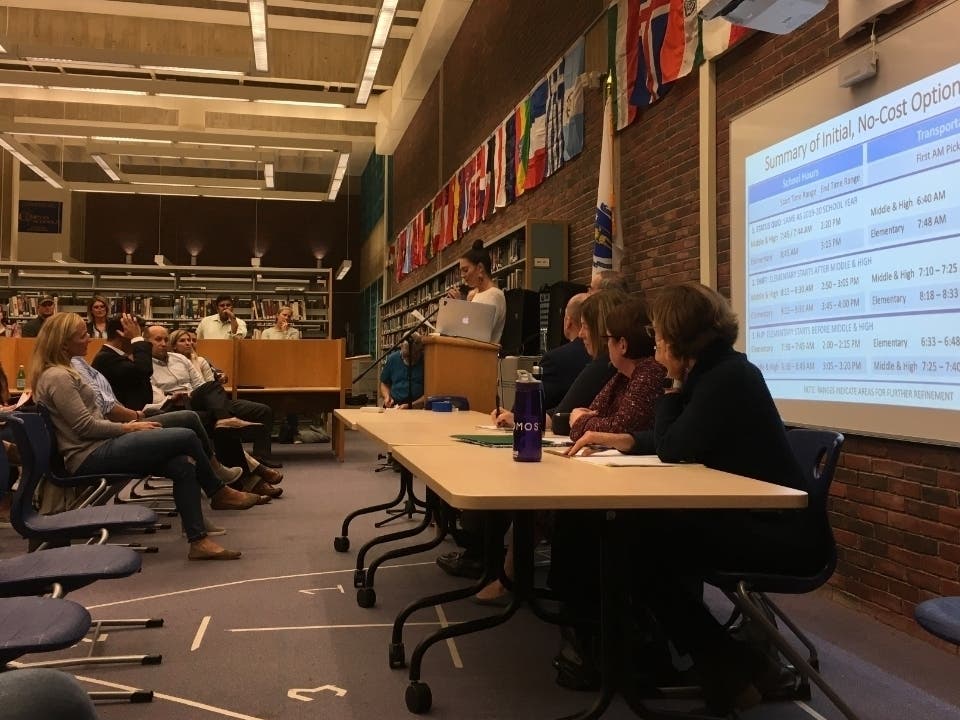
ANDOVER, MA — If the school committee thought opposition to changing elementary school start times was nominal before, they do not any more, after Wednesday night's school committee forum. Parents, largely of elementary-age students, showed up en masse to ask the committee to not to make "too drastic" changes to bell times for their kids. Instead, public commenters urged the committee to delay making a decision until they have examined other options, and to seriously consider busing options that would cost money but enable changes to middle high school start times without seriously affecting elementary schools.
The meeting's attendance nearly overwhelmed the space, with numerous parents standing at the back and along the sides of the seating area. The planned hour and fifteen minute meeting went on for over an hour and a half.
School Committee Chair Joel Blumstein opened the meeting by outlining the process and coming steps. He explained that the committee is awaiting a "transportation bus study" to "refine" the existing options. Currently, the district spens over $2 million annually on transportation.
Find out what's happening in Andoverfor free with the latest updates from Patch.
"No decisions have been made about start times," said Blumstein. "We understand that [health impacts on younger kids] are an important issue for many."
Shannon Scully, the school committee representative on the start times working group, then summarized the research saying adolescents should not be going to school before 8:30 a.m., based on a shift in their circadian rhythms.
Find out what's happening in Andoverfor free with the latest updates from Patch.
"This is not a lifestyle issue — it's a biological issue," Scully said. "Because start times are early, it's created a public health crisis where adolescents are seriously sleep deprived."
Once the public comment period began, however, the effect of start times on adolescents was barely discussed, with parents focusing instead on the effects on elementary school students.
"Most are not debating the compelling data on the benefits of sleep to adolescents," said Kristin Kissane, the first speaker. Kissane described herself as the "rebel that started the petition," referring to a petition with over 700 signatures to keep elementary start times unchanged.
"Who feels the proposed start times for elementary school students are too drastic?" Kissane asked, to raised hands from most of the room.
Kissane asked the board to delay a decision and discuss more possibilities.
Most of the parents who followed echoed Kissane's requests; of 18 speakers, 12 spoke explicitly against the proposed elementary school start times.
The second speaker, Erin Adams, summarized some recent research suggesting behavioral problems resulting from early start times in elementary schools, among other effects of sleep on younger children.
"I have reached out to many experts in the medical field who have expressed concern about the early start times our school is considering," Adams said.
"It is important to remember that younger children actually sleep even more than older children," said Geneva Crowley, a parent of kids ranging in age from six weeks to high school.
"If this child needs 12 hours of sleep, they need to go to sleep at 5:30 [to get up in time for a 6:30 a.m. bus]. Dinner needs to be at 4. Elementary-aged kids might be more adaptable, but not that adaptable," Crowley said.
There were a couple of exceptions; one speaker, a 7th-grader named Dylan, argued in favor of changing start times for older kids.
"Waking a younger kid or an adult up at 4 a.m. is equivalent to waking a teen up at 6 a.m. No one wants to get up at 4," said Dylan. "One argument I've seen is that we need to toughen teens up for the real world. That's like depriving a 2-year-old of their nap. They need their nap, and teenagers need their sleep."
At times, the conversation spun into other issues facing either adolescents or the town. Multiple speakers argued that if they had less homework, students would get more sleep.
One resident, whose last kid graduated high school last year, spoke in favor of changing start times for older kids, but urged the crowd to go to finance committee and town meetings. If residents want to keep elementary school start times in place but have middle and high schools start later, they need to support spending money on more buses.
"You need to show up and say you're willing to pay more taxes. People in town are very careful about how they spend their money," she said.
"With a community as affluent as Andover, I think we need to consider a cost option," said another speaker.
"After tonight, I hope they'll take other concerns into account," Crowley said after the meeting. "Funded options are something people really are willing to consider."
Committee Chair Blumstein said after the meeting that options including delaying decisions and funded options will be discussed.
"It's not a decision any one of us can make," Blumstein said. "We're not ruling anything out."
"We'll continue to show up at the meetings — it shows the school committee how important this is to people," said Kissane.
In coming weeks, the school committee has multiple informal forums scheduled, as well as an official school committee meetings Oct. 24 and Nov. 7. More details are available on the district website.
Christopher Huffaker: 412-265-8353 or chris.huffaker@patch.com.
Get more local news delivered straight to your inbox. Sign up for free Patch newsletters and alerts.