Politics & Government
Arlington Police Chief: 'We are Not at War with Our Communities' in Battle Against Drug Addiction
Arlington Police Chief Frederick Ryan testified at the U.S. Senate Wednesday to discuss the opioid epidemic and solutions for the future.


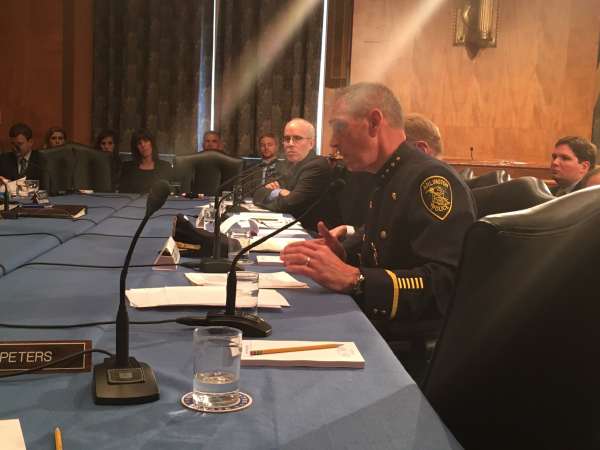
Washington, DC — Arlington Police Chief Frederick Ryan was not leading the police force in Arlington Wednesday because he was in Washington testifying before the U.S Senate Committee on Homeland Security and Governmental Affairs.
During a roundtable discussion entitled America’s Insatiable Demand for Drugs: Examining Alternative Approaches, the committee brought together a panel of federal, state and city officials as well as medical professionals to discuss America's challenges dealing with drugs in an attempt to come up with solutions. Ryan was the lone law enforcement official on the panel.
Ryan attended the meeting on behalf of the Police Assisted Addiction and Recovery Initiative (P.A.A.R.I) and focused his points on seeking help for people with addictions and to treat addiction as a public health issue rather than a criminal one.
Find out what's happening in Arlingtonfor free with the latest updates from Patch.
"We as law enforcement cannot solve this problem on our own, and we should stop telling America that with more police resources that we can," Ryan said during his testimony."In fact, a strategy that relies largely on law enforcement and arrest, especially aimed at low-end users, only fuels the epidemic and complicates the chances of long-term recovery for people suffering from substance use disorders."
In March, the U.S. Senate passed the Comprehensive Addiction and Recovery Act by a vote of 94-1. The bill aims to expand prevention and educational efforts as well as improve the monitoring of prescription drugs and help cut down on the supply of drugs.
Find out what's happening in Arlingtonfor free with the latest updates from Patch.
"I'm frustrated and have been at this a long time," Sen. Rob Portman (R-Ohio) said at the conference. "Twenty-two years ago a constituent came to me when I was at the house and said, 'My son just died, what are you going to do about it?' I was fully armed with all the statistics, and she said, 'Well, what are you doing for me?'"
Part of the discussion was focused on the stigma of drug addiction. The Massachusetts State Without a Stigma campaign focuses on removing the stigma from those suffering from drug addiction and focusing on addiction as a disease, much like heart disease and diabetes.
"We can't keep drugs out of our prisons," Ryan added. "If we think we are going to keep it off the streets of America through heavily weighted enforcement priorities, we've simply got it wrong. It speaks to the need a treatment prevention."
According to the Drug Policy Alliance, there were 1,561,231 drug law violations in 2014. Possession arrests accounted for 83 percent (1,297,384) of them.
Ryan's closing remarks focused on the relationship of police officers with the communities they serve. He said while enforcement remains a factor in the battle against opioid addiction, it is important to help those suffering from addiction as well.
"I will never argue that enforcement isn't a part of the global piece of the pie of this challenge," Ryan concluded. "It has to be proportional. You can't label it a war. As we try to roll out community policing and build trust in our communities, the last thing you want to do is conduct behavior like a warrior. We are not at war with our communities, we are guardians of our communities as law enforcement."
Photo Credit: Arlington Police Department
Get more local news delivered straight to your inbox. Sign up for free Patch newsletters and alerts.