Arts & Entertainment
Artist Freedom Baird cultivates her ROOM TO GROW in Arlington.
Freedom Baird makes ROOM TO GROW on the Minuteman Commuter Bikeway now underway as part of Arlington Public Art's new PATHWAYS series.


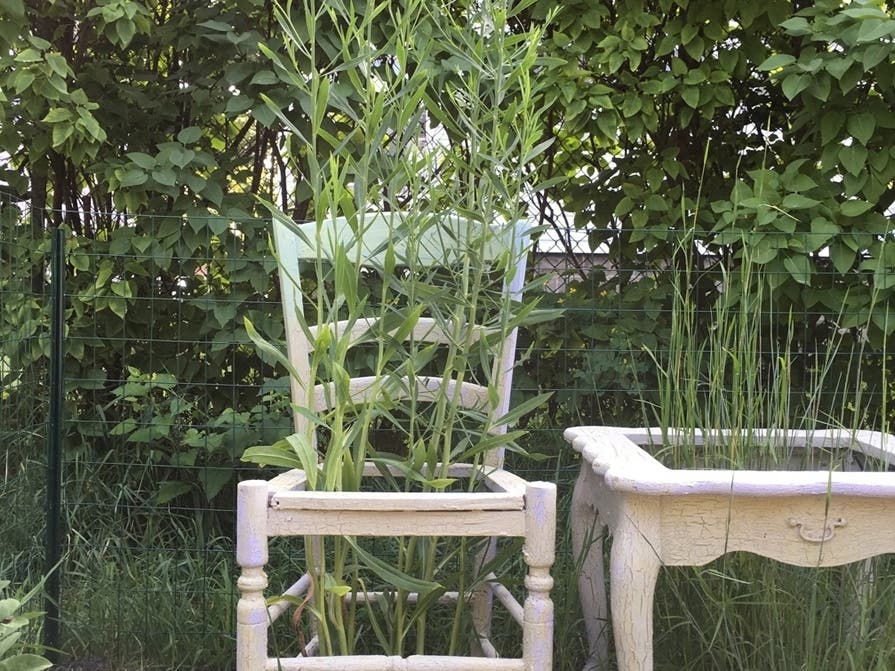
“The Minuteman Bikeway is an ideal place to spend time in the world of green growing things and to consider issues of environmental health and sustainability,” explains Arlington Public Art’s first Artist-in-Residence, Freedom Baird, “as well as how humans and nature interact. I’m inviting people to visit and talk with me about how human habitat and nature intertwine, literally!” Baird has created ROOM TO GROW, an intimate outdoor room composed of salvaged furniture and growing plants; the third ingredient is conversation. Baird’s practice centers on exchanging ideas, sharing experiences and exploring values with the public through casual conversation. ROOM TO GROW will evolve through the season until it is dismantled on September 29, 2019.
The residency is part of PATHWAYS: PUBLIC ART ON THE MINUTEMAN BIKEWAY, and joins work by three other exceptional Boston-area artists that explore nature in a suburban setting shaped by a two hundred years of human development. PATHWAYS was developed by Arlington Public Art, a committee of the Arlington Commission for Art and Culture, with multiple goals. Sited on New England’s most heavily used bikeway, PATHWAYS installations reach a large and diverse audience. PATHWAYS focuses on a specific section of the Bikeway in order to strengthen the new Arlington’s Cultural District, a designation town activists sought to support the fragile ecosystem of independent small storefront businesses in Arlington Center and Capitol Square, where storefront turnover rates and vacancies are high. And finally, organizers sought to commission art that would celebrate the survival of nature in the town – an essential part of its current character – and promote values of environmental stewardship.
Stewardship of nature is becoming a pressing theme as Arlington faces development pressure and the realities of climate change. A recent proposal to site a 219-unit development on wetland property around Spy Pond was opposed due to concerns about flooding and environmental sustainability; at the same time, affordable housing is an urgent need and in short supply. Will the town be able to balance human needs and preservation better than Belmont, which was forced to sacrifice a Silver Maple Forest to development because of its failure to plan for affordable housing?
Find out what's happening in Arlingtonfor free with the latest updates from Patch.
In this context, Baird has created ROOM TO GROW to prompt people to think about their use of resources. The artist will be present – dressed in farmers overalls – on six Sundays in August and September for dialogue and conversations with neighbors, passers-by and visitors about a range of issues that are the focus of her work and relevant to the Town. On September 8 and 22 from 5 to 6 pm she will be joined by local activists who will share their expertise and Arlington perspective as “conversation partners.”
ROOM TO GROW is furnished with a few items basic to survival – a bed, chair, and bureau – and to the soul – a window to view the world and the suggestion of a work of art hanging on the wall. All were cast-offs Baird has salvaged from curb-side trash, stripped down to create a sculptural outline of the original form, and painted to resemble the sky at twilight. Baird sited native plants to grow through this ghostly evocation of “home”. “Freedom has created a hybrid, in-between space,” stated project curator Cecily Miller. “People may wonder if they have stumbled upon a ruin -- where nature is reclaiming a space abandoned by people, or an area where humans are engaged in clearing away nature in order to move in and settle down.”
Find out what's happening in Arlingtonfor free with the latest updates from Patch.
By juxtaposing native plants with salvaged human-made objects, Baird aims to raise questions regarding the origins of the elements used to construct ROOM TO GROW. “I hope people may be prompted to think about the trees that were used to make this chair, this table, this dresser – before we turned them into furniture. And ask how was the earth mined for the metal in this lamp or this bed frame? And even from which drops of crude oil was my house paint derived?”
These questions become the more pointed when one considers that the humble, solid furnishings of ROOM TO GROW were destined for the landfill in the dramatic seasonal cycle of people on the move, driven by university and college calendars. Sustainability, our consumption of natural resources and impact on the planet are vital issues for contemporary culture. Baird evokes them without being didactic, aiming to elicit an unmediated response from viewers. And she also wants to talk about art and the creative process, conceived broadly and inclusively.
“We are encouraging people to visit while Freedom is on-site,” explains Miller. “Her work is designed to provoke conversation, and this residency offers an exciting opportunity to talk with an artist about her ideas. Freedom is genuinely eager to hear what visitors think about a range of topics – environmental activism, gardening, their own creative pursuits and what inspires them. Dialogue with visitors is as important to her art practice as the objects on view.” In just a few visits to her work-in-progress site to date, Baird has already engaged in dialog with bikeway neighbors who tend bees, struggle to eliminate invasive plants, and share stories of local history.
Other works on view are: a whimsical village of bird-scale houses composed of a variety of architectural styles and perched on a tree by Christopher Frost; 80 colorful painted plywood discs woven through foliage by Johnny Lapham; and a collectible postcard collection of vivid portraits of “Extraordinary Ordinary Birds” by Resa Blatman urging people to take steps to ensure that common birds survive the challenges of urban back yards and parks (dispensed via Plexiglas boxes).
Artist-at-work is on designated upcoming Sundays (weather permitting) from 3 to 6 pm: August 4, 18, and 25, September 8, 15 and 22. Reception with music and refreshments: Sunday, September 15, 4 to 6 pm with a raindate of September 22. Installation take-down: Sunday, September 29.
The specific location along the Bikeway: west of Linwood Street (near Spy Pond Park), Arlington 02474. And further details can be found at www.artsarlington.org/pathways, www.facebook.com/artsarlingtonMA/
Further background information on artist Freedom Baird -- (her first name is indeed her given name) -- can be found at
www.freedomBaird.org, www.facebook.com/freedom.baird.5.