Neighbor News
Reminder to be aware of performative police activism
Events in our own community should encourage us to reflect on how "good cops" should be demonstrating their support for BLM beyond photo ops
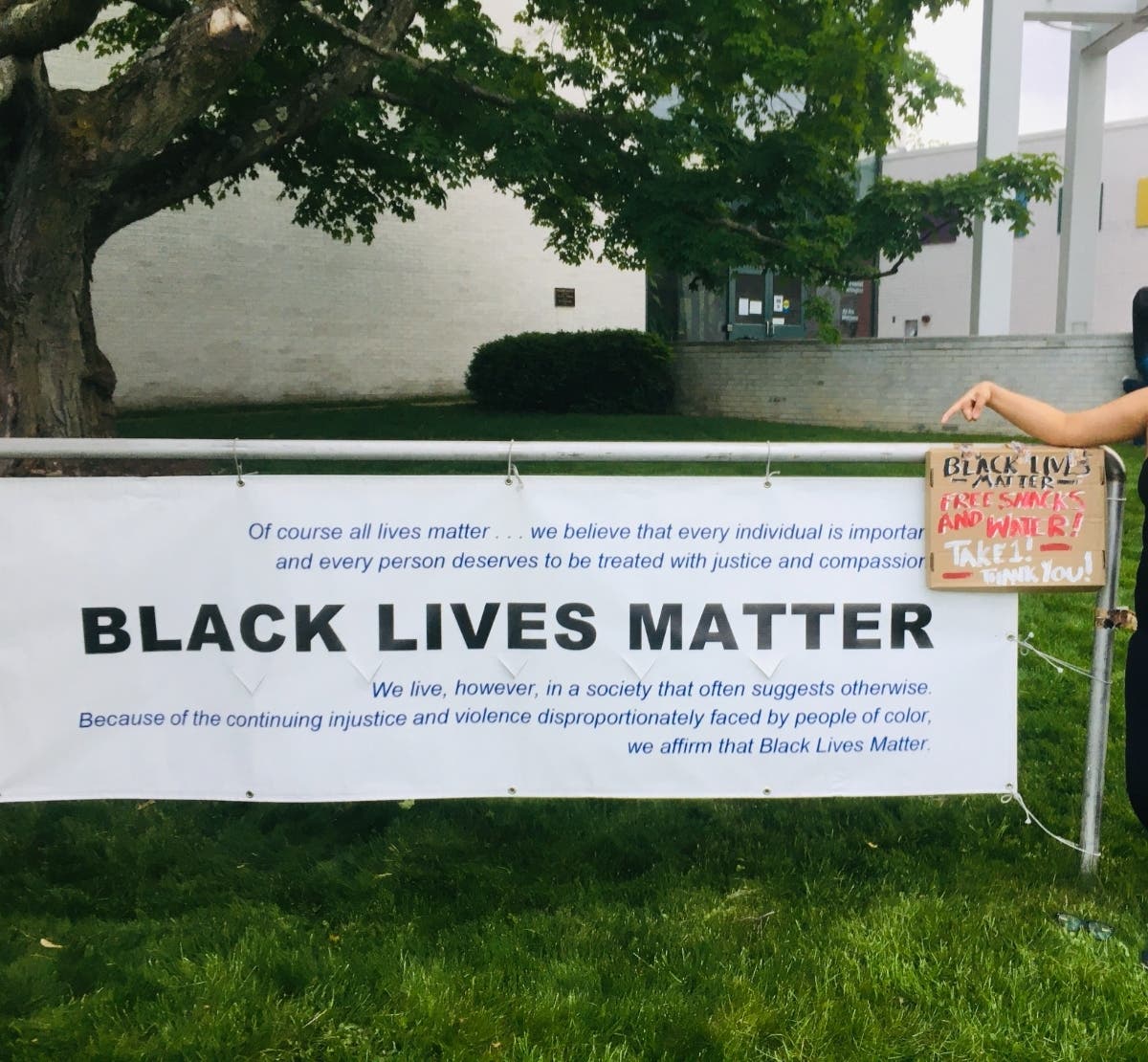
I've been an Arlington resident my whole life, and graduated from Arlington High in 2016. And I just graduated from Vassar College with a B.A. in French and Francophone Studies and International Studies. I'm back in Arlington for the time being, and needless to say we are living in a moment of complex, intersecting crises, during which I have invested myself in the Black Lives Matter (BLM) movement to a degree I have not previously, and come to see the importance of becoming involved in my community and engaged in local politics in order to make my voice heard. One part of my intentional efforts to strive to be more of an activist and become ally to Black people has been showing up to the vigils held for BLM every evening from 6-7 in Arlington Center; there, I have been warmed to see the outpouring of support night after night, and struck to see the energy and passion exuded by youth, who seem to comprise a majority of the crowd. Here, the solidarity, borne out of protestors' mixtures of profound anger, frustration, disillusionment with systemic racism, and also tenacity and motivation to realize true justice for all, has been palpable, and has inspired me as I continue charting my own path towards being a White ally and thinking about how integral my generation will be to effecting change. Yet this energizing atmosphere of the vigils has certainly been impacted by police officers, who despite their intentions of protecting the crowd and being available should anything go awry during the hour, have surely made their presence apparent. This is a time in our country where police officers and all of law enforcement have come under deep scrutiny for police brutality and violence toward Black people, people of color (POC), and so many protestors in this country, and the systemic racism and complicity underpinning such violence. I have consequently remained attuned to local events which have encouraged me to reflect on how Arlington's police force and community connect to the events we see transpiring across the nation.
A concerning encounter that my friend and I observed Friday evening at the end of the vigil for me provides that connection for me, and I would like to share it here to bring it to the community's attention. At the end of the protest, a White police officer who had stood in the back the entire hour and watched over the crowd approached a Black man and his little girl who had attended the protest, and asked the man if he could take a photograph with his daughter who was holding a sign with the names of many victims of police brutality. The man agreed rather tacitly and proceeded to take the photograph of the officer with his little girl.
While I am not trying to presume how the Black man and his daughter felt in the moment (as we did not personally speak with them), I was nonetheless unsettled by this encounter between a White police officer and a Black man. From my personal observations the man was not thrilled after receiving the request from the officer, and because of the racial power dynamics inherent in this interaction I believe that his agreeing to take the photo could have constituted a form of coercive consent. In this type of scenario which is playing out throughout the nation, the Black individual could very likely feel the need to give their consent as they may feel threatened by the White law enforcement official and what they represent; they may also fear how the official would have reacted and subsequently treated the man and his daughter at future protests, at different locations around town, etc. should they have declined the photo request. Consent is thus given, but is not necessarily a genuine representation of the consenter's true feelings and concerns. These trepidations and hesitancies may be ignored out of fear of some sort of retribution from the requestor, who retains a certain power and/or ability to inspire fear and intimidation because of his characteristics or negative connotations that have been learned by the consenter through history and personal experiences. The history of anti-Black racism in this country, for which law enforcement has served as a major engine, cannot be removed from an analysis of this scenario I witnessed.
Find out what's happening in Arlingtonfor free with the latest updates from Patch.
While I do not profess to know the intentions of the officer either, I disapprove of the familiar image he reproduced: one of cops taking a knee, holding a sign, and marching with protestors, attempting to solidify their "good cop" persona in the public eye. In my eyes this act constitutes a performative attempt to display activism and support for BLM while not necessarily true advocacy for actual police reform to hold themselves and their fellow officers accountable for whatever offenses they may have committed, and keep their records transparent to the public. I would like to see the Arlington Police Department demonstrate their support for the BLM movement in ways that go beyond taking a photograph with Black people at the end of a protest that they did not partake in but surveilled. I hope and expect that our community's police officers are attending the protests out-of-uniform and acting in solidarity with Black folx and their White allies, and making more conscious efforts to build trust with their community that they are charged to not only protect but also, to serve. This second element at the core of law enforcement's job, predicated on speaking with community members, empathizing with them, helping them, listening to their needs, and supporting them to live safe and productive lives, was missing when I saw this incident unfold between the White officer and the Black man. After ten seconds of interaction with the Black man, during which the officer simply asked the man about taking the photo rather than attempting to engage them in actual conversation and treat them like human beings, the Black little girl became simply a photo op, a prop for the White officer to pose with and then share with his network to show that he is for Black lives, that he is not one of those bad, "racist cops who have got to go" (I hear the chant over and over again in my head). Don't get me wrong: this officer very well could have had good intentions, and could have not consciously imitated this problematic trend that continues throughout the nation, but this does not mean that the impact of his actions should go unacknowledged or unexamined. Impact on others, and the impact this type of encounter could have on individuals were it to recur, is critical to consider. How actions are perceived and felt by other human beings directly impacts the trust people feel with their local police and how safe they feel, a fact which reminds us of how many Arlington residents were and remain disturbed and personally threatened by the harmful and racist comments made by Arlington Police Lieutenant Rick Pedrini in an opinion editorial published two years ago (https://arlington.wickedlocal.com/…/chapdelaine-addresses-p…).
I feel strongly that at future solidarity vigils in Arlington, in interactions between White police officers and Black people, the initiative for photo or video capture should come from the Black person or persons in order to avoid a situation in which their consent could be compromised. I encourage all Arlington residents and those attending the vigils to report if they see this scenario occur again, and to call out the APD for these superficial actions that fail to go beyond the symbolic. How are our town's police officers stepping up and acknowledging the violence they have been complicit in, how are they working to dismantle various policies like Qualified Immunity in this town and in other communities that legislate the police's lack of accountability?
Find out what's happening in Arlingtonfor free with the latest updates from Patch.
Never, but especially now, do cops need photographic evidence to attest to the fact that they are anti-racist. What I saw in Arlington is and should be a critical reminder for all of us of the dangers inherent in images we see plastered across the media of cops feigning support for BLM and purporting to be anti-racist. We should all remain attentive to how cops, politicians, and others with political and other agendas will attempt to turn such examples of fake outrage, solidarity, and concern for Black lives into novel and more creative ways to control, exploit and commit violence against Black people, preserving and perhaps exacerbating racial injustices, and the war against Black people. I personally am not going around taking photos with Black people who I do not know and posting them on my social media or sharing them with others to prove to others that I am not racist and am an active ally of Black people; I am not defining myself as an ally, I am not objectifying Black people to sculpt my own satisfying and even self-aggrandizing image of myself to receive gratification from others, which we as an American, Western society should know, Whites have a long and violent history of doing. Rather, I am partaking in a challenging, often uncomfortable, yet intentional journey full of mistakes and learning where I am striving to become an ally to Black people, who will call me an ally and an advocate of racial justice when they observe my actions and evaluate their impact themselves. In my view, a "good cop" is not someone who surveils protests and then takes photographs of themselves with protestors, but rather someone who demonstrates humility, empathy, and a deep commitment to challenging themselves, admitting and learning from their past mistakes, and their implicit biases they may have, and bettering themselves and their fellow officers. So be careful when perusing the media and applauding the "good cops" you see, that is a title that they must earn through their concrete actions to combat those enabling violence and racism and actively fight against it through reform and policy change, and we as a community must all hold them accountable for that.
I welcome dialogue and your own thoughts and comments on this topic that I feel is critical to reflect upon for its implications. I appreciate your insights you would like to share, and thank you for reading.