Politics & Government
20 Months After 2021 Mayoral Election: Still No Rent Control In Boston
Between 2022 and 2023, homeless number in families jumped by 17.5 percent and homeless number on street jumped by 42 percent in Boston.
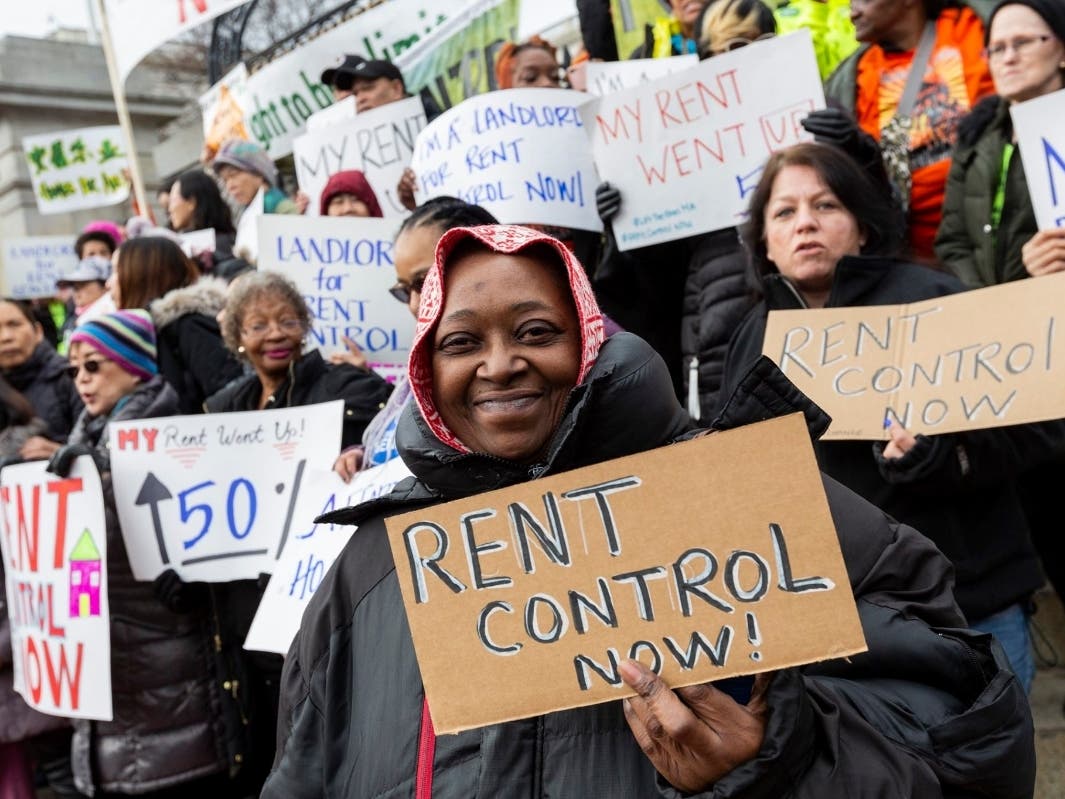
In November 2021 a purportedly politically "progressive" Democratic Party mayor of Boston was elected--on a platform pledging to restore rent control, provide fare-free public transit and end institutional racism in Boston.
Yet during the last 20 months, the economic hardships, institutionally classist exploitation and displacement experienced by the majority of Boston's working-class tenants, of all racial backgrounds, have progressively increased.
In the absence of Boston's upper-middle-class mayor declaring an affordable housing crisis emergency, mandating a rent freeze (whose legality would be defended in court by City of Boston attorneys), excluding rent control opponents connected to real estate developers from a "Rent Stabilization Advisory Committee" and instructing city agency officials to prioritize mobilizing Boston's tenant majority to demand that the Massachusetts state legislature allow restoration of rent control in Boston, for example, "the total number of homeless persons in families--homeless children and adults in all family emergency shelters and transitional housing--increased by 17.5 percent, from 2,894 in 2022 to 3,399 in 2023," according to the City of Boston's 43rd annual homeless census. And the median market-rate monthly rent for an apartment in Boston increased by $225 between June 2022 and June 2023--to $3,225 per month.
Find out what's happening in Bostonfor free with the latest updates from Patch.
Yet, as the Independent Socialist Group noted in an early 2023 flyer, even if the Democratic Party's Boston mayor and Boston city council's proposed "rent stabilization" ordinance "to cap rent increases at 10 percent for" Boston's "tenants continuing leases" was allowed by the Democratic Party-controlled Massachusetts legislature to be implemented:
"This will not apply to housing less than 15 years old or to small owner-occupied buildings [with less than 6 rental units]. It also will not prevent rent increases for new tenants. Only 56% of rental units--or 185,000 homes--would be affected by this measure. And with 65% of residents being renters, half of whom are cost-burdened, a rent increase of 10 percent would still be a massive hike to already high rents."
Find out what's happening in Bostonfor free with the latest updates from Patch.
In addition, major cities in states with universities that are less wealthy than Harvard University and MIT--like Kansas City, Albuquerque, Denver and Raleigh--currently provide fare-free public transit for all riders on all bus routes in these cities.
But the City of Boston still doesn't use the over $4 billion in public operating funds or the over $4 billion in capital expenditure funds it controls to provide fare-free public transit for all riders on all bus routes in Boston.
And, although 29 percent of Boston's city government employees are Black, 43 percent of the city government employees being paid only $20,000 or less in annual salaries by Boston's "progressive" city government are Black city government workers.
Twenty months after the November 2021 Boston mayoral election, the Democratic Party's "progressive" municipal government of Boston still seems to be more interested in continuing to provide tax breaks for universities, foundations and nonprofit institutions, as well as giving tax breaks and zoning variances to real estate developers, to help them make "progress" in constructing more high-rise luxury apartment buildings in neighborhoods like Allston-Brighton and Dorchester, than in adequately responding to the affordable housing, public transit and cost-of-living economic crisis faced by Boston's working-class tenants, of all racial backgrounds.
And, not surprisingly, in the absence of a mandated rent freeze, a rent rollback or rent control restoration in Boston in 2023, nearly 5,000 eviction notices--for failing to pay excessively high, inflated rents to their landlords--were delivered to tenants in Boston during the first two months of 2023; while, between January 30, 2022 and January 30, 2023, according to the June 28, 2023 City of Boston press release:
"The number of homeless people in Boston...increased by 17.2 percent from 4,439 people in 2022 to 5,202 people in 2023...In 2023, the number of individuals experiencing homelessness in Boston on the night of the census rose by 16.7 percent, from 1,595 individuals in 2022 to 1,803. The number of individuals staying in emergency shelters on the night of the census increased by 19.8 percent from 1,121 individuals in 2022 to 1,343 individuals in 2023...
"The number of unsheltered persons on the street on the night of the census increased by 42 percent, or 50 individuals, from 119 individuals in 2022 to 169 individuals in 2023
"The total number of homeless family households increased by 18.4 percent, from 955 households in 2022 to 1,131 households in 2023.
"The number of persons in families in emergency shelter increased by 19.5 percent from 2,841 in 2022 to 3,995 in 2023.
"The number of family households in emergency shelter increased by 21.5 percent from 929 households to 1,129 households.
"The number of unaccompanied youth (up to age 24) experiencing homelessness on the night of the census increased by 25 people from 87 to 112, a 28.8 percent increase. Five people (20 percent) were unsheltered..."