Neighbor News
Israeli Scholar’s Seminar at Boston University Bridges Ethics and Technology
"Neglecting ethics can ultimately damage trust and long-term success," explains Bar-Ilan University's Prof. Orly Shapira-Lishchinsky.

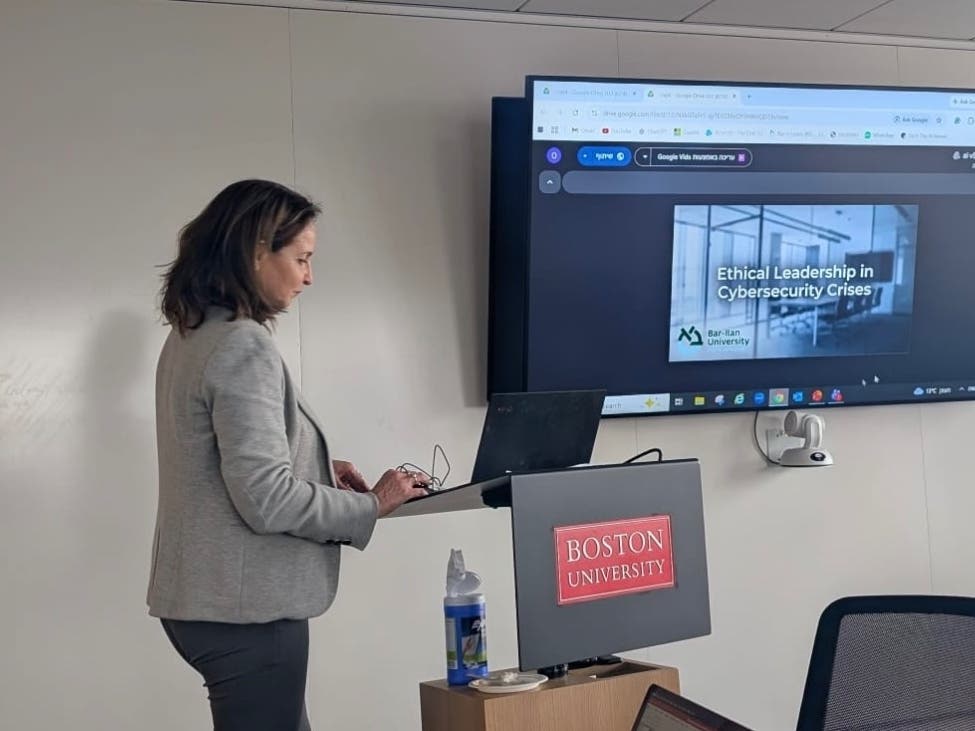
A recent seminar at Boston University (BU) spotlighted a growing challenge at the intersection of technology and society: how to integrate ethical decision-making into the rapidly evolving field of cybersecurity. Led by Bar-Ilan University’s Prof. Orly Shapira-Lishchinsky in collaboration with BU researchers, the event highlighted an innovative interdisciplinary approach to training future leaders in cyber ethics.
At the heart of the April 17 seminar at BU’s Center for Information and Systems Engineering was a research-driven workshop developed jointly by Prof. Shapira-Lishchinsky and her partners Prof. Ari Trachtenberg and Prof. David Starobinski, both from BU’s College of Engineering. Their collaboration reflects a broader effort to address ethical blind spots in technical fields—particularly in cybersecurity, where decisions can have far-reaching societal consequences.
“It’s challenging to convince stakeholders in cybersecurity to dedicate time to training on their ethical dilemmas in a field where time is seen as money; however, neglecting ethics can ultimately damage trust and long-term success,” said Shapira-Lishchinsky, Professor in the Department of Educational Administration and Leadership, and Head of the Institute for Social Integration in Bar-Ilan's Faculty of Education.
Find out what's happening in Bostonfor free with the latest updates from Patch.
A new model for ethical leadership
Shapira-Lishchinsky, a scholar specializing in mentoring and leadership, described the project as the result of an interdisciplinary initiative supported by Bar-Ilan University leadership. By partnering with engineering experts at BU, the team created a novel training program that blends social science and technical perspectives.
Our collaboration brings together social science and the exact sciences,” she said.
Find out what's happening in Bostonfor free with the latest updates from Patch.
The workshop centers on immersive, interactive case studies. Participants engage with realistic cybersecurity scenarios presented through avatar-based simulations, designed to reflect diverse perspectives. These scenarios prompt users to confront ethical dilemmas commonly faced in the field.
One case draws inspiration from a real-world cybersecurity incident involving a major company update that led to widespread system failures, disrupting hospitals, airlines, and banks. The case challenges participants to consider difficult questions: Should a company disclose its mistakes at the risk of losing clients? Why are internal warnings sometimes ignored? And how should organizations balance speed, profit, and responsibility?
According to Prof. Shapira-Lishchinsky, the goal is not only training but also achieving research impact. The training program includes pre- and post-workshop evaluations to assess whether participants develop stronger ethical leadership skills and strategies by practicing ethical decision-making through cybersecurity case studies.
The team’s suggestion is a systematic dynamic model that integrates insights from both social and exact sciences. This model encourages participants to examine systems holistically, identifying ethical dimensions that might otherwise be overlooked.
Why ethics matters more than ever
The seminar underscored a critical concern within the tech industry: the lack of ethical grounding among decision-makers.
“There’s a real concern in technology about ethics,” Trachtenberg said, “because you have executives running tech companies who by and large seem to not have a historical understanding of philosophy and the other humanities-related disciplines behind the Western culture we have today. They’re making decisions largely on technical and business considerations and there could be damaging outcomes as a result of that.”
To address this gap, the workshop aims to influence not just current professionals but future leaders, so that “when students become important leaders one day, they’d be cognizant about some of these tradeoffs,” Trachtenberg noted.
The urgency of ethical awareness is particularly evident in areas like data privacy:
“In the privacy domain, everything we do on many websites or apps is being recorded at levels that I think most people don’t realize,” he explained. “This is a very legitimate privacy violation and also somewhat of a moral violation.”
By embedding ethical reasoning into cybersecurity education, the program seeks to shift industry norms—making ethics a core component rather than an afterthought.
The power of U.S.-Israel academic collaboration
Beyond its research contributions, the seminar also highlighted the importance of international academic partnerships—particularly between institutions in the United States and Israel.
Shapira-Lishchinsky called the collaboration a “win-win situation,” combining Israel’s strengths in organizational behavior and cybersecurity with America’s resources and scientific infrastructure. The partnership enables both sides to expand their perspectives and develop more robust solutions to global challenges.
Trachtenberg emphasized the broader role of academia in transcending political divisions: “Such collaborations are especially significant in today’s geopolitical climate.”