Schools
New Shape of Bullying Detailed at Braintree High
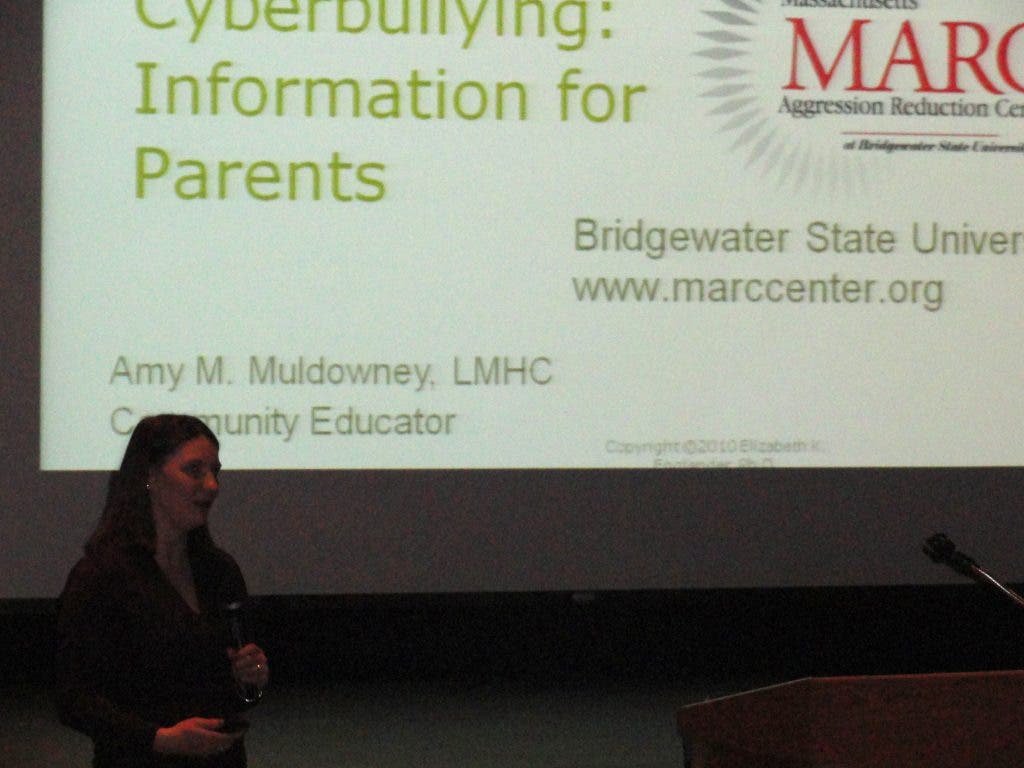
Amy Muldowney, a clinician and educator that works with a child aggression center at Bridgewater State, presented bullying information and tips to Braintree parents Monday night.


He is no longer a large, isolated boy with only a tag team of friends striking out at the smaller kids, sometimes physically. Instead, in this modern age, the bully takes many forms, and may just as easily be a group of popular students turning jokes into vicious rumors, or a girl scorned, doling out her revenge on Facebook.
Today's schoolyard power struggles don't always match up big and little, and aren't necessarily happening on the blacktop, at lunch or on the bus. No, bullying now predominantly takes place in cyberspace, where even more kids gather and adults have been playing catch up on imposing boundaries.
This much is known about the changing world of bullying, though plenty remains to be learned, by both academics and parents, said Amy Muldowney, a psychologist and school counselor, during a presentation hosted by the Braintree Alliance for Safe and Healthy Youth at the high school on Monday night.
Find out what's happening in Braintreefor free with the latest updates from Patch.
"None of this stuff was happening when I was in school," Muldowney said, imagining a scenario where some fourth graders have cell phones and others don't, and the resulting power imbalance. "It's all the things that could have been happening the past 100 years, but now there's this other component to it."
Muldowney shared data from the Massachusetts Aggression Reduction Center (MARC) at Bridgewater State University with parents gathered in the auditorium, encouraging them to have frank conversations with their children about setting up online rules, sexting, and the proper ways to deal with emotions.
Find out what's happening in Braintreefor free with the latest updates from Patch.
Norfolk District Attorney Michael Morrissey, who voted for the and other schools last year when he was in the Senate, said before Muldowney spoke that he supports prevention and intervention in juvenile cases ahead of prosecution.
"It is a very different world these days when you look out there at the choices you have to make," Morrissey said.
Of the kids studied by MARC in 2009, 27 percent met the parameters of cyber bullies, compared to 7 percent for those practicing more traditional bullying. "We don't have a really firm profile of who these kids are," Muldowney said. "We're pulling in a whole other group of kids we never anticipated would be a problem."
Along with the ease and anonymity of picking on fellow students online, increasing sarcasm on children's television programs and in the world around them – "It oozes from us" in Massachusetts – has added kids to the bullying ranks.
This wider definition requires heightened attention to what actually constitutes bullying. It is a learned behavior, perpetuated by the positive response of peers. It is repetitive, not just an isolated mistake. And it leads to the victim feeling depressed, irritated, unable to enjoy the same things as before, and ultimately afraid to go to school.
Parents should turn the topic into a constant message, Muldowney said, like warnings about seatbelts and smoking. "That's what we need to do with bullying," she said. "Bullying is a social health issue."
The overwhelming majority of educators recently polled by MARC say that children's social coping skills have diminished, often dramatically, over the past decade. Schools focus more and more on just academics, with test prep and literacy and math lessons taking up an increasing amount of time even for kindergarteners, reducing the chance at free play, when students learn conflict resolution.
"Show them what a good argument looks like," Muldowney urged parents. "They're just not picking up these skills."
She also suggested parents provide their children play time outside of school, even high schoolers. "Kids are often looking for a time when they can be immature," Muldowney said. "A lot of our children are very regimented now. We leap in to help their problems."
A final piece of advice, driven hard by the master's level clinician, who reminded the crowd she wasn't so far out of grade school, was to take charge of electronic devices their children have access to. Smart cell phones are connected constantly to the Internet, video game systems can go online, social networking can quickly overwhelm with its unintended networking –all of this is potential pitfall and opportunity, Muldowney said.
"You need to be aware of the websites they are using and what they are using them for," she said. "I'm assuming none of your children are paying the Comcast bill."
Get more local news delivered straight to your inbox. Sign up for free Patch newsletters and alerts.