Politics & Government
Substance Abuse Seminar Focuses on Solutions to Prescription Drug Abuse
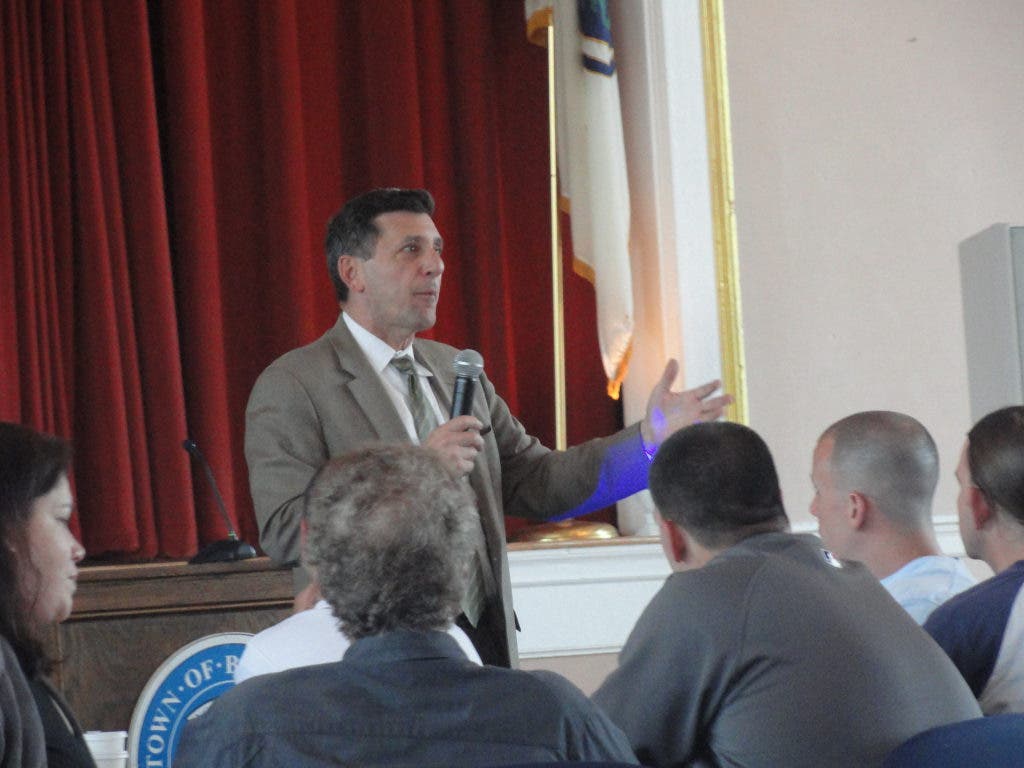
Braintree's Community Partnership on Substance Abuse put on the event Wednesday evening at Town Hall. Attendees included state legislators, the sheriff, the DA and other stakeholders.




When Peter Thompson and his wife Heather mourned the loss of their son to opiates last fall, they purposefully avoided the term, "He died suddenly."
The term simply didn't fit.
Ryan Thompson, who grew up and went to school in Braintree, had long been an addict of OxyContin, had been to treatment and had been known to the police by the time his parents learned of his death, in California on his 25th birthday.
Find out what's happening in Braintreefor free with the latest updates from Patch.
"He didn't die suddenly. We want people to know our son died of addiction. He was a great kid, but once he started he couldn't stop," Peter Thompson told a crowd of state and local officials and residents gathered on Wednesday evening for a Substance Abuse Symposium at .
"The best thing we can do for our children is to teach them younger not to start," Thompson said. "Once you do that first drug you never forget."
Find out what's happening in Braintreefor free with the latest updates from Patch.
Better education for all of those involved – from kids and young adults to doctors, law enforcement and lawmakers – emerged as the focal point of the night, developed over the course of several months by Braintree’s Community Partnership on Substance Abuse.
About eight months ago the partnership began a series of meetings with the goal of increasing awareness, especially in the , but also among the general public, Mayor Joseph Sullivan said. Public safety and schools representatives joined with residents, the district attorney's office and others to craft the message.
The effort comes as Braintree and other communities face a surge in opiate-related crime, deaths and illness. Over the last 12 months, Braintree has seen a 10 percent increase in drug-related crime, Sullivan said, and from 2005 to 2010 the town's overdose rate doubled to two per week, not including situations where no one calls 911 or where the overdose is immediately fatal.
Just this week, in connection with a prescription drug trafficking scheme that stretched from here to Florida.
"It's important to put up a strong defense and signal as a community that we are not going to put up with this activity," Sullivan said. "We need to be monitoring it."
Wednesday evening's keynote speaker was Michael Botticelli, director of the Bureau of Substance Abuse Services at the Massachusetts Department of Public Health. He also turned the audience's attention to some startling numbers – people have an 85 percent chance of receiving treatment for diabetes but only a 2 percent chance of the same with substance abuse; 70 to 80 percent of those in correction facilities are alcohol or drug addicts – and stressed the need for a wholesale shift among communities and those in authority about how to deal with the problem.
"It's really a system failure," Botticelli said. "These are the people you are arresting time and time again... these are the students who aren't doing well in school."
Botticelli is himself a recovering addict of 22 years whose father was an untreated alcoholic. He said that over time the route to substance abuse has changed, the tradition of cigarettes to alcohol to marijuana to harder drugs having largely been supplanted by easy access to prescription medication.
Still, alcohol is a significant factor, Botticelli said, pointing out that a person is four times more likely to try drugs likes opiates if they take their first real drink before age 15. The average age in Massachusetts, he said, is 14.
Therefore the answer, or at least a major part of it, is to discover the behavior typical in a town, neighborhood or school and work to shift attitudes in a more healthy direction. "Is there a norm in your community that doesn't tolerate use?" Botticelli said.
Turning to the legislative side of the issue, state Sen. John Keenan, D-Quincy, spoke of how, a few weeks after his appointment in January, he received a surprising envelope. Inside contained a committee slot, which he expected to be centered around his knowledge of municipal finance. Instead he received the Senate chairmanship of the Joint Committee on Mental Health and Substance Abuse.
Soon Keenan began making visits around the state to different health facilities, talking with patients about their addictions and illness.
"You hear these stories and you realize it is truly an epidemic," said Keenan, who has three boys, ages 17, 16 and 10. "It scares the living daylights out of me as a parent."
That fear is compounded, he said, by the fact that it is more difficult, even impossible sometimes, to detect whether someone has been on a prescription drug rather than alcohol or marijuana. "You can't be too vigilant," Keenan said. "Pills are everywhere."
As a result of increased awareness brought to the problem, the legislature is working on several initiatives, Keenan said, including a prescription monitoring program with real-time information for doctors, drug drop-off events such as the one that recently netted thousands of pounds of unused prescriptions throughout the state, and pill bottle labels with warnings about addiction.
"We can't keep our heads in the sand," he said. "We can't refuse to recognize that this is a big problem."
Norfolk County Sheriff Michael Bellotti and a representative for Norfolk County District Attorney Michael Morrissey also spoke to the crowd of about 100 people at Town Hall, offering ideas as part of what Mayor Sullivan termed "a coordinated effort to reach this in a big way."
Bellotti promised to continue working on ways his department could better shift resources toward treatment and away from what he called unnecessary prison time, and also called on the public to reach out to lawmakers and the governor.
"As the head jailer, as the sheriff of Norfolk County, we do not do it right," he said. "Drop the tough on crime talk."
The DA's office is working on a number of priorities, including restructuring the state police's drug unit, installing drug kiosks at police stations, diverting juveniles into treatment and updating community outreach programs, especially those associated with schools.
Volunteering and partnering with the community were what kept Peter Thompson off drugs, he said. When Thompson was a kid he was shuttled around to basketball games and was so involved in town and neighborhood activities that he managed to avoid the pull of substances. These days, he said, it's difficult for kids to do the same because of availability and the lack of many of those pastimes.
"I'm here to say drugs are alive and well in Braintree High School," Thompson said. "This isn't about our government. It's about our community... Maybe it's more about caring about your neighbor, caring about your friend."
Get more local news delivered straight to your inbox. Sign up for free Patch newsletters and alerts.