Schools
Engineering Technology students at Blue Hills Regional combine robotics with 3D printing for innovative projects
Amazing robots created by Blue Hills Regional students using the latest technology
By Judy Bass
When juniors in the Engineering Technology program at Blue Hills Regional Technical School in Canton recently combined their knowledge of robotics with the capability and versatility of 3D printing, the results were nothing short of remarkable.
“The Blue Hills Engineering program has a comprehensive robotics program that starts freshman year and continues through grade 12,” observed Engineering Technology Lead Teacher Dr. Michael Meyers, who plays an important role in the design and programing of the robots, according to Engineering Instructor Dan Hamill. His expertise in digital electronics, said Mr. Hamill, is essential in the operation of the vehicles.
Find out what's happening in Cantonfor free with the latest updates from Patch.
“Students are encouraged to use their design, building, programming and testing skills to complete complex robotic platforms that can perform and solve real-life tasks,” added Dr. Meyers.
The students did exactly that when they recently fashioned robots crafted to handle certain roles with ease.
Find out what's happening in Cantonfor free with the latest updates from Patch.
For example, two robots were created to travel successfully over any kind of challenging terrain. Another remotely-operated robot can “battle” a second robot.
To produce them, students had to master the use of sophisticated software as well as the 3D printer, which was utilized to make parts such as shock absorbers for the robots. They also were required to bring into play their problem-solving skills and analytical ability – in short, they needed to act just like actual engineers working to conceptualize and perfect a new high-tech device.
“Students use the latest technology available to design, program, and build these robots,” explained Mr. Hamill. “They use Inventor 2015, the latest in mechanical engineering software, to design the robots in a 3D drawing environment. We use RobotC to develop programming skills that tell the robot what to do and how to react to the environment around it. An SE Print plus is utilized to create special designs via 3D printing technology.”
Mr. Hamill continued, “The class that I have taught for five years is called Computer Integrated Manufacturing (CIM). I use a nationally certified curriculum called Project Lead the Way (PLTW) to implement these types of projects. The curriculum has been developed by a team of industry professionals to get students interested in engineering at a young age. Essentially, the curriculum teaches students to solve problems. The projects have increased in the level of difficulty every year since the course’s inception.”
Mr. Hamill described the projects done by each pair of students.
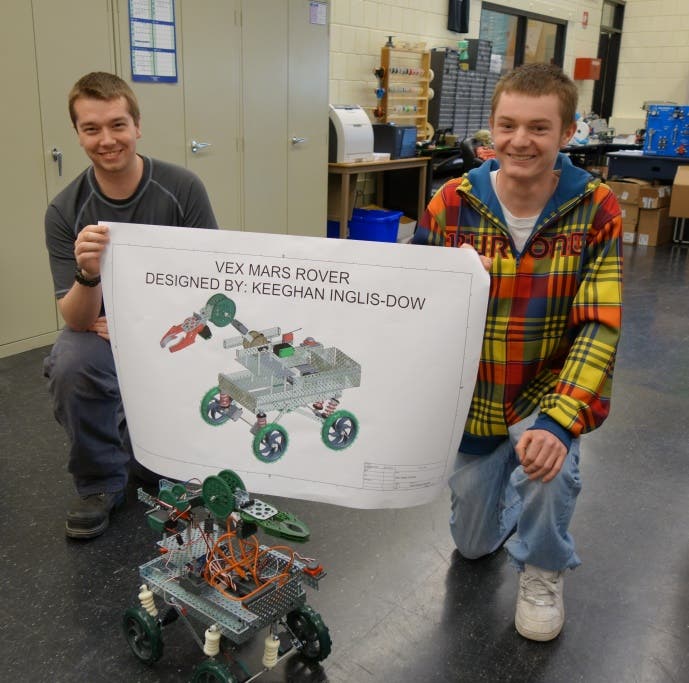
Keeghan Inglis-Dow (Holbrook) and Corbin Clancy (Braintree) were tasked with creating a robot that will solve a particular problem. On this robot, students designed a system to handle many different types of terrain on a distant planet. Not only did the robot have to travel to any destination, it had to pick up rock samples and place them in a storage area located on the back of a different robot. Students built and programmed the robot, and also developed a shock absorber system to enhance its maneuverability. The shock absorber was developed with the latest mechanical engineering software called Inventor 2015 and printed in 3D with a SE Plus 3D printer.
Kimberly Sian (Holbrook) and Markanthony Robinson (Dedham) designed a robot for a Nerf gun challenge. The goal of the project was create a robot to battle another robot of similar design. They had to create a robot that could be remotely operated from another room and “see” the environment via use of a remote camera. They also developed a system that could fire a Nerf projectile onto a bull’s eye located on an opponent’s robot. When the bull’s eye was hit, the robot would be programmed to shut down and disable movement for thirty seconds. The bull’s eye was printed in 3D with an SE plus 3D printer.
A robot was designed by Patrick MacPherson (Holbrook) and Alyssa Campbell (Randolph) to navigate any terrain conditions such as tall grass, rocks, or a muddy stream. Students researched many types of all-terrain vehicles. They used the Internet to research wheel designs found at the Boston Robotics site. They then used reverse engineering procedures to develop their own design on Boston Robotics’ wheel design and the wheels were printed in 3D.
The experience was clearly a rewarding one for the students. “From this project I learned how to better navigate through problems that arise during the building and design process,” said Keeghan Inglis-Dow. “We had to redesign the robot several times and that was the most challenging aspect of this project that I can think of. This is the reason why I joined this technical program. I enjoy solving problems and Engineering provides a great environment for just that.”