Neighbor News
The Future of Obama Care in a Trump Administration
MGH Institute of Health Professions faculty discuss ramifications if the Affordable Care Act is repealed.
Although details of his plans have been sketchy, President-elect Donald J. Trump promises to shape a very different health care landscape than his predecessor, Barack Obama.
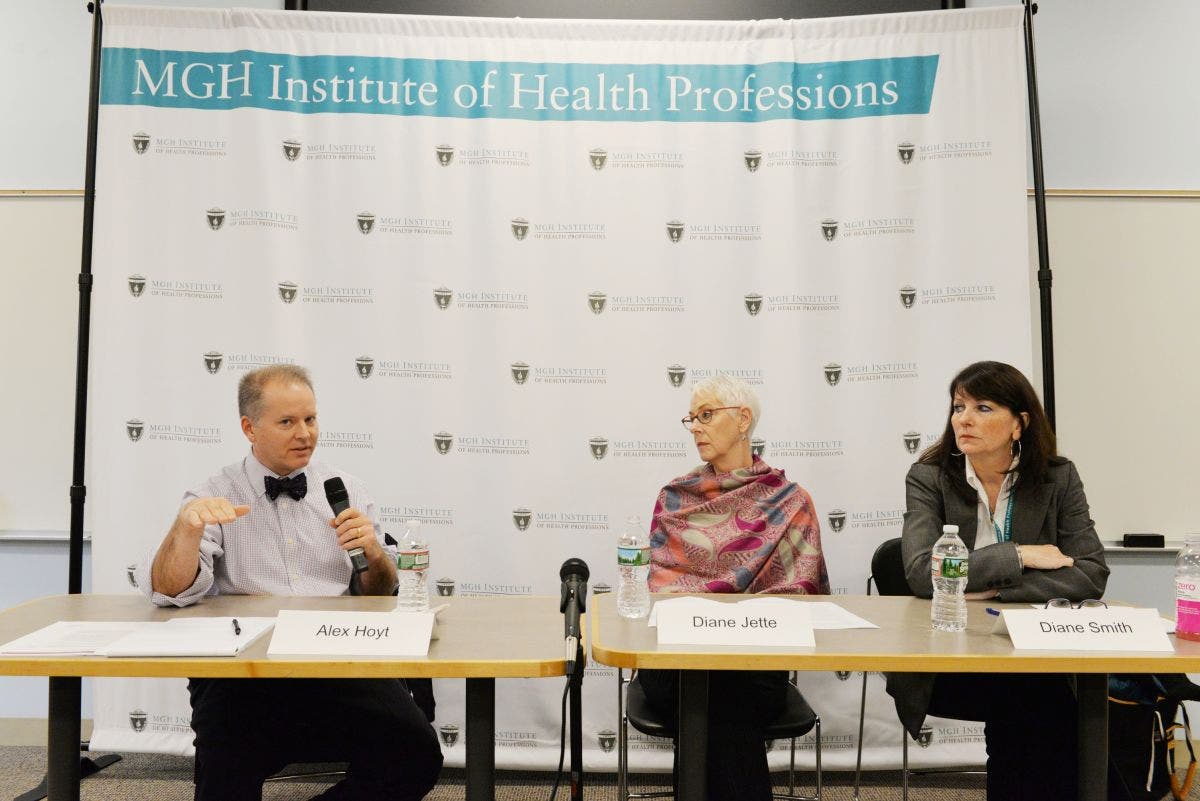
To MGH Institute of Health Professions faculty members (left-right, above) Alex Hoyt (nursing), Diane Jette (physical therapy), and Diane Smith (occupational therapy), this week’s election means it’s even more imperative to educate health care graduate students on how to adjust to a system that has the potential of eliminating health insurance for millions of Americans if the Republican Party follows through with its six-year goal to repeal the Affordable Care Act.
“As health care providers, you are going to be working with clients on what their choices are,” said Dr. Smith, who teaches Leadership, Management and Policy, and Disability and Society. “ A lot of the time they won’t know what to do or what their options are, so it will be on all of us to help them through the process.”
The faculty members presented their views during a panel discussion on November 9, “The Day After: How the Election Affects Health Care” on the Charlestown Navy Yard campus of the health sciences graduate school.
Since the ACA was enacted in 2010, the House of Representatives has voted its repeal more than 60 times, only to be thwarted by President Obama’s veto. A straight repeal could cancel coverage for upwards of 25 million people, but Dr. Hoyt noted that eliminating popular elements such as providing coverage until a person is 26, or not allowing someone with a pre-existing condition to get coverage, could be quite unpopular – even among people who voted for Trump. Unpopular or not, changes to the ACA, can, and likely will happen without congressional voting, through budget reconciliations or executive order.
“There’s going to be a backlash. There must be some sort of replacement,” said Dr. Hoyt, who teaches Health Care Policy and Politics, and Health Care Economics and Financing. He noted that several GOP plans include having states set up their own health care exchanges, allowing consumers to purchase insurance from exchanges outside their state, providing tax credits to purchase insurance, and replacing Medicare with a voucher system.
Dr. Jette warned that if the federal government implements a replacement plan similar to that proposed by the GOP, the federal budget could increase by as much as $41 million annually because of the proposed tax breaks for insurance premiums and loss of other revenues accrued through provisions of the ACA.
Additionally, healthcare costs could rise as underinsured or uninsured people return to using emergency rooms for routine care, or stop receiving care entirely until they are so ill as to require hospitalization. “Even under the ACA, we have people with insurance who don’t receive care because it’s still too expensive,” said Dr. Jette, who teaches Clinical Perspectives in Health Policy.
The panelists urged the students, faculty, and staff in attendance to be advocates for change, especially within their disciplines’ professional organizations to ensure politicians will hear about the potential downsides of new policies.
“It’s even more important now,” said Dr. Smith. “We all need to continue to be aware of what’s going on and advocate for our clients. It does affect what you do as a practitioner.”
Dr. Hoyt noted that there’s a major difference in the care people receive in urban versus rural areas of the country, a divide that played out in the voting patterns of this year’s election, and urged the students in attendance to consider working where the needs are greatest. For Bianca St. Louis, a second-year Master of Science in Nursing student, returning to her hometown of Brockton is where she believes she can best provide care for a vulnerable population in an underserved area.
Like most people in the audience, St. Louis was tired after staying up into the wee hours of Wednesday morning to hear the election’s results. But ever hopeful that as a soon-to-be IHP graduate she will be able to make a difference in the world, she noted, “I still have a glimmer of hope that things will be better, even if it doesn’t feel that way right now.”