Neighbor News
Falmouth Turbines Bad Narrative For Massachusetts Offshore Wind
A 400' Science Fiction Project Gone Horribly Wrong
Massachusetts state and local officials failed the Massachusetts land-based wind turbine agenda of 2000 megawatts of power by 2020 over health issues in twenty-one communities.
The Town of Falmouth installed two-megawatt wind turbines in 2010 and 2012 despite multiple 110-decibel noise warnings from the wind turbine manufacturer Vestas and on top of that, the state had all the specifications showing the turbines were as loud as a rock band playing 24/7.
As soon as the first turbine began to spin up to 200 neighbors complained about a range of health effects from hearing loss, nausea, and sleep disorders to dizziness, blood pressure, tinnitus, and more.
Find out what's happening in Falmouthfor free with the latest updates from Patch.
The Massachusetts Department of Environmental Protection who brokered a 5 million dollars American Recovery and Reinvestment Act loan on the town-owned wind turbine wasted years conducting noise studies and hearings in an effort to hope the residents would just go away.
The Massachusetts Department of Environmental Protection is in bed with the wind turbine industry and had to ignore the health of thousands of citizens to meet its renewable energy goal.
Find out what's happening in Falmouthfor free with the latest updates from Patch.
Two town-owned wind turbines have not operated since a Barnstable Superior Court judge in June 2017 ordered that the pair shut down.
Today the 15-year-old gearbox -driven wind turbines sit there waiting years for decommissioning.
First the citizens now the Whales:
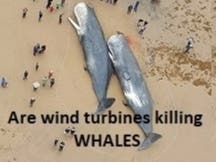
We know the area that has the world’s biggest concentration of offshore wind turbines that there is ample evidence that their acoustic pollution can interfere with whale communication and navigation.
The types of noise measured in decibels and infra-sound or low frequency made by offshore wind farms can interfere with a whale’s sonar, and can in tragic cases see them driven onto beaches where they often die.
The U.S. Navy recognizes the danger that sonar systems represent for all types of marine mammals. The U.S. Navy has concluded that it killed at least six whales in an accident involving common ship-based sonar. This proves low frequency can travel long distances.
In a February 2005 letter, the Massachusetts Audubon Society estimated that the proposed Cape Cod wind project alone would kill up to 6,600 marine birds each year, including the roseate tern, which is on the endangered list.
After the land-based wind turbine disaster, the same Massachusetts state and local officials are in charge of installing and regulating ocean wind turbine projects.
Time to stop the insanity ?
Old Gear Driven Wind Turbines Rusting Away
.jpg)