Neighbor News
Falmouth Wind Turbines: Massachusetts DEP "Grand Corruption"
Grand corruption is an abuse of entrusted power by public officials that benefit the few at the expense of all. Corrupt Massachusetts DEP
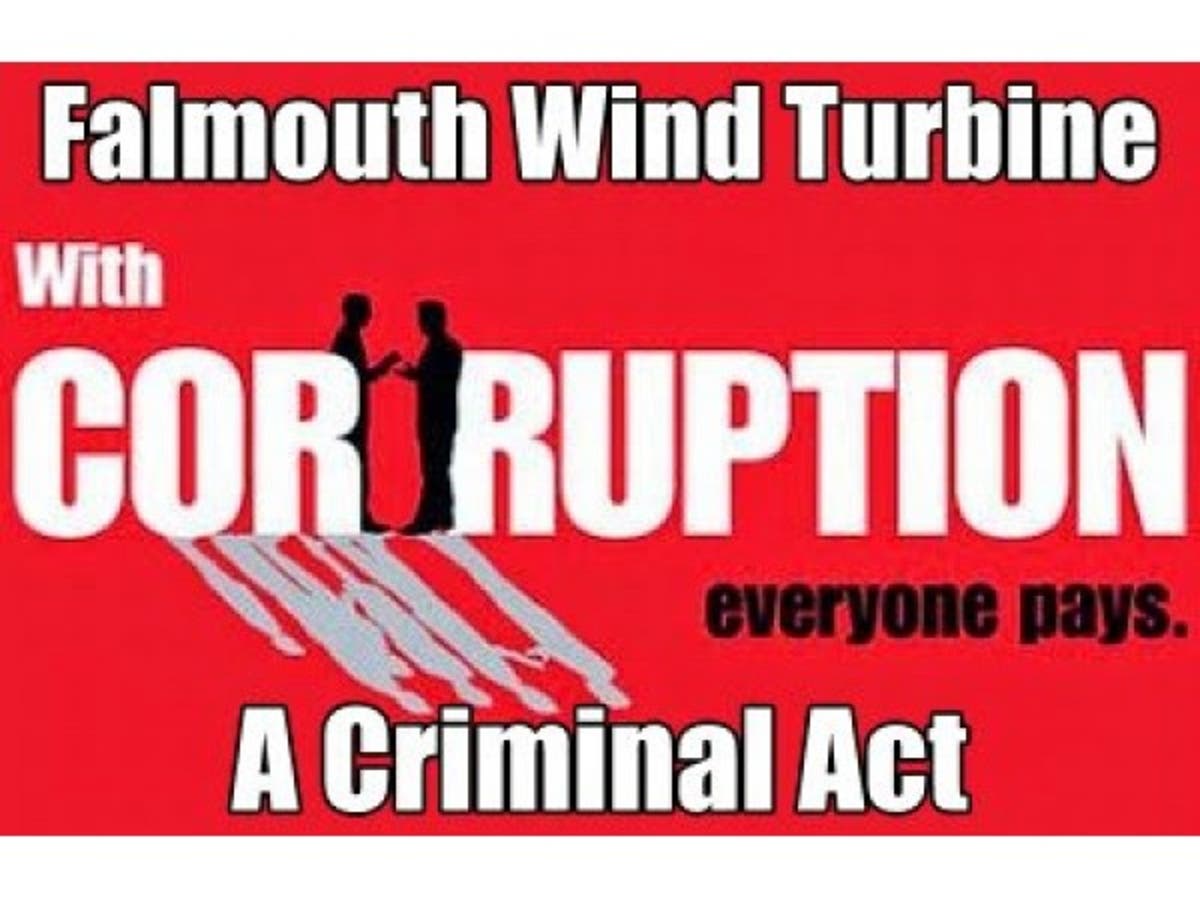
Grand corruption is the abuse of entrusted power by public officials that benefit the few at the expense of all. The public officials ignore ordinary citizens. The installation of commercial wind turbines in Falmouth, Massachusetts has caused serious and widespread harm to individuals and society.
The Massachusetts Department of Environmental Protection has ignored the environmental noise from land-based wind turbines. The MassDEP is well aware the Falmouth wind turbines generate 110 decibels of noise and wind turbines in Kingston may, in fact, generate up to 112 decibels of noise. Wind turbine manufacturers statewide have major issues with turbines generating more than 103.5 decibels.
What has happened in Massachusetts is worse than unethical human experimentation because government officials have known prior to the construction of turbines they cause health issues known since 1987.
Find out what's happening in Falmouthfor free with the latest updates from Patch.
These government officials have illegally installed wind turbines they knew broke state noise regulations. The result was worse than making the neighbors human test subjects because they were installed without consent or informed consent.
----------------------------------------------------
Find out what's happening in Falmouthfor free with the latest updates from Patch.
Falmouth wind turbines : The Massachusetts Superior Court requires appellants, Friends of Falmouth Wind, counsel to specify by name the parties making the appeal by name.The courts no longer allow the use of the term “et al.”
On November 15, 2017, a local 501 (c)(3) nonprofit group and a list of named Falmouth residents, Friends of Falmouth Wind, filed a MOTION to Intervene in the Town of Falmouth vs the Town of Falmouth Zoning Board court case filed in January of 2014.
The case was concluded in June 2017 with a court order agreeing with the Falmouth Zoning Board the Falmouth wind turbines are a nuisance., The group waited, five (5), months after the decision to shut down the wind turbines to file the MOTION to Intervene.
On November 20, 2017, Massachusetts Superior Court Judge Moriarty ruled those that appealed, Friends of Falmouth Wind, have, no standing and filed the motion far too late., The motion was denied
On December 18, 2017, an appeal was filed with a higher court of the refusal of Judge Moriarty to allow the MOTION to Intervene by the Friends of Falmouth Wind and the 501 (c)(3) nonprofit group.
The objective analysis suggests that the likelihood of success on appeal is extremely remote.
The Town of Falmouth has had up to eleven ongoing litigation cases over the turbines.
The objective over the years by the Friends of Falmouth Wind appears to be to use the court system to outspend the neighbors around the wind turbines with legal and court fees stalling until they run out of money. The appellate courts are willing to impose sanctions when an appeal in a civil case is frivolous, immaterial or intended for delay.
The legal fees over the next two years could very well be considered by the Appeals Court to be an element of damages for the frivolous appeal.
The appellate court may, upon motion of any party or upon its own motion, award double costs, damages and interest to the appellee.
Massachusetts judges can use an equitable remedy to require the losing side to pay attorneys’ fees. This type of equitable remedy of granting attorneys’ fees to the winning side is often used when the losing side brought a lawsuit that was frivolous, in bad faith, stalling or to oppress a defendant, and the defendant wins.
Often in extreme cases, the judge will warn the offending attorney.