Politics & Government
First Steps in Wastewater Plan Underway
The Water Quality Management Committee continues its information gathering process with further testing and a hypothetical inlet widening project.
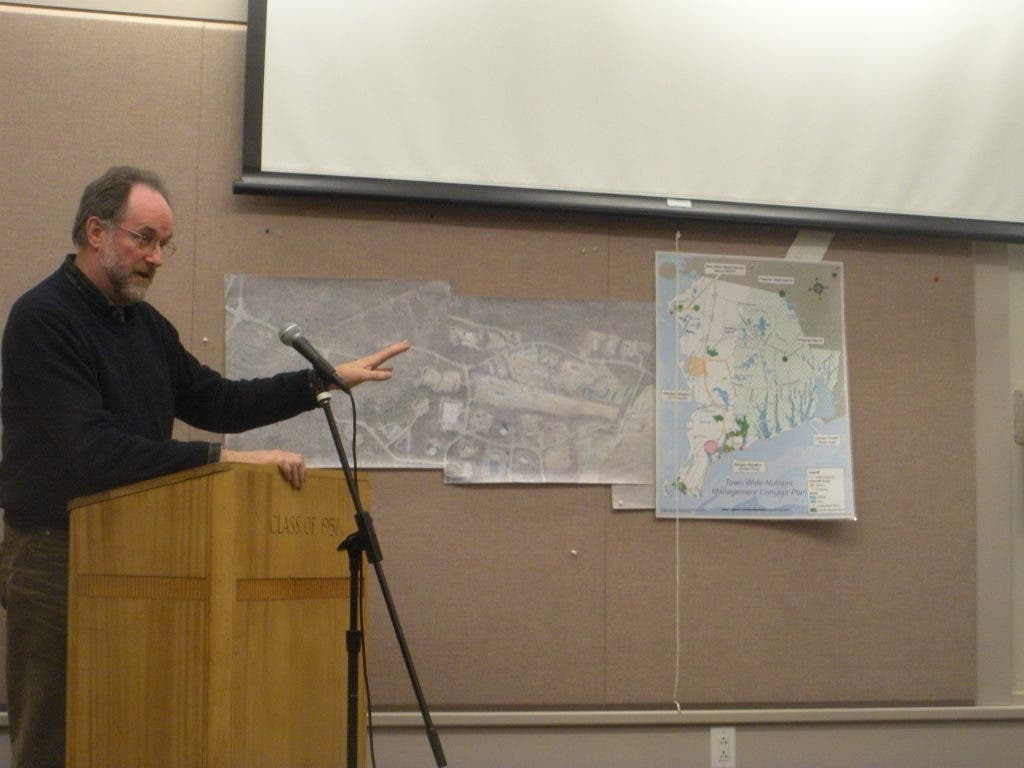
At its meeting on Monday night, the Board of Selectmen authorized several preliminary steps in Falmouth's Comprehensive Wastewater Management Plan, the set of strategies designed to lower the elevated nitrogen levels in town waters.
Virginia Valiela, member of the Water Quality Management Committee and chairman of that body's Inlet Widening Subcommittee, explained the committee's decision to submit to the state an environmental notification form dealing with a proposed inlet widening at Bournes Pond. She stressed that the hypothetical plan is designed to open a dialogue with state regulatory agencies, rather than begin the process of actually widening the Bournes Pond inlet, a step concerning which the WQMC has not yet made a decision.
“It is the regulatory process that is being discussed,” she said. “We are in an information gathering mode.”
Find out what's happening in Falmouthfor free with the latest updates from Patch.
The Bournes Pond plan will work as a hypothetical test case, Valiela said, allowing the WQMC to become better acquainted with state regulations and regulators, and get a better idea of the exact guidelines within which any future plan would have to be constructed and executed. The environmental notification form, which the board voted unanimously to submit, in no way obligates Falmouth to actually perform inlet widening, at Bournes Pond or anywhere else.
Valiela said the step was necessary, because of the town's need to gather as much information as possible about all aspects of the CWMP, and to keep its options for denitrifying Falmouth's waters open. Any final plan is likely to involve a combination of a number of strategies, including inlet widening, shellfish aquaculture, ecologically friendly toilets, and sewering.
Find out what's happening in Falmouthfor free with the latest updates from Patch.
“There is no silver bullet,” Valiela said.
The board also heard from Stephen Rafferty, vice-chairman of the WQMC, regarding another step in the information gathering process. Rafferty recommended asking the University of Massachusetts' School for Marine Science and Technology to perform water quality studies at Quissett Harbor and Falmouth Inner Harbor. The board approved the plan, which will provide a more comprehensive picture of the nitrogen accumulation in those bodies.
The board also interviewed several candidates for a vacancy on the WQMC. Two outspoken proponents of alternative denitrifying techniques, Mark Finneran and Ron Zweig, told the board they are interested in serving in order to continue that work, and hopefully to limit the extent of expensive sewering which the town eventually performs.
“We need to start with the least-cost options first,” Zweig said.
The other applicants echoed that sentiment. John Waterbury, a member of the Board of Health, and of the WQMC's predecessor, told the board that a range of strategies would be necessary.
“It's not going to be one solution that we can apply universally,” Waterbury said.
Michael Powers, a civil engineer with experience in groundwater hydrology, agreed.
“I find it hard to believe that one big sewering project is the way to go,” Powers said.
After hearing from all four men, the board decided to take their applications under advisement. The board will likely appoint the WQMC's new member at its next meeting, Monday, Feb. 6.