Neighbor News
The Great Provincetown Summer - 1916
Bohemians, Radicals and Free Thinkers - Provincetown's Emergence as the Nation's Largest Art Colony Highlighted in Upcoming Exhibition
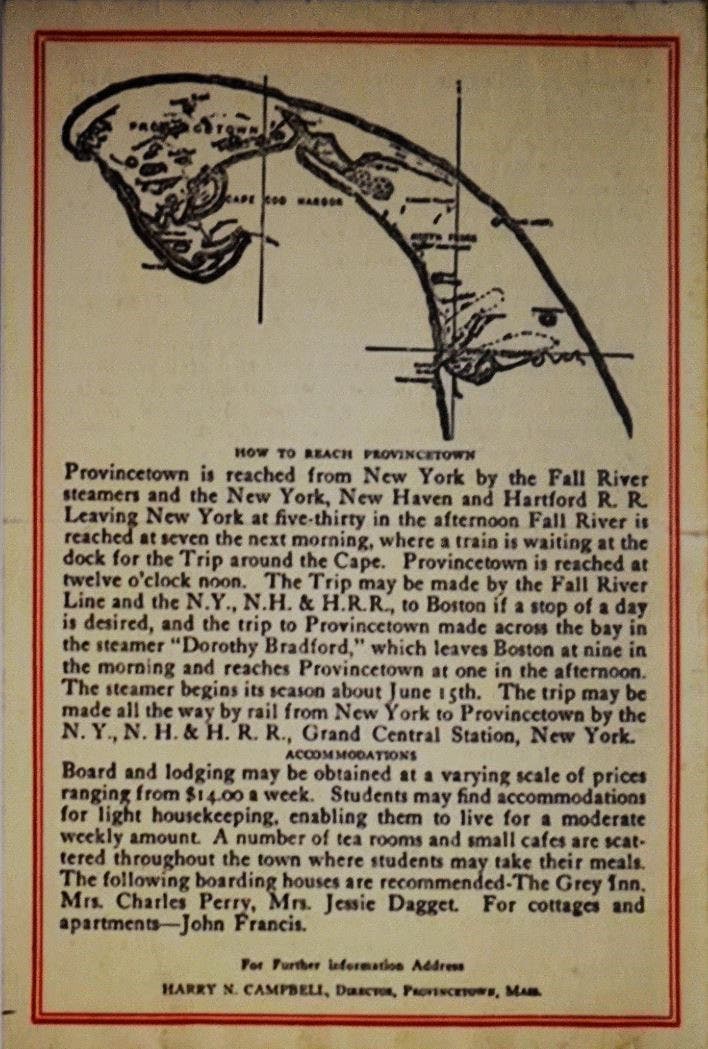


The year was 1916….it took four hours to travel from Boston to Provincetown on the steamer Dorothy Bradford, arriving at the tip of Cape Cod in the tiny Portuguese fishing village where rooms rented for $14 per week and less….
…..the Boston Red Sox were in the hunt for a World Series trophy ….
Norman Rockwell (who studied in Provincetown) had just published his first illustrated cover of the Saturday Evening Post….
Find out what's happening in Falmouthfor free with the latest updates from Patch.
Theater goers headed to the wharf to see new plays written by emerging playwright Eugene O’Neill, often joined by his summertime housemate and writer John Reed…
The Town Crier strolled through the streets of Provincetown announcing the latest news…..
Find out what's happening in Falmouthfor free with the latest updates from Patch.
The Pilgrim Monument and Provincetown Museum’s (PMPM) new exhibition, “The Great Provincetown Summer – 1916,” is an immersion into the year 1916, a pivotal time in the town’s history, when Provincetown was put on the map as the largest and most influential art colony in the world and the birthplace of the modern American theater. It was a year when bohemians, radicals and free thinkers joined writers, artists and others who came together in the tiny town at the tip of Cape Cod. Provincetown was, and continues to be, a haven for artistic freedom and expression and has led to the town’s rightful designation as “the world’s longest continuous art colony.” The exhibition is currently on display at the PMPM throughout the 2016 season.
“In the summer of 1916, there was a great convergence of international political and cultural voices in Provincetown,” said John McDonagh, Executive Director of the Pilgrim Monument and Provincetown Museum. “The town saw an influx of writers, radicals, bohemians, actors and artists who were all influenced in part by the outbreak of the First World War and the resulting displacement of people. The exhibition will give visitors a real sense of what was happening at that snapshot in time,” McDonagh said.
Curator Sam Tager says the exhibition keys off of two major pieces; an article in the Boston Sunday Globe Magazine, written by A. J. Philpott, published on August 27, 1916 with the headline “Biggest Art Colony in the World in Provincetown,” and by an unpublished essay written by artist and poet Marsden Hartley, many years after spending the summer of 1916 in Provincetown.
“I want to convey, through the exhibition, that 1916 was truly a special time in Provincetown as World War One transformed it into the center of the artistic universe. The artists, writers and actors who came to Provincetown, as a result of the war, transformed the town and the course of art and theater history in America,”
said Tager.
The museum’s exhibition, like Philpott’s article, highlights four major schools of art that were thriving in Provincetown in 1916: Charles W. Hawthorne, founder of the Cape Cod School of Art which gave rise to the Provincetown Art Colony; E. Ambrose Webster, modernist and another founder of the Provincetown Art Colony; George Elmer Browne, landscape painter and illustrator who founded the West End School of Art; B.J.O. Nordfeldt and William and Marguerite Zorach, founders of the Modernist School of Art. Philpott’s article distinguishes the different styles of painting from each school and how the Modernist artists were way ahead of their time in 1916 – calling them “futurists.”
The exhibit also includes the great thinkers and writers of the era such as Susan Glaspell, Emma Goldman, John Reed and Eugene O’Neill who were all drawn to Provincetown to share and inspire each other. The social atmosphere of the era is also represented in the exhibit with a section on the Beachcombers, which was a private club that sits on a wharf overlooking Provincetown Harbor where artists gathered, and continue to gather, to meet for dinner every Saturday. The current skipper of the Beachcombers is block printer Bill Evaul who has created special prints of O’Neill, Glaspell and Cook for the exhibit.
The exhibit also includes an original 35mm newsreel from 1916 that spotlights the history of Provincetown as the first landing of the Mayflower Pilgrims and its emergence as a haven for artists.
“Historians often characterize the people who arrived in Provincetown following the outbreak of the First World War and during the summer of 1916 as bohemians, radicals, liberals, freethinkers, and members of the avant guard. What this really means is that Provincetown was a place that was struck and transformed by the powerful currents of modernism. Not just with regard to making art but also in challenging and transcending historic political and social systems, religious institutions, and perspectives on gender and identity,” Tager said.
Tager has collaborated with a variety of scholars and experts to depict the year 1916 and what set it apart from any other artist haven in the U.S. Jeff Kennedy from Arizona State contributed the section on the Provincetown Players. Other contributors to the exhibition are Stephen Borkowski, James Bakker, Napi Van Dereck, the Del Deo family, Berta Walker and the Provincetown Art Association and Museum (PAAM.)
“Everyone has their own Provincetown whether they are a visitor or a local. I want people to delve into the exhibition, to reflect on how their Provincetown has been shaped by the remarkable men and women who came to Provincetown in 1916 to make art, not war,” Tager said.
(For high resolution exhibition images please visit the PMPM Press Gallery)
About the Pilgrim Monument and Provincetown Museum
Dedicated in 1910, the Monument commemorates the first landing of the Mayflower Pilgrims in the ‘new world’ -- in Provincetown in 1620. Here they signed the historic Mayflower Compact, the first agreement to establish a government by the people, the cornerstone of American democracy. They explored the Cape for five weeks before sailing on to Plymouth. At 252 feet, the Monument is an engineering marvel and the tallest granite tower in the United States. Visitors can climb the Monument’s 116 steps and 60 ramps at a leisurely pace and enjoy a breathtaking view of the entire Cape and visit our webcam for a live “View from the Top.” The Provincetown Museum at the base of the Monument presents engaging exhibitions of important chapters in our national heritage and the Town’s history and is a partner in Plymouth 400 in 2020, the anniversary of the Mayflower voyage and founding of the Plymouth Colony. Pilgrim Monument and Provincetown Museum is a non-profit educational, tax-exempt 501(3)(c) organization. For more information please visit pilgrim-monument.org.