Politics & Government
Town May Seek Prop 2 1/2 Override
Finance Committee Chair Gary Anderson recommends a raise in property taxes to cope with the "looming crisis" in Falmouth's capital budget.
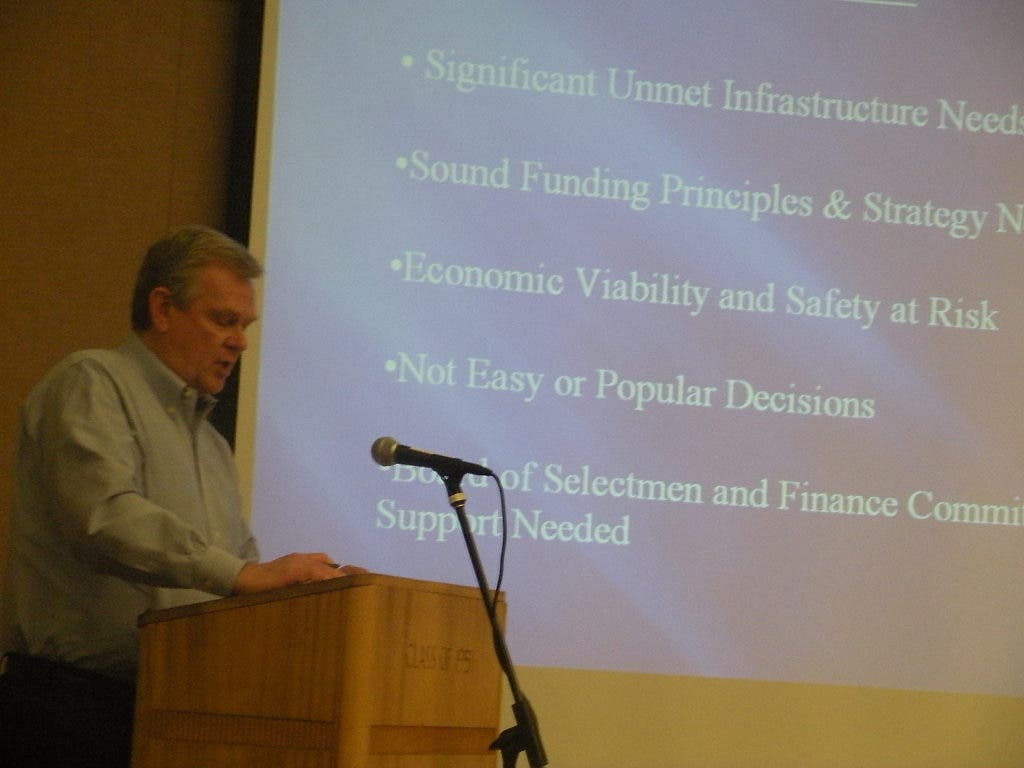
At its meeting on Monday night, the Board of Selectmen heard a presentation by Gary Anderson, Chairman of the Finance Committee, on what he described as “a looming crisis which is deepening.” Anderson said action would be necessary in the near future to address “the serious issue of our capital needs.”
For the past few years, as Falmouth has tightened its belt to cope with the difficult financial environment, the capital budget has gone by the wayside. Used to fund maintenance to bridges and coastal structures, vehicles and equipment, roads and sidewalks, police and fire equipment, beach nourishment, and other regularly occurring work, an annually replenished capital budget was among the first financial casualties suffered by the town.
In recent years, Falmouth has sought funding for individual projects on a case-by-case basis, sometimes seeing such funding denied, either at Town Meeting or as ballot questions. Anderson said that strategy is no longer adequate to deal with Falmouth's annual maintenance and repair budget, as well as the “backlog of needs” accumulated over the past three years.
Find out what's happening in Falmouthfor free with the latest updates from Patch.
Anderson called for an annual capital budget of $3 million, and said such a figure could be reached by a combination of several sources, including the meals tax and the proposed tax on hotels and motels.
The bulk of the budget, however, would come from an increase in property taxes, a measure which would require a permanent override of Proposition 2½. In effect since 1982, Proposition 2½ limits increases to property taxes in all Massachusetts municipalities to 2.5 percent.
Find out what's happening in Falmouthfor free with the latest updates from Patch.
An override would require approval both by Town Meeting and the general public, a pair of challenges of which Anderson said he is well aware.
Passing the override, he said, would require “an educational and convincing process for the voters... The final hurdle is the ballot.”
While the board did not decide to either endorse or reject the proposal, there was some discussion of Anderson's plan. Selectman Kevin Murphy voiced concern over the willingness of Town Meeting members and the general public to agree to a property tax increase in the midst of ongoing and virtually universal financial difficulties.
Chairman Mary Pat Flynn acknowledged that concern, but appeared to lean toward Anderson's plan, citing the increasing expense of neglected capital projects.
“If you don't take care of it,” she said, “then it takes two and three times as much to fix it in the future, because it doesn't take care of itself.”
While the warrant for the upcoming spring Town Meeting has already been closed, Anderson's override could still make it onto the agenda, since a placeholder article was placed in the warrant in anticipation of his recommendation. The board is expected to finalize the warrant at its next meeting, on Monday, Jan. 23, and to make its recommendations sometime in March. The spring Town Meeting begins on April 2.