Neighbor News
Wind Turbine Noise Nuisance Defined By Massachusetts
Massachusetts 2005 Warned Two Distinct Types Of Wind Turbine Noise Regulatory and Nuisance levels. Nuisance Was Dropped In Falmouth Study.
Wind Turbine Noise Nuisance Defined By Massachusetts Clean Energy Center
In 2005 the University of Massachusetts and Massachusetts Technology Collaborative today known as the Massachusetts Clean Energy Center defined wind turbine nuisance.
By 2005 the Massachusetts Clean Energy Center, MassCEC , had produced a study called Wind Power in Mattapoisett, Marion & Rochester: Siting Considerations for a Met Tower and Fatal Flaws Analysis for a Wind Turbine.
Find out what's happening in Falmouthfor free with the latest updates from Patch.
Prior to 2005 many wind turbine studies were done by the state for various cities and towns that included a warning of wind turbine nuisance
The wind turbine noise nuisance warning prior to 2005 could be found in almost all wind turbine noise studies or what is called boiler plate studies because they were almost the same for every city or town.
Find out what's happening in Falmouthfor free with the latest updates from Patch.
You can see from the quote below in the older wind studies prior to the Falmouth wind studies the state warned of two distinct types of wind turbine noise "regulatory" and "nuisance levels."
"Noise considerations generally take two forms, state regulatory compliance and nuisance levels at nearby residences:"
The Massachusetts Clean Energy Center prior to 2005 also went into great depth in wind turbine nuisance studies and actually spelled out the regulatory compliance and nuisance levels as A. "Regulatory compliance " and B. "Human annoyance."
See quotes from state studies prior to 2005 next
A. ”Regulatory compliance”: Massachusetts state regulations do not allow a rise of 10 dB or greater above background levels at a property boundary (Massachusetts Air Pollution Control Regulations, Regulation 310 CMR 7.10).
B.”Human annoyance”: Aside from Massachusetts regulations, residences must also be taken into consideration.
Prior to 2005 these reports which notified residents about regulatory noise compliance and nuisance levels were handed out at local community meetings by local town officials and representatives of the Massachusetts Clean Energy Center.
At that time in 2005 anyone reading these reports knew that regulatory compliance is noise measured in decibels like a lawn mower or in the case of the Falmouth wind turbines a loud rock band.
The question for neighbors at the time in 2005 was what was the " Human Annoyance " that must be taken into consideration.
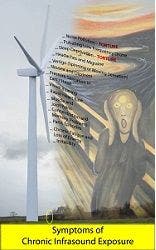
The warning of " Human Annoyance" can be found in research supported by the US Department of Energy. Dr. Neil Kelly and his colleagues in 1987 identified impulsive low frequency noise. The wind turbine infra sound and vibration produced “ Human Annoyance “ within neighbors homes in Boone, North Carolina.
So let's be clear in 2005 the Massachusetts Clean Energy Center warned noise considerations generally take two forms, state regulatory compliance and nuisance levels at nearby residences.
At that time in 2005 the Massachusetts Clean Energy Center was the owner of two Vestas V 82 type 1.65 megawatt wind turbines.The state agency had become stuck with the two commercial wind turbines in fact they could not even sell the turbines at auction.
The noise warning of "state regulatory compliance" and "nuisance levels" at nearby residences was preventing the sale to local towns that had received the boiler plate noise studies.
A few years later after 2005 the Town of Falmouth, Massachusetts was looking to install a small 660 Kilowatt commercial wind turbine and then changed midstream and looked at a turbine three times that size a General Electric 1.5 megawatt wind turbine.
General Electric a domestic wind turbine company refused to build a single wind turbine because of setbacks to residential homes and ice throw on route 28.
So how did the Town of Falmouth end up with two commercial Vestas V-82 type 1.65 megawatt wind turbines with a warning of two distinct forms of noise "state regulatory compliance" and "nuisance levels" at nearby residences ?
The answer is simple and has been avoided for years and it is embarrassing for all local and state officials.
The Massachusetts Clean Energy Center was tasked with obtaining 2000 megawatts of commercial wind turbines by the year 2020.
A calculated gamble was taken to sell Falmouth Wind 1 to the Town of Falmouth. The Massachusetts Clean Energy Center dropped all references to two distinct types of noise "state regulatory compliance" and "nuisance levels" or "human annoyance" at nearby residences. The Falmouth studies done after 2005 only reference regulatory noise.
The Falmouth wind turbine manager who was also the Falmouth assistant town manager at the time admitted the wind turbine installations are a gamble and the Town of Falmouth can afford to take that gamble.
So here you have the Massachusetts Clean Energy Center the original owner with all the wind turbine specifications and warnings drops the warning of two distinct types of noise. The state agency and town also hide a noise warning letter to the Town of Falmouth that the turbines are 110 decibels twice as loud as a General Electric wind turbine.
An engineering company prior to the installations of the Falmouth wind turbines prepared Special Permit 240-166 to install Falmouth wind turbine number one.
The town avoided Special Permit 240-166 because it would require additional notifications to the neighbors of the wind turbines and hearings at the Falmouth Zoning Board of Appeals.
A public hearing and notification to the neighbors would have drawn attention to prior boiler plate studies done by the Massachusetts Clean Energy Center which include state regulatory compliance, nuisance levels, human annoyance and/or infra sound.
The Massachusetts Clean Energy Center originally gave the Town of Falmouth one million dollars in advance to look the other way.