Neighbor News
Wind Turbine Parasitic Energy Consumption In Falmouth V-82
Large wind turbines require a large amount of energy from the grid to operate up to 25 percent of their output
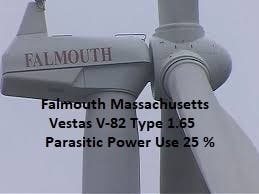
Energy consumption in wind facilities story source [www.aweo.org]
http://www.aweo.org/windconsumption.html
Large wind turbines require a large amount of energy to operate. Other electricity plants generally use their own electricity, and the difference between the amount they generate and the amount delivered to the grid is readily determined. Wind plants, however, use electricity from the grid, which does not appear to be accounted for in their output figures. At the facility in Searsburg, Vermont, for example, it is apparently not even metered and is completely unknown [click here].*
Find out what's happening in Falmouthfor free with the latest updates from Patch.
The manufacturers of large turbines -- for example, Vestas, GE, and NEG Micon -- do not include electricity consumption in the specifications they provide.Among the wind turbine functions that use electricity are the following:†
- yaw mechanism (to keep the blade assembly perpendicular to the wind; also to untwist the electrical cables in the tower when necessary) -- the nacelle (turbine housing) and blades together weigh 92 tons on a GE 1.5-MW turbine
- blade-pitch control (to keep the rotors spinning at a regular rate)
- lights, controllers, communication, sensors, metering, data collection, etc.
- heating the blades -- this may require 10%-20% of the turbine's nominal (rated) power
- heating and dehumidifying the nacelle -- according to Danish manufacturer Vestas, "power consumption for heating and dehumidification of the nacelle must be expected during periods with increased humidity, low temperatures and low wind speeds"
- oil heater, pump, cooler, and filtering system in gearbox
- hydraulic brake (to lock the blades in very high wind)
- thyristors (to graduate the connection and disconnection between generator and grid) -- 1%-2% of the energy passing through is lost
- magnetizing the stator -- the induction generators used in most large grid-connected turbines require a "large" amount of continuous electricity from the grid to actively power the magnetic coils around the asynchronous "cage rotor" that encloses the generator shaft; at the rated wind speeds, it helps keep the rotor speed constant, and as the wind starts blowing it helps start the rotor turning (see next item); in the rated wind speeds, the stator may use power equal to 10% of the turbine's rated capacity, in slower winds possibly much more
- using the generator as a motor (to help the blades start to turn when the wind speed is low or, as many suspect, to maintain the illusion that the facility is producing electricity when it is not,‡ particularly during important site tours or noise testing (keeping the blades feathered, ie, quiet)) -- it seems possible that the grid-magnetized stator must work to help keep the 40-ton blade assembly spinning, along with the gears that increase the blade rpm some 50 times for the generator, not just at cut-in (or for show in even less wind) but at least some of the way up towards the full rated wind speed; it may also be spinning the blades and rotor shaft to prevent warping when there is no wind§
Could it be that at times each turbine consumes more than 50% of its rated capacity in its own operation?! If so, the plant as a whole -- which may produce only 25% of its rated capacity annually -- would be using (for free!) twice as much electricity as it produces and sells. An unlikely situation perhaps, but the industry doesn't publicize any data that proves otherwise; incoming power is apparently not normally recorded.Is there some vast conspiracy spanning the worldwide industry from manufacturers and developers to utilities and operators?
Find out what's happening in Falmouthfor free with the latest updates from Patch.
There doesn't have to be, if engineers all share an assumption that wind turbines don't use a significant amount of power compared to their output and thus it is not worth noting, much less metering. Such an assumption could be based on the experience decades ago with small DC-generating turbines, simply carried over to AC generators that continue to metastasize. However errant such an assumption might now be, it stands as long as no one questions it. No conspiracy is necessary -- self-serving laziness is enough.
Whatever the actual amount of consumption, it could seriously diminish any claim of providing a significant amount of energy. Instead, it looks like industrial wind power could turn out to be a laundering scheme: "Dirty" energy goes in, "clean" energy comes out. That would explain why developers demand legislation to create a market for "green credits" -- tokens of "clean" energy like the indulgences sold by the medieval church. Ego te absolvo.
(One need only ask utilities to show how much less "dirty" electricity they purchase because of wind-generated power to see that something is amiss in the wind industry's claims. If wind worked and were not mere window dressing, the industry would trot out some real numbers. But they don't. One begins to suspect that they can't.)
*Wayne Gulden has analyzed the daily production reports of a Vestas V82 1.65-MW wind turbine at the University of Minnesota, Morris, from 2006 to 2008. Those records include negative production, i.e., net consumption, as well as daily average wind speeds. The data suggest that the turbine consumes at a minimum rate of about 50 kW, or 8.3% of its reported production over those years (which declined 2-4% each year).
There is also the matter of reactive power (VAR). As wind facilities are typically built in remote areas, they are often called upon to provide VAR to maintain line voltage. Thus much of their production may go to providing only this "energy-less" power.