Politics & Government
Framingham Councilor George King Impedes Schools Educational Progress
State Chapter 70 education funds boost our students' performance. Yet George advocates their use for many other things, like fixing sewers.


For more than a decade, an aberrant philosophy of how to deploy incoming state education Chapter 70 funding, intended to help our students, has distorted Framingham financial decision making. That philosophy is espoused by City Councilor George King and is well described in a recent Facebook post he made in the Framingham Community & Government Chat group, where he said:
“Chapter 70 is a general fund revenue that can be used for anything”
For years, it has seemed to me that George was working to diminish the flow of Chapter 70 aid to students, but it always appeared to be done in an oblique way. Now he finally set the record straight, so there can be no doubt about his approach.
Find out what's happening in Framinghamfor free with the latest updates from Patch.
In George’s view Chapter 70 funds don’t have to end up supporting students. They can be used for anything.
Such a view is completely at odds with the general intent of Chapter 70 state education aid, and very specifically with the Student Opportunity Act which boosted that aid to target disadvantaged students.
Find out what's happening in Framinghamfor free with the latest updates from Patch.
Let me explain how egregious this is by first giving some background on Chapter 70 and the Student Opportunity Act.
Chapter 70 state educational aid is administered through the Department of Elementary and Secondary Education (DESE) and is well described on the DESE website at:
“The Chapter 70 program is the major program of state aid to public elementary and secondary schools.”
In recent years Chapter 70 aid for schools was boosted by the state Student Opportunity Act, which was designed to ensure “that every student in the state experiences high-quality learning opportunities that lead to success in school and in postsecondary success.”
That Student Opportunity Act investment in students is well described at:
where its more specific aim is described as solving the problem of:
“inequitable gaps in experiences and outcomes across racial and ethnic groups, in economically disadvantaged communities compared to higher income communities, for students with disabilities relative to their non-disabled peers, and for English learners compared to students whose first language is English.”
Nothing should be clearer than the fact that Chapter 70 state educational aid must flow to our schools and that the boosted aid supplied by the Student Opportunity Act must flow to classroom support for disadvantaged students.
And yet George King, in concert with the Mayor, who is fully aligned with George in this matter, has acted in the last 3 years to diminish the impact of Chapter 70 support for students and now promises to continue that damaging practice in the FY26 budget cycle.
You can tell something is up by looking at the Chapter 70 aid increases in FY23 and FY24, when the first big boosts from the Student Opportunity Act flowed into Framingham, and seeing how they relate to the Framingham Public Schools annual budget increases, as shown in the table.

It is clear that the Chapter 70 increases were bigger than the FPS annual budget increases, so there is ‘missing money’.
Almost $5 million was siphoned off and shifted to cityside coffers in FY23, and a further $4.8 million was siphoned off in FY24. Chapter 70 funding is recurring, so coming into FY25, the school district was short $9,749,307 in recurring funds in its budget.
That buys a lot of support for students and could have:
- Solved the late bus problem by boosting driver pay.
- Solved the pre-K capacity problem by expanding it to include all 4-year-olds
- Boosted classroom aide pay by 20% to solve the chronic aide shortage and reduce annual aide turnover which runs at 25%.
Coming out of the pandemic, this boosted funding could have made an enormous difference.
But the George King philosophy is that all that boosted Chapter 70 funding does not have to go to students, so he and the Mayor engineered things, so students got short-changed by $5 million in FY23 and $9.8 million in FY24. That money went to the cityside operations and likely ended up funding water & sewer maintenance, roof replacements and road repair.
It certainly did not go to students.
There is a bit of technical financial manipulation which went on to achieve this diversion of money from students, and that is most easily understood by observing that the Framingham Public Schools (FPS) annual operating budget is made up of two pieces: Chapter 70 state educational aid, and the local contribution funded by property taxes.
In the FPS budget book, there are charts which show the FPS budget and its Chapter 70 and local contribution components. In these charts, the Chapter 70 state aid is always shown as flowing into the schools in full measure, rather than with pieces lopped off.
The way that the city achieves the diversion of funds is to simply lower the local contribution.
So, in FY23, the local contribution was lowered by $4,975,090 and in FY24 it was lowered by a further $4,774,217. The net effect is that money is diverted into cityside coffers.
Here is a chart showing the total tax levy for the last 10 years, split into its two components: the local contribution to the schools, denoted as the schools levy allocation and the part funding cityside operations: the cityside levy allocation.
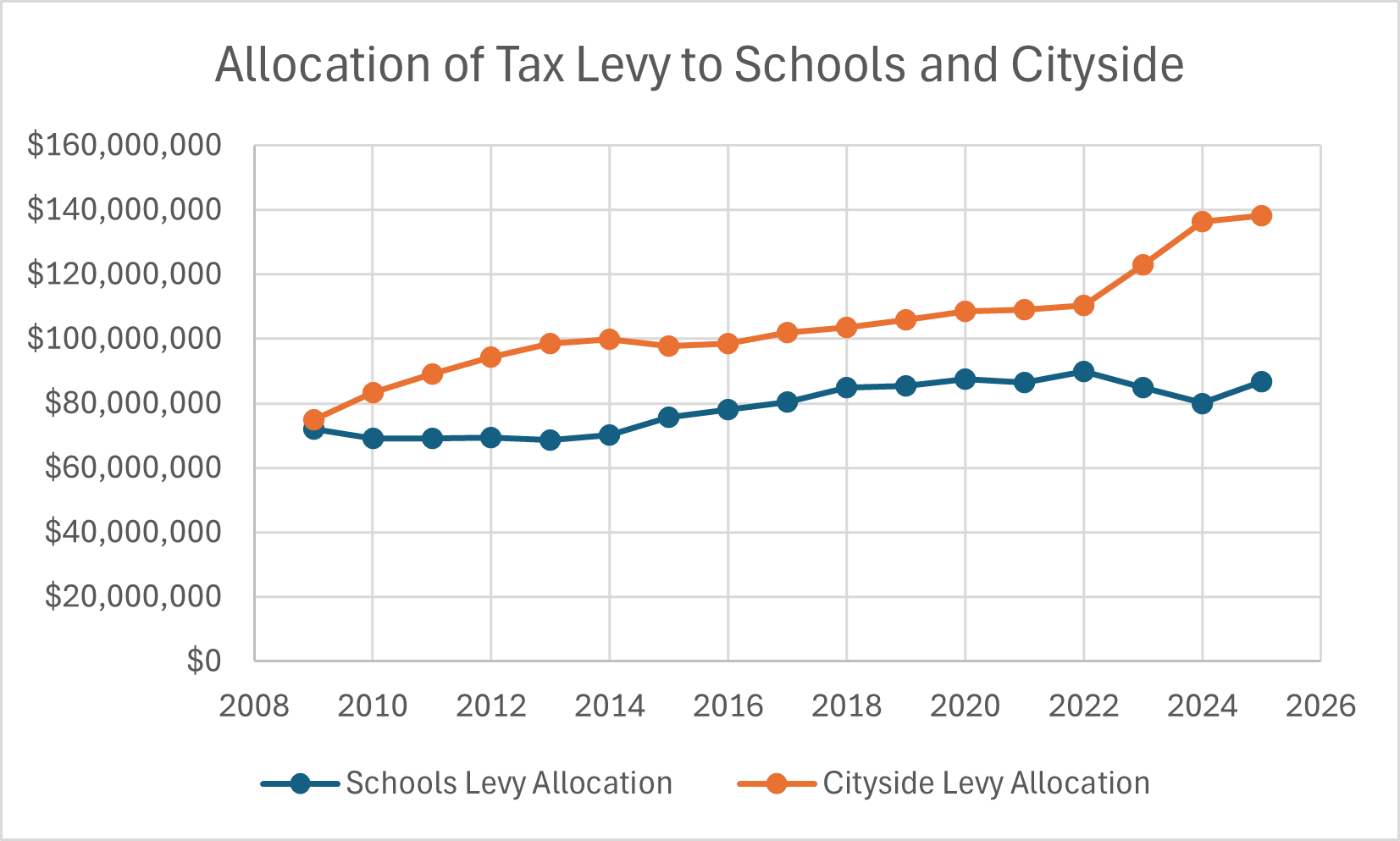
It is clear how the local contribution, the schools levy allocation, drops in FY23 and FY24, and the cityside levy allocation rises. This shows, as we have been arguing, how money which should have gone to students went to cityside operations.
That fits entirely with George King’s philosophy that when state Chapter 70 funding rolls in for students, you can take some of that to fix cityside problems like water & sewer, roofs and roads.
As shown in the chart below, the FPS administration and the School Committee are trying to reverse the FY23, FY24 defunding of the schools. In FY25, they managed to reverse the trend, although they still did not manage to get the funding back to the FY22 level.
In FY26, they are trying to continue that effort and wipe out all of the Sisitsky/King cuts to the local contribution. In FY22 the local contribution funding was $89.8 million. For FY26, the voted FPS FY26 budget moves the local contribution to $91.3 million.

If that is accepted by the Mayor and approved by the City Council, FPS will be back on a sound financial track and students will finally get the level of support they need to boost their achievement.
However, the Mayor and City Councilor George King are likely to team up to prevent that happening. George is Chair of the City Council Finance Subcommittee, which has a powerful influence on the city budget.
They don’t ‘see’ the students in the schools.
They simply see the schools as an item in the city budget to be tapped at will to solve their cityside problems, and they have made it very clear that they plan to cut $5 million from the voted FPS FY26 budget.
After all, George King’s philosophy is that:
“Chapter 70 is a general fund revenue that can be used for anything”
If that philosophy is allowed to prevail, Framingham Public Schools will continue to see poor progress in student achievement, and a great opportunity to reverse the performance slide will be lost.
Framingham will also move into an unusual category of school districts, where it will be recognized as a reasonably affluent community, but one where local taxpayer support for education is poor, and more typical of Lawrence, New Bedford, Holyoke, Springfield and Lowell.
I have faith, from what I have observed in my 11 years living in Framingham, that the community at large believes that one of the most important investments they can make is in our kids’ education.
I look to them to let George King and the Mayor know that they are on the wrong educational track, and that they should not make cuts to the FPS FY26 budget which the School Committee recently approved.
The Mayor can be reached at: 508-532-5409 or mayorsisitsky@framinghamma.gov.
George King can be reached at: gking@framinghamma.gov
The City Council can be reached at: citycouncil@framinghamma.gov
Postscript
This is a very critical piece, but as I wrote it I was thinking of the 300 children who each year enter kindergarten with no ability to speak English, because they had no pre-K instruction. How hard it is for them!
I was also thinking of the children who wait for buses which are late, both going to school and when returning home. When that happens day after day, it is no wonder these kids are frazzled and more difficult to manage in class.
Further, piling onto those difficulties is classroom aide support, which is either absent or not the best quality. That makes kids struggle, with no relief, and again classes are harder for teachers to manage.
The diversion of Chapter 70 funds has real consequences for hundreds of children, and we must do everything we can to remedy the situation.
If that means directing some heat on the Mayor and George King, so be it.