Community Corner
Framingham Student, Leaders Honor City's Native American History
Framingham High School student Elana Gelfand pushed city leaders to add a marker at Indian Head Heights honoring the Nipmuc tribe.


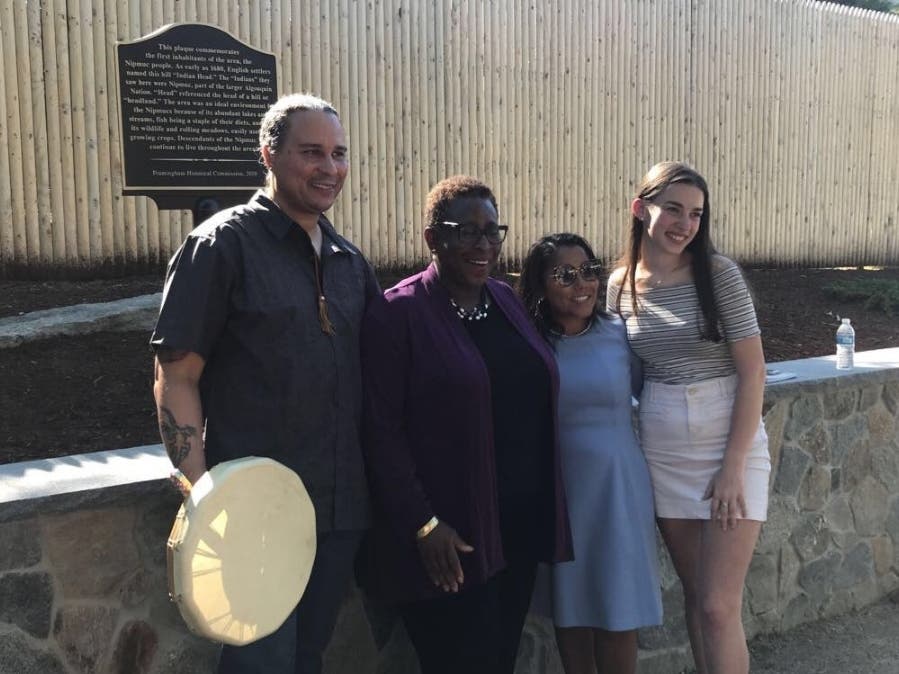


FRAMINGHAM, MA — Elana Gelfand worked for two years to shed light on Native American history in Framingham, particularly the Nipmuc tribe and its ties to Indian Head Heights. On Wednesday afternoon, Gelfand saw the fruits of her work planted in the form of a historical marker at Indian Head Heights.
Gelfand's journey started when she was 13 years old at Hemenway Elementary School. Elana is now 15 and attends Framingham High School. Gelfand said she read a book in her fifth-grade class that followed a Native American boy and his father and detailed their mistreatment. Gelfand said the history of their mistreatment stuck with her and sparked an idea when she drove past the Indian Head Heights road sign.
"I had passed it all the time, but it just connected," she said, "I wanted to change the name because it seemed offensive and derogatory."
Find out what's happening in Framinghamfor free with the latest updates from Patch.
But she didn't jump to a proposal so quickly. Gelfand said she did copious amounts of research to better understand the area and the Nipmuc tribe — the indigenous population of the area.
"I wanted to get lots of perspectives on this," Gelfand said, which brought her to Larry Spotted Crow Mann. He is a member of the Nipmuc tribe and cultural educator and travels to schools and municipalities teaching about the history of the Nipmuc people and their contributions.
Find out what's happening in Framinghamfor free with the latest updates from Patch.
"This was the first time out of the classroom I got questions from someone so young," Mann said, "It was really unique."
The plaque placed on the road honors the Nipmuc as the first inhabitants of the area and notes that the name "Indian Head Heights" came from English settlers who took the word "Indian" to describe the Nipmuc people and "Head" to reference the head of the hill or headland.
The Nipmuc people are a group within the Algonquin Tribe and native to central and eastern Massachusetts.
Several local officials were present for the plaque unveiling including Mayor Yvonne Spicer, who praised Gelfand for "standing up for what she believes in."
Said Spicer, "This is just one opportunity for us as a community to embrace difference, embrace diversity in a way that honors who we are as the city of Framingham."
City Councilor Cheryl Tully Stoll said Gelfand brought the proposal to her back when the town had a Board of Selectman and was under transition.
"She wanted to wait until she could present to a body that could make a difference," Stoll said. She added that countless streets and municipalities are named after indigenous tribes, but people rarely think about the indigenous people who inhabited the land. Gelfand did, however.
City Council Chair Dennis Giombetti was pleased to see a young person from the community have a hand in local politics. "It's wonderful — two major ordinances in the city were brought forward by students," he said, highlighting the Youth Council ordinance pushed by another Framingham High School student Isabella Petroni.
Mann explained to the crowd at the unveiling that this generation of youth are effecting change in ways that were not thought possible before. He explained how just three generations ago, his grandfather would have been jailed for speaking out as an indigenous man and his mother never had the opportunity to marry someone of a different race.
"We're on the right side of the curve now," he said, "She (Gelfand) has done something that educators, philosophers, religious groups, politicians have not done."
Grinning at Gelfand, who was beaming with pride, Mann said, "She's a part of that history now — this is a big deal, kid."
Get more local news delivered straight to your inbox. Sign up for free Patch newsletters and alerts.