Politics & Government
Framingham Mayor Depletes Reserves Creating a Fiscal Cliff Next Year
After exhausting federal & state aid to prop up prior budgets starved of tax revenue, the Mayor plugs a recurring budget gap with reserves.


The FY25 city budget is about to be approved by the City Council at its next meeting on Tuesday, May 21, 2024. It was approved by the City Council Finance Subcommittee in a 3-2 vote last week, with Councilors King and Cannon approving every component of the budget, but then voting against the complete package, in protest at the size of the Mayor's 2.5% tax levy increase.
King and Cannon remain zealously committed to their personal principle that the annual tax levy increase must be kept well below 2.5%, even though the actual Proposition 2 ½ limit on the tax levy increase is currently about 22%, due to a decade of taxing below the levy limit, and even though inflation is playing havoc with city finances.
The fundamental nature of their misinterpretation of Proposition 2 ½ has been thoroughly discussed before:
Find out what's happening in Framinghamfor free with the latest updates from Patch.
Find out what's happening in Framinghamfor free with the latest updates from Patch.
The following table captures the problem.
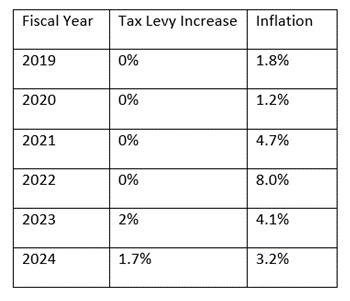
Looking at the big picture, for over 10 years Framingham has pursued a property tax policy which ignores the realities of inflation, and has throttled back the property tax revenue stream to such a degree that municipal infrastructure: roads, buildings, water & sewer system, has significantly deteriorated.
The staff providing all of the basic city services, including teaching staff, have also seen their compensation eroded by severe inflation, yet the city grimly clings onto a 2% inflation figure for cost of living adjustment in union contracts for FY25. Even services like the spring leaf and brush pickup are beginning to fail due to equipment and staffing problems.
In addition, in the last several years, the quality of education has deteriorated significantly, especially disadvantaging low income, special needs and non-English speaking students, but also lowering the quality of all instruction across the entire school district, as classes get disrupted by a severe shortage of quality classroom aides and late buses, pre-K capacity remains stalled at 400, when the city has 800 4-year-olds, and capable teaching staff leave for better pay elsewhere or retire early.
In particular, the shortage of classroom aides could have been fixed in this FY25 budget, but the School Committee failed to defend students in their budget negotiations with the Mayor. For the appalling details of the classroom aide shortage, see:
Framingham Shortage of Quality Classroom Aides Confirmed In Budget Review
Most residents seem to be unaware of the approaching danger across all fronts of city and school operations.
In the prior two city budgets: FY23 and FY24, millions of federal pandemic American Rescue Plan Act (ARPA) relief were deployed to prop up the Enterprise Fund which supports water & sewer system maintenance, and millions more were sucked out of state Student Opportunity Act (SOA) education funding for Framingham, to plug the gap in recurring funding for the cityside operating budget due to the depleted property tax revenue stream.
Without ARPA and SOA infusions of huge amounts of federal and state funds designed to address the pandemic and student educational deficits, the city would have foundered financially 3 years ago.
The plain fact is that those vast amounts of state and federal aid largely missed their intended targets, and were spent to provide stop gap solutions to the structural problems caused by a decade of tax increases which did not keep pace with inflation. Half of the cityside budget increases for FY24 and FY25 were funded by money shifted from city funding of the school district. For details on that shift, see:
Third Year of Zero Tax Dollars for Framingham Schools Budget Increases
In his term thus far, the Mayor has failed to produce a sustainable financial strategy for the city. Even worse, he has produced no strategic planning on anything. The guardrails, cemented in place by the City Charter to guide operating and capital budget planning, collapsed as the Mayor produced virtually no information for the FY25 budget and cancelled the 5-year capital plan.
By doing this, he successfully hid the perilous state of the city from the community.
His plan for FY25 amounts to a series of 1-year financial fixes which will defer all the problems to the FY26 budget. It can be summarized as follows:
- Kowtow to the King/Cannon ‘personal rule’ that the tax levy must not increase beyond 2.5% annually. [This seems to be the 3rd rail of Framingham politics.]
- Invoke a 25 year old obsolete local rule that debt service cannot be more than 5% of the operating budget, to slash the proposed capital budget by a factor of 3, shifting a huge number of key capital projects to FY26, with an estimated future cost of $220 million. See: Revised FY2025 Recommended Capital Budget (2023-103) for details. [The 5% rule was invented out of thin air in 2000 by the Board of Selectmen, with Sisitsky a member.]
- Fund the entire Framingham Public Schools budget increase by returning some of funds diverted from education in the prior two city annual budgets. Note that the cityside of the budget still uses $4 million/year in diverted education funds which have not been returned to the schools.
- Plug the remaining $9 million gap in the cityside budget by:
- Moving $3.5 million to the operating budget from free cash reserves.
- Moving $2 million to the operating budget from the overlay reserve which holds money to deal with property tax abatement claims.
- Moving $3.5 million from the Enterprise Fund to the operating budget to pay Department of Public Works staff salaries. The Enterprise Fund finances water & sewer maintenance, so this is a big hit to water & sewer projects in FY25. That means more deferrals to FY26.
Item 4 especially spells trouble for FY26, as when budget planning is done in that next cycle, this 1-time fix will have to be replaced by recurring money before any FY26 budget increase is contemplated.
If FY25 was difficult, FY26 will be $9 million more in the hole.
Note that every 1% increase in the tax levy brings in another $2.2 million in tax revenue, as the current tax levy is about $216 million, so if these items above were funded in FY25 with property taxes, the tax levy would have to increase by a further 4%, totaling 6.5%.
If the slashed capital budget was also restored, another 1% would have to be added to the levy. That moves the tax levy increase to 7.5%.
That shows the scale of the problem for FY26.
The $40 million/year in current property tax revenue lost by taxing below the levy limit for a decade will truly come home to roost in FY26.
The Mayor has not talked about the structural deficit Framingham has in its property tax revenue stream and seems inclined never to talk about it. That is why there is no Long Range Strategic Plan and there was no Mayoral FY25 budget message.
Given this critical failure in leadership, it seems time to invite the state in to do a full financial review of Framingham.
The Massachusetts Division of Local Service operates a Financial Management Resource Bureau which “helps cities and towns improve the effectiveness of their financial management operations by providing project-based consulting service and training”.
This bureau has completed dozens of reviews of cities and towns, with significant positive impacts on their financial positions and the means by which they deliver services. Here are some examples of a recently completed reviews:
Natick Financial Management Review February 2023
Holliston Financial Management Review November 2021
Framingham is clearly approaching a fiscal crisis in the next year, and it is time to do something about it.
It would be truly game-changing if the City Council kept the Mayor’s FY25 budget at its current funding, but replaced some of the stop-gap reserve use by recurring property taxes.
If the City Council would simply go above a 2.5% tax levy increase, even to something like 5%, the fiscal problems of the FY26 budget would be significantly mitigated. Then there would be a year to develop a truly sustainable financial strategy for the city.
Otherwise, the future beckons with wide-ranging layoffs which will have a broad damaging impact on both the schools and cityside operations.
We don’t want to go down the same rabbit hole as Brockton: